


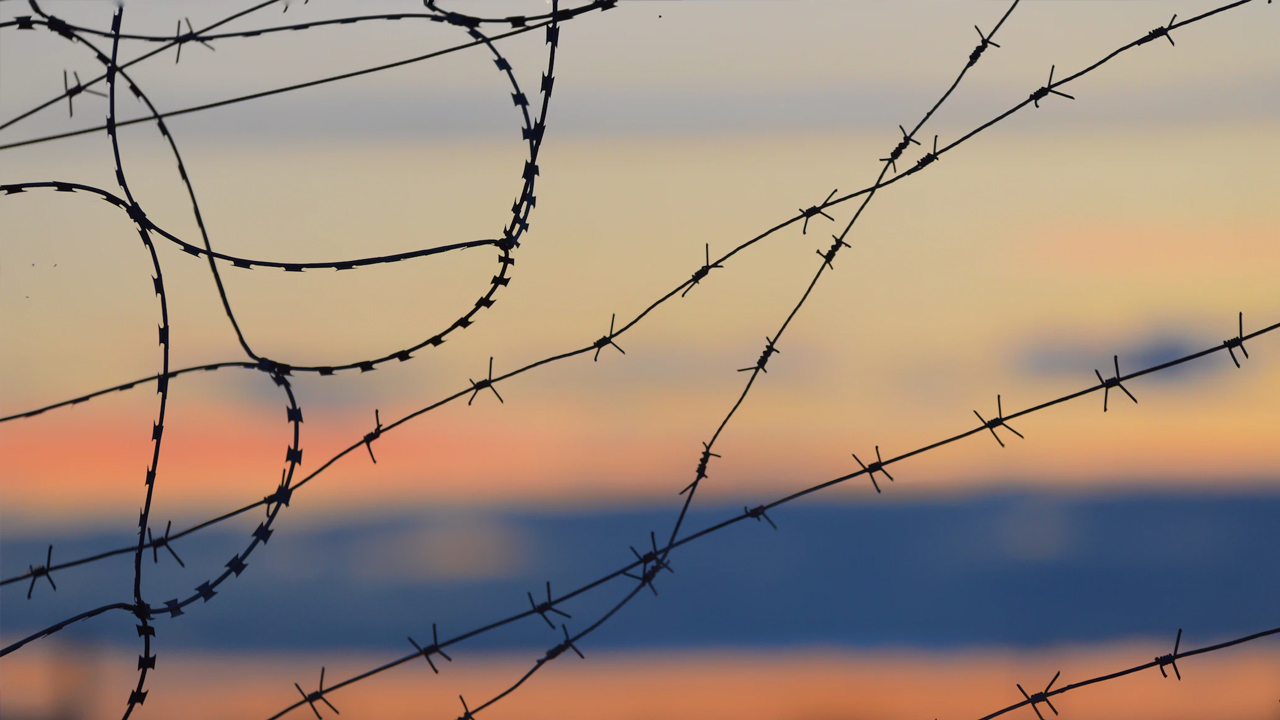
Russia’s invasion of Ukraine on Feb. 24, 2022, marked a major escalation in a war that began already in 2014. Since then, those of us in North America have looked on in horror at scenes of cities laid waste, families fleeing their homes as refugees, waves of newly deployed weapons and caskets lined up in rows.
Most news agencies report that at least 50,000 combatants and civilians have died in the conflict, with perhaps 300,000 suffering injuries.
Barely remembered amid the carnage unfolding in Ukraine are violent conflicts in far-flung places like Afghanistan, the Central African Republic, Somalia, South Sudan and Syria.
Like most contemporary wars, the violence in Ukraine does not demand a personal moral decision for those of us in North America, at least not in the form of military conscription. Superpowers today tend to fight their wars by proxy. What they need is expensive equipment — missiles, drones, advanced electronics — not massive armies. They need our tax dollars, not our bodies. Draft cards, conscription lotteries and alternative service are receding memories.
But for many in the global church, moral questions raised by war and violence are urgent and consequential. Recently, the Church of the Brethren in Nigeria commemorated its 100th anniversary, with church members and guests across the country gathering for worship and celebration. As they gathered, they also remembered the lives of more than 8,000 members who were violently killed in recent years. Nearly 100 of the 276 Chibok schoolgirls kidnapped by Boko Haram in 2014 are still missing.
In 2013, a member of the South Korean Mennonite Church was sentenced to 18 months in prison for refusing to report to military training. Though the laws are slowly changing, military service is still mandatory in South Korea. In a country where the military is a crucial component of citizenship, identity and coming of age, the decision not to participate comes with great social, economic and psychological costs. Conscientious objectors who elect alternative service — which is generally limited to prison work — must serve twice as long as military conscripts.

The Evangelical Mennonite Church in Burkina Faso is also facing a moment of profound testing. Once known for its political stability, the West African nation is confronted with a host of serious security issues. Deadly attacks by radical armed groups and violent responses by local militias and government troops have led to massive internal displacement, instability and widespread school closures. Nearly 1,000 civilians were killed in the conflict in 2022, and even the national army has been implicated in several horrific massacres of civilians.
In response to the growing insecurity, religious organizations are among those who have made large voluntary financial contributions to the government’s “Patriotic Support Fund.” This spring, the Protestant Federation — which includes the Evangelical Mennonite Church among its members —informed each church of the expected amount of their donation. Mennonite church leaders have requested prayer support from the global church as they meet with Protestant leaders to courageously protest this demand and communicate their refusal to contribute to this war fund based on their Christian convictions. It remains unclear whether the general draft announced by the government in April will include a provision for conscientious objectors.
At its most recent meeting in Abbotsford, B.C., the Mennonite World Conference Executive Committee adopted a “Declaration on Conscientious Objection” to offer encouragement to brothers and sisters in the global church who are facing pressure to support military solutions.
“We as Mennonite World Conference,” the statement reads in part, “are dedicated to Jesus and his example and understanding of peace. . . . His example forms the foundation for our understanding of conscientious objection — objecting to participation in mechanisms, systems and actions that lead to war, violence, and death.”
Pray for the churches in Burkina Faso, South Korea, Nigeria, Colombia and elsewhere who face daily pressure to conform to the logic of violence. Pray for our churches in North America who are drawn to the seductions of Christian nationalism. And ask how you and your congregation can respond creatively, courageously and compassionately to the suffering of innocent people, even as we bear witness to the resurrection claim that life is more powerful than death.


Have a comment on this story? Write to the editors. Include your full name, city and state. Selected comments will be edited for publication in print or online.