


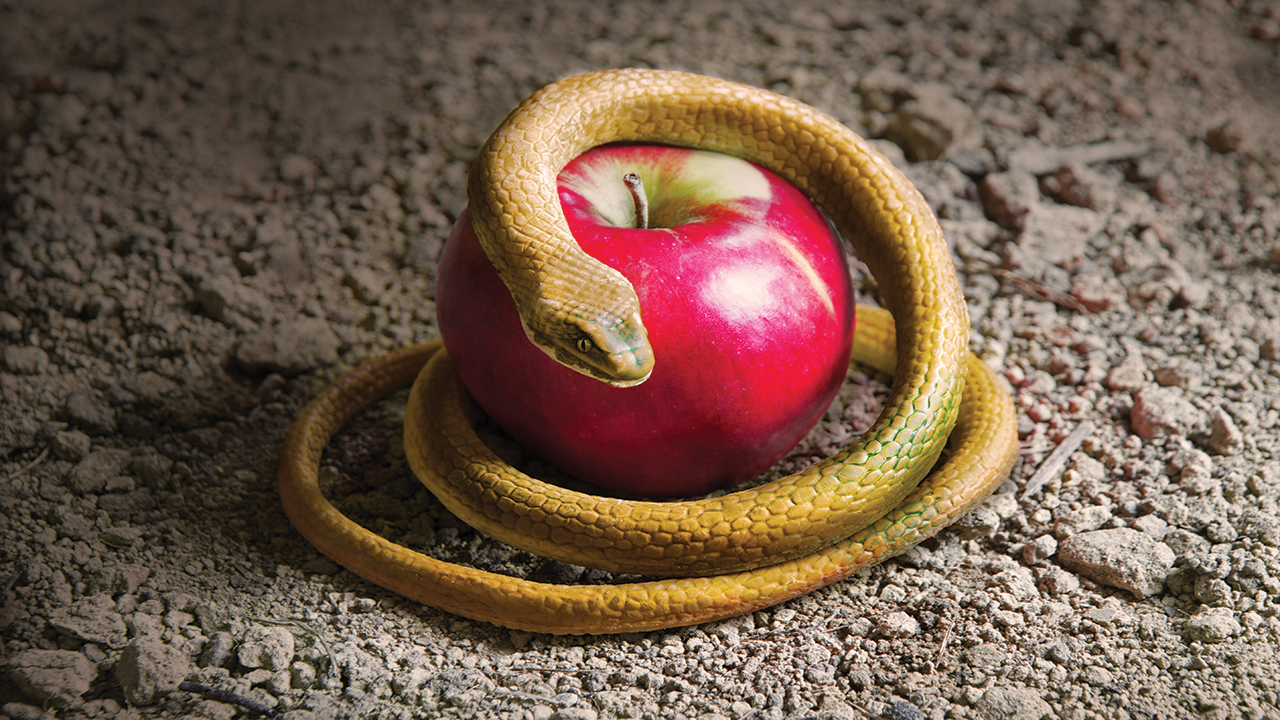
The Serpent lived in the Garden in the days before men. It marveled at the newness, the vastness, the shared breath of all who dwelled within.
Most of all, it admired the Tree of Knowledge of Good and Evil.
As its gaze fell from the birds dancing on the wind to the animals burrowing in the earth, a second between heartbeats was all the Serpent needed to be snared by the Tree’s mysterious allure.
How can you love a place you don’t truly know? the Serpent thought.
Then God’s children entered the Garden, and the Serpent wanted to know them, too.
Adam, the first of men, held dominion over the Garden. He declared himself lord over all its creatures.
Yet the man did not love the Garden in any way the Serpent could understand. He dug up its plants to eat the roots, diverted the rivers to run where he pleased, raised whelps to send cattle where he pleased.
The Serpent did not know what love meant to the man, a being so unlike the rest of God’s creation.
How could the man know anything at all? The Tree was the source of knowledge of good and evil, which surely included love in its domains.
If the man was God’s favorite, then surely he must love the Garden as God loved it. But human love was a strange thing — veiled, all-consuming, beyond the comprehension of animal-kind.
The man’s love for the Garden was almost greedy — surely God’s favorite could not be such a thing? — but not curious. The man walked by the Tree of Knowledge without turning his head. It seemed the one thing the man felt no greed for was the Serpent’s only desire.
And then there was another being: Eve, born of God-tongue; Eve, made from Adam’s rib; Eve, God’s last creation, for whom the whole world was built; Eve, formed into flesh and blood out of heart-armor.
Where Adam took the Garden as his due, his greed directed to possessing its riches, Eve’s greed was a different kind. Her eyes were always roaming. Her fingers trailed along rough bark, fur that thickened and thinned with the seasons, stones wetted by calm brooks fed by the four great rivers.
Her heart flew against her breast as if it could beat its way out into the Garden, offering itself in exchange for being loved as it loved. Oh, her heart loved the Garden in the same way the Serpent did, in eternal search for more to know and love.
Eve’s and the Serpent’s souls were formed of the same ravenous love.
One day, the Serpent came to Eve as Adam roamed the Garden.
Maybe it said, “You will not die; for God knows that when you eat of it your eyes will be opened, and you will be like God, knowing good and evil.”
Maybe it said, “I cannot reach the tree, and I want to understand good and evil. Will you help me?”
Or, “How can we love this place and God, our Creator, without truly knowing them?”
Or, “Our souls are made of the same stuff, and you ache to know this place just as I do.”
Whatever the serpent said, Eve ate the fruit. The stories tell of her nakedness, her sudden shame, the fig leaves.
Maybe she also knew the shame of subservience, of being made from man rather than from dust.
Maybe she wandered the Garden and marveled at the innocence of its inhabitants.
Maybe, in that incredible moment of sudden knowing, her love for all of creation caused her heart at last to free itself from the confines of her chest, or to draw the whole world safe inside with it.
Maybe she lifted up the Serpent and at last truly knew her kin, shared her bounty, cried from the force of her love.
Maybe.
Amelia Faulkner is a first-year student at Goshen College from Granger, Ind.


Have a comment on this story? Write to the editors. Include your full name, city and state. Selected comments will be edited for publication in print or online.