


A reflection on Trinity Sunday, June 3
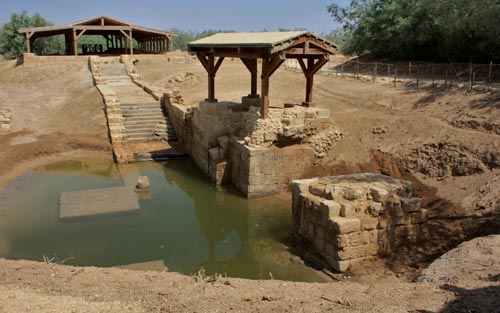
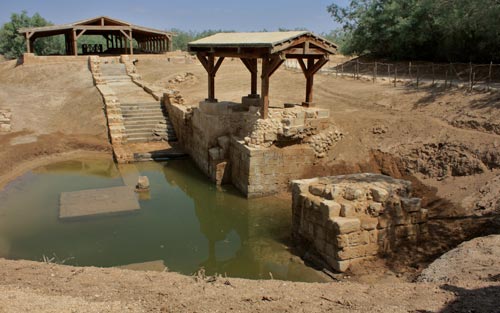
The spot in the Jordan River where Jesus was baptized is near the north end of the Dead Sea. The shore of the Dead Sea is the lowest dry land in the world. This means that Jesus’ baptism at the beginning of his public ministry signaled that his work would stretch from the lowest dry land to the highest heavens. It covered all …
In those days Jesus came from Nazareth of Galilee and was baptized by John in the Jordan. And just as he was coming up out of the water, he saw the heavens torn apart and the Spirit descending like a dove on him. And a voice came from heaven, “You are my Son, the Beloved; with you I am well pleased.” —Mark 1:9-11
The spot in the Jordan River where Jesus was baptized is near the north end of the Dead Sea. The shore of the Dead Sea is the lowest dry land in the world. This means that Jesus’ baptism at the beginning of his public ministry signaled that his work would stretch from the lowest dry land to the highest heavens. It covered all.
The Mark 1 story of Jesus’ baptism also has a second unique element: It is the only time that God the Father, Jesus and the Holy Spirit appear together in the Bible.
There may be some other occasions when the presence of the Holy Spirit is intimated. But in this scene, Jesus’ rebirth (baptism) was attended by the Holy Spirit as a dove and God the Father as a voice.
In 2007, I was privileged to visit Bethany Beyond Jordan, on the east bank of the Jordan River. According to tradition, this is the spot where Jesus was baptized. An Eastern Orthodox priest baptized or rebaptized with river water anyone who wanted to go into the river. Because of that experience, I began contemplating the Trinity.

Since then, I have observed faithful Christians drawn to one part of the Trinity, rather than all three persons, as their personal way to God. Further, over the past five years, I’ve also observed how various writers we publish think about God. Here are some of those observations, beginning with the first sentences in the first three articles (in reverse order) from Confession of Faith in a Mennonite Perspective:
Holy Spirit
We believe in the Holy Spirit, the eternal Spirit of God, who dwelled in Jesus Christ, who empowers the church, who is the source of our life in Christ, and who is poured out on those who believe as the guarantee of our redemption and of the redemption of creation.—Article 3
The Holy Spirit is the sacred Presence of God. As the ancient Latin says, “Bidden or unbidden, God is here.” We don’t need to ask God to be with us, because the Spirit is always with us—and waiting for us to notice. The challenge for me is to quiet the noise in my mind and attend to this presence.
For most of us, this is the least developed face of God. We come closest to talking about God’s Spirit in our hymns and Scripture songs, such as “Spirit of the Living God,” “Holy Spirit, Come with Power” or “Rain Down.”
But for some people, life in the Spirit is the primary way they come to God. I observe that for people who primarily come to God this way, their lives are filled with serenity, grace and the fruits of the Spirit. But I’ve also seen another, less healthy pattern: speaking in tongues and being slain in the Spirit as proofs of faithfulness.
But a helpful understanding of how the Holy Spirit is integrated with God the Father and Jesus comes from the writings of Paul to the church in Corinth: “But it is God who establishes us with you in Christ and has anointed us, by putting his seal on us and giving us his Spirit in our hearts as a first installment” (2 Corinthians 1:21-22).
Jesus Christ
We believe in Jesus Christ, the Word of God become flesh. He is the Savior of the world, who has delivered us from the dominion of sin and reconciled us to God by humbling himself and becoming obedient unto death on a cross.—Article 2
In the setting for my work and in my congregation in Goshen, Ind., this is the most important person of the Godhead for many. What matters most is obedience as a disciple to this historical figure who is not present now. But when faith is reduced to formulaic discipleship, it becomes arid and dry. As Stephen Dintaman pointed out in his Feb. 23, 1993, Gospel Herald article, such a narrow definition can impoverish the Anabaptist vision.
But there are other ways people come to God through Jesus. For many, Jesus’ atoning death on the cross is the central life pulse of their faith. Forgiveness of sins for a life of faithfulness comes primarily when “saved by the blood” of the cross.
Others describe Jesus as “my best friend.” I don’t resonate with the language but am intrigued by friends and relatives who post Facebook testimonies describing the intimacy of their relationship with Jesus. Those who believe Jesus was a historic figure only may argue that the intimacy being experienced is really the Holy Spirit. However, there is no problem with this because there is no separation between the Holy Spirit, Jesus and God the Father.
As a young adult, I did not want to think about Jesus. This was because of my childhood situation: My father was a firstborn, my mother was a firstborn, my older brother was a firstborn: I was the first person in the family not a firstborn. And then, as a child in Sunday school, I learned that Jesus was a firstborn. I was surrounded by firstborns. So troubling to me was this as a boy that Exodus 12 became my favorite Bible story. I imagined another Passover like the one that killed all the Egyptian firstborns. I’d be in charge.
But now I understand discipleship as accepting the salvation God provided by so loving the world that he gave up his only begotten son. Our calling now is, as President Jimmy Carter said at the Nashville convention in 2001, to be “little Christs.”
God the Father
We believe that God exists and is pleased with all who draw near by faith. We worship the one holy and loving God who is Father, Son and Holy Spirit eternally.—Article 1
Here we find the Trinity: “a loving God who is Father, Son and Holy Spirit eternally.”
My father, Leon, imprinted on my young mind what a loving God would be like as a father. Leon was the most loving, gracious and maternal man I’ve ever known. So it was an easy reach for me as a teenager to accept that the Creator of this world was like my earthly father but with infinitely more love and power. I do realize how fortunate I was to have Leon as my father. Many men spend much of their lives dealing with “father wounds.” Many women who were abused by their fathers or saw their mothers abused did not have the same imprint as did I.
Others, especially in older generations of Mennonites, came to view God the Father as a cruel judge and law enforcer. But Jesus called God Abba. It is a great gift from Leon that I, too, call God Abba.
Trinity
So in the Trinity we have three paths to God. While we may follow different paths to put together our faith, it is sometimes difficult to understand the way others put together their relationships with God. As I curate the differences among us in the Letters section of this magazine and listen to differences in the church when it comes to right belief and practice, I wonder whether we could share our testimonies first: How do you come to God? Let me tell you how I come to God.
Among other reasons for doing so, our differences do not change God. For all the ways we may try to create God in our own image, God remains one. The first word of the greatest commandment lays down the imperative to listen, really listen. God is, has always been and will always be one.
“Hear. O Israel, the Lord your God, the Lord is one.”
Everett J. Thomas is editor of The Mennonite. This article is adapted from a sermon he preached on Oct. 2, 2011.


Have a comment on this story? Write to the editors. Include your full name, city and state. Selected comments will be edited for publication in print or online.