


Don and Deb Schmidt find spiritual growth on the Camino de Santiago, a 500-mile walking pilgrimage.
The northern Spain sun beat down on Deb Schmidt as she guzzled water and followed her husband, Don, to a roadside café. They lunched there before walking several more hours that day on the Camino de Santiago, a six-week, 500-mile walking pilgrimage. She was grateful to rest her sore knees.
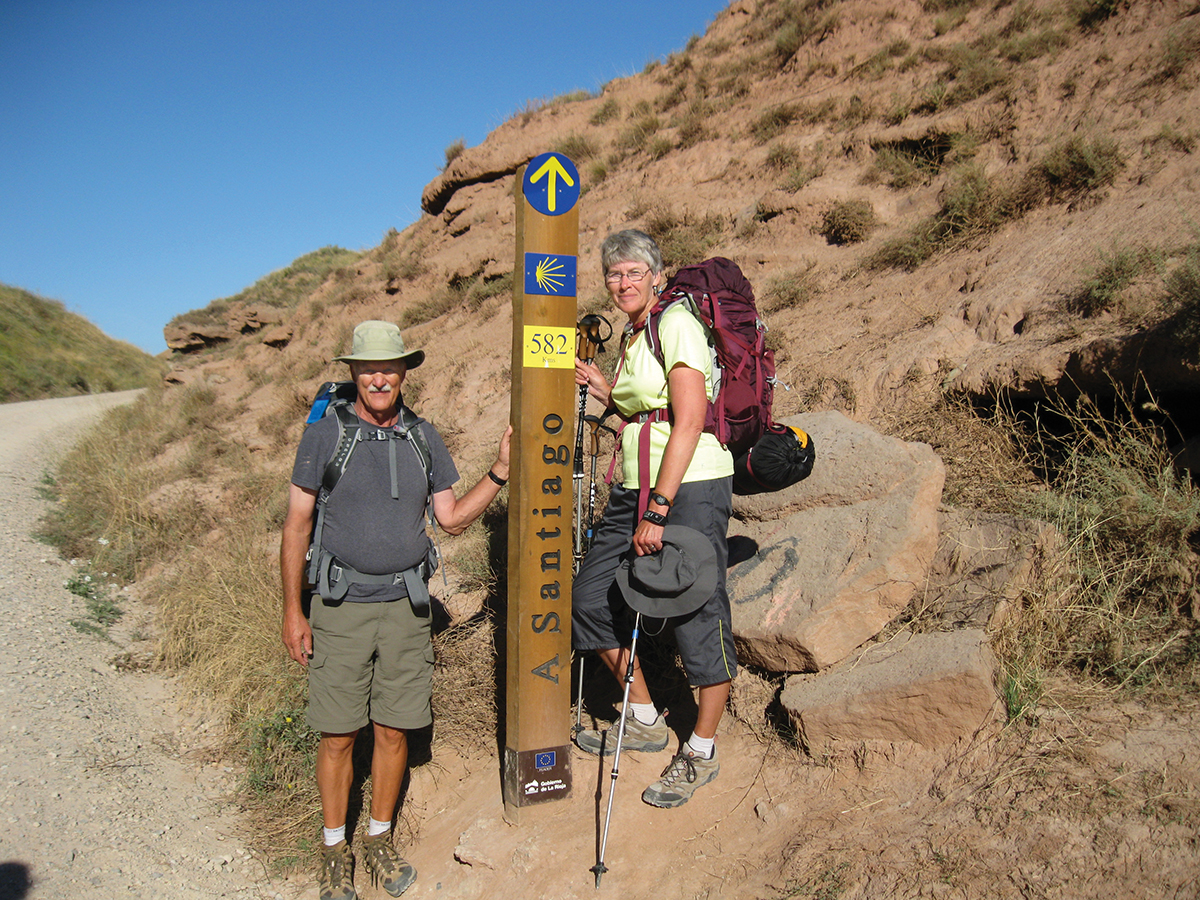
On the first day of their route, which began Sept. 1, 2013, in St. Jean Pie de Port, France, the mountainous climb had caused the injury to set in. But it was not enough to deter her from completing the pilgrimage, which wound westward to Cathedral Santiago de Compostela. God willing, they hoped to reach their destination by mid-October.
For centuries, this route led countless pilgrims to the cathedral, which tradition says holds the remains of the apostle James. A prominent practice in medieval times, the pilgrimage fell into obscurity before becoming popular again recently.
It has always offered a pathway into deeper spirituality, and Don and Deb also hoped the experience would help launch them more reflectively and spiritually into a new chapter of their lives.
Deb, 65, had recently retired from 18 years as a pastor and a chaplain. And Don, 66, had retired from a long career in social work. They believed the miles symbolized stepping stones marking the completion of careers, 45 years of marriage and their next juncture.
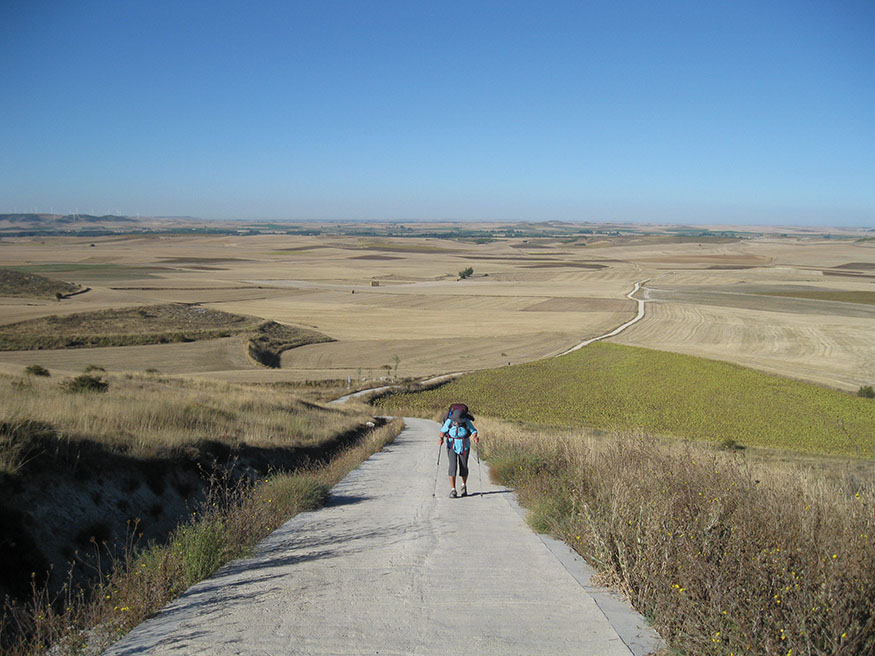
It didn’t take long for their dreams for Camino to be reshaped by the daily realities of getting up at 5:30 a.m. to log 17 miles by mid-afternoon. The first day, they had a steep ascent up and over the Pyrenees Mountains into Spain.

They discovered that walking one’s way into growth while lugging a 17-pound backpack had its price: wounded joints, blistered toes and the stretching of one’s soul and body.
For Deb, that stretching came in the form of letting up on driving herself. Initially, she felt it was important to walk every step for the pilgrimage to be successful. Instead, her injuries required they take a bus for a short time midway into their trek, dashing her version of completing a “perfect” Camino. And Don faced unexpected emotional and mental vulnerabilities.
“Because my bad knees caused us to walk about 12 miles a day instead of 17, we had to take a bus for 100 miles to make our scheduled flight home,” Deb said during a Dec. 26, 2013, interview. “I struggled with that a great deal. I was angry at myself because I am a driven person in a lot of ways. It had been my idea in the first place to do this, and I felt I was the one who was faltering,” she said.
She continued: “Like most pilgrims, when I started out, I vowed to walk every step of the 800 kilometers [500 miles]. I felt that if I didn’t walk every step of the journey, I would fail. But the slowing down became a gift to me. It helped me learn that the journey is not about every step taken but what happens to you along the way. A pilgrimage is not about physically completing the mileage but about entering into the journey and letting it shape you.”
In that same interview, Don said the difficulty of the journey for him occurred when it became more spiritually impactful than he had planned on it being. “You had six or seven hours to walk every day, and during that time, you spent a lot of time in your head and heart, reviewing everything you had ever thought or done, or anything you might ever want to do,” he said.

After the first week, in the midst of walking, Don and Deb heard each other snuffling as feelings surfaced into tears.
“Being physically tired and kind of emotionally wrung out tapped deep wells of emotion that we were unaware were there,” she said. “Some of the hardest lessons on the trail were learning to allow others to care for you and witness to you and to not have all answers or to be the strong one all the time. The walking and the grind strips away everything, and you are just left with who you are in the inside and what you see in other people.”
Walking with the world
Even as the emotional and physical costs mounted, Don and Deb were simultaneously enriched with relationships forged with fellow pilgrims from around the world, they said. While the daily walking itself was threaded with contemplation, the evenings provided a diverse tapestry of community of people from all five continents. They shared meals with strangers turned friends, even though they spoke different languages.
With gestures and smiles, good bread and wine and the solidarity of having braved similar challenges, hearts opened and stories were told. One cared less about who slept in the next bunk and more about getting enough sleep amid the stormy sea of snoring. The first night, the couple slept in a large room with 118 people who had to share two bathrooms.

The Camino gave them instant friends, Deb said. They experienced common vulnerabilities and trials, all of which established bonds they couldn’t understand rationally but felt emotionally and spiritually. “We experienced the incredible kindnesses and hospitality of people every day,” she said.
“And when met up with others at the café, you asked their names and where they lived and why they were walking the Camino,” she went on. “You hardly ever asked someone what they did for a living. The Camino became so much more about you as a person rather than what you did. It really caused you to shed your public persona and become your true, unvarnished and stripped-down self.”
One of her most significant moments of letting go was when they met a man named Stan, who had common knee injuries.
“He wanted me to take his knee brace, and at first, I said no,” Deb said. “Later that day, he came up behind us and said, ‘I’ve been trying to catch you all day, because I really want you take my knee brace.’ Don said under his breath, ‘Just take his knee brace, Deb.’ So I finally did. I wore it every day, and it really helped. Every morning as I put it on, I thought of how Stan sacrificed his comfort for mine. I never saw him again, but his presence stayed with me all the way.”
Pilgrims also shared emotional and spiritual pains. Even though backpacks were kept light, with two changes of clothes and bare necessities, people carried heavy interior baggage.
“One day we sat with a gentleman from Holland who hardly spoke any English,” Don said. “I noticed he wore a wedding band. I pointed to his wedding band and through gestures managed to ask whether he was traveling alone or with his wife.
He told me his wife had died six months [earlier] and that he was walking for her. We had that kind of experience over and over again at the end of long days.”
Many pilgrims were walking to heal from relationship wounds. One group from Ireland was walking to raise money for cancer research. “Many people had lost mates,” Deb said. “We often cried together. Some folks carried a pebble or stone as a symbol of carrying a burden of a loved one—a wayward child, a spouse, a parent. … We became tied to each other through our stories and the commonality of carrying stuff. It was different stuff. But it was still stuff.”
Walking the Camino into the center of one’s soul
A pilgrimage entails more than the miles traversed, as it shakes loose desires in one’s interior landscape, Deb said. In the midst of the sweat, blisters and constant need for water, one begins to thirst for new vistas to unfold in one’s soul.
The couple said the Camino connected them more deeply with the historical Jesus, who lived in early Palestine and told parables about the same kinds of vineyards, olive gardens and sheep they saw along the way. They did not structure their days around Scripture reading or journal time. The walking became their praying, and the stories shared with others proclaimed the gospel. The lush green landscape, with its village vistas and tinkling cow bells, connected them to their growing hearts.
To a person, no matter what their religion or lack of, their friends shared spiritual insights gleaned along the way, inspiring the Christian faith of the couple.
“I think all of us search for ways to plug into deeper spiritual meaning, but we don’t always have the tools to do that,” Deb said. “So we carry around a longing that can be sometimes hard to identify or touch. Church doesn’t always give us the fullest, richest or deepest experience of God. And then, someone or something comes along that piques those longings in new ways.”
That was the case for Deb on her annual summer retreat in 2012. That’s when she read excerpts in Living Into Focus, written by Arthur Paul Boers, a former professor at Anabaptist Mennonite Biblical Seminary in Elkhart, Ind., who briefly described his Camino in that book. He also wrote extensively about his pilgrimage in The Way Is Made by Walking (InterVartisty Press, 2007).
“I was so captivated by his account that I re-read it six or seven times,” she said. “When I came home, I told Don about it. We had been planning a retirement trip, likely to Peru. So when I shared how I thought the Camino could help us share a spiritual retreat, I thought he’d say, ‘What, are you out of your mind?’ Surprisingly, he replied, ‘Count me in.'”
Gaining gratefulness with each step
By the time they reached their destination on Oct. 15, the path had yielded surprises around each bend that satisfied their longings for a deeper connection to God through gratitude: for the beauty of creation, no-frills living, the renewal of marital bonds and a resymbolized sense of home.
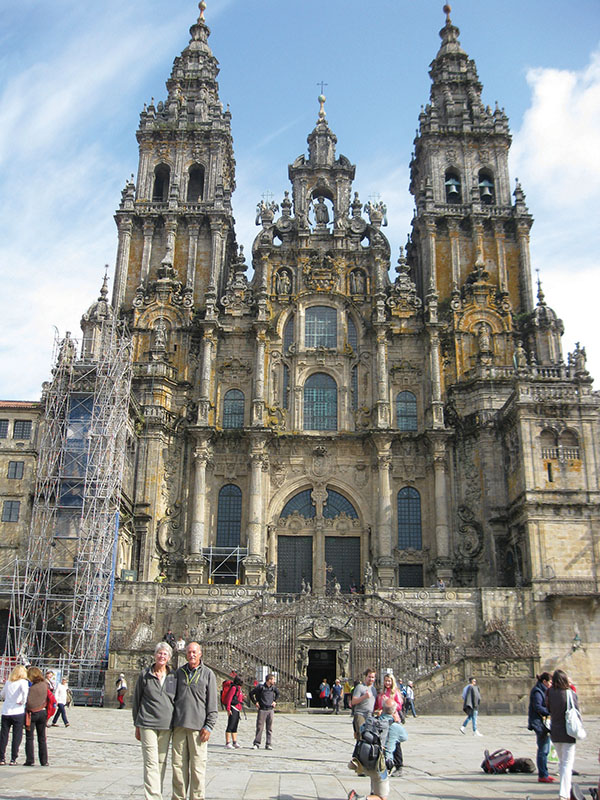
“We were amazed how there was not one day when we did not face some kind of trauma, and every morning we joked, ‘What will be our breaking point today?'” Deb said. “But also not a day went by without experiencing some kind of mountain-top emotion, great conversation and incredible beauty. On the trail, I thought often of a phrase from the novel The Unlikely Pilgrimage of Harold Fry. He is walking through Europe, and the lush landscape causes him to ‘be humbled by the green.'”
The all-encompassing tasks of securing a sufficient day’s hike, food and lodging burned off the fog of worrying about bigger things, i.e. the world situation and their family in Kansas, they said. The couple was stripped down to what Richard Rohr calls “the naked now.”
“We did not worry about our three sons and their spouses and our seven grandchildren because we were so engrossed in surviving every day,” Deb said. “It’s not that we stopped loving them; it’s just that we began to experience the freedom to be in the now, in a moment so full that it becomes enough.”
Don agreed. “By having no electronics or cell phones, we didn’t worry about the U.S. government shut down,” he said. “Our focus narrowed down to our own life journey and the emotions one finally tends to without all the busy static back home. There was a freedom in that simplicity.”
Their family was thousands of miles away, but they still had each other, albeit with the same personality differences they had grappled with for four decades. Deb said, “Our kids jokingly said before we left that they were worried about our marriage on this trip because the two of us are so different.”
Don said that over and over again they felt like the Camino was a second honeymoon, all except for sleeping in bunk beds in a room full of other people. “It renewed our relationship, because we had gone our separate ways because of our separate work lives,” he said. “On the trail, our differences helped us complement one another—I nursed her feet and scouted out our next café, and Deb was the big picture planner.”
The busyness back home was waiting for them, especially in the midst of the holiday frenzy.
However, they continued to bask in the glow of what they had learned about staying present to each day, embracing simple blessings and feeling gratitude for the love they renewed.
Their reflections post-Camino are akin to what the late T.S. Eliot penned: “We shall not cease from exploration and the end of all our exploring will be to arrive where we started … and know the place for the first time.”
Don said they became grateful for the ordinary basics of food and lodging at the end of a long day and learned that the ordinary was not so ordinary.
“Our place to stay for the night was home,” he said. “It is here now in this home where we want to keep living out the lessons of our pilgrimage—letting go, letting down, letting loose, not carrying around certain things and picking up other things, such as people’s stories and what matters to them.”
Deb said. “They have a saying in Nepal, that wherever you put your mat is home. The Camino taught us that home is where you are—and where your heart is.”
Laurie Oswald Robinson is a free-lance writer in Newton, Kan., and the author of Forever Family.


Have a comment on this story? Write to the editors. Include your full name, city and state. Selected comments will be edited for publication in print or online.