


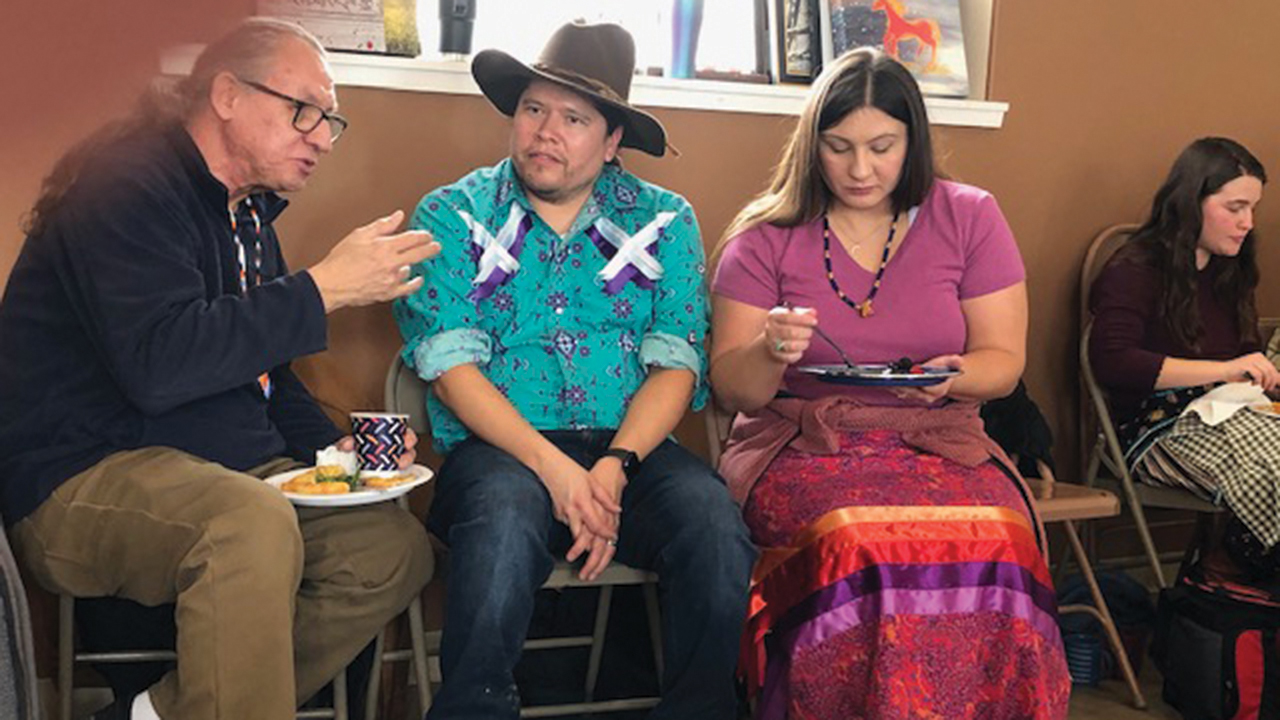
Is repair between Indigenous communities and settler communities possible? The people of Makoce Ikikcupi think so, and a recent recovery of land in rural Minnesota is an example of the power of returning land and repairing relationships damaged over centuries.
Makoce Ikikcupi, which means “land recovery” in the Dakota language, is a movement to recover land, build homes and a community that is authentically Dakota.
“Our cultural survival depends on it,” is how the organization describes the stakes of this endeavor.
Over the past several years, Mennonite families — descendants of colonists — have connected with the vision of Makoce Ikikcupi in response to this invitation toward repair.
Makoce Ikikcupi invited the Mennonite-affiliated Coalition to Dismantle the Doctrine of Discovery to join them in land return and land restoration. (The Doctrine of Discovery is a historic framework that was used to justify displacing Indigenous people from their lands.)
Makoce Ikikcupi is the vision of a group of Dakota/Lakota/Nakota people led by Waziyatawin, a writer, teacher and justice advocate from the Pezihutazizi Otunwe (Yellow Medicine Village) in southwestern Minnesota.
A governing council made up of Dakota, Lakota, Ojibwe and others connected to the Oceti Sakowin (Seven Campfires) homelands is charged with the strategic vision of this growing network of communities.
Right now, two villages are being developed on Dakota/Lakota/Nakota homelands in Minnesota. Luke Black Elk, a member of the Makoce Ikikcupi Governing Council, shares the vision to create a new way of living rooted in the lands and traditions of the Dakota people.
“We looked to our ancestral territories and began to imagine where we could live a more natural, connected lifestyle,” he said.
The challenge is not just the concept of individual land ownership brought by colonists centuries ago but also corporate land ownership and federal land ownership.
“Out of that current reality, we’re trying to create safe space for our people to live in a way that works with how our bodies, minds and hearts connect with the world,” Black Elk said.
The homes and other structures being built at the first village, Zani Otunwe (Village of Wellbeing) are earth lodges using construction techniques the Dakota have practiced over hundreds of years.
The communities will be places where villagers can practice traditional wild-ricing, sugar-bushing, hunting, foraging and growing food in gardens. They will also practice traditional forms of governance, spirituality and education.
“It’s about living closer to the earth and listening to what the earth has to say,” Black Elk said. “It’s about living in justice and making sure it’s not just justice for me, it’s justice for everyone.”
How does the Coalition to Dismantle the Doctrine of Discovery connect with efforts like Makokce Ikikcupi?
“We’re working toward dismantling oppressive structures and specifically the Doctrine of Discovery through a lens of decolonization,” said Sarah Augustine, the executive director.
The coalition aims to join in and partner with Indigenous groups who are working toward these goals.
“There’s a difference between partnership and charity work where you remain in a position of power,” Augustine said. “We’re trying to dismantle systems of oppression, and we do that through partnership — collegial or sibling partnership — with Indigenous groups.”
In Minnesota, a partnership unfolded with coalition members and others living on Dakota ancestral lands.
The seed of the partnership was planted in 2012 when John Stoesz and his family had some decisions to make. His grandparents’ farm near Mountain Lake needed to be sold. Stoesz was, at the time, executive director of Mennonite Central Committee Central States.
“When my family sold my grandparents’ farm, I consulted with the Indigenous leaders about what to do with the proceeds,” Stoesz said. “Eventually, I decided to return half of my share to Indigenous people working for land justice.”
Through that process, he was introduced to the work of Waziyatawin and the Makoce Ikikcupi project.
Learning more about Makoce Ikikcupi and connecting with the coalition, Stoesz went on to form the Mountain Lake Repair Community, part of the coalition’s Repair Network, which invites faith communities to join in the work of decolonization.
The local Repair Community consists of about 15 people mostly from three churches in Mountain Lake: Bethel Mennonite, First Mennonite and Community Bible.
The most recent work toward repair concerns the second village, located in Mountain Lake. This community is called Hohwoju Otunwe (Village of Vibrant Growth). In December, Makoce Ikikcupi settled on this property, an organic farm and community-supported agriculture operation. The Dakota group plans to use the farm and CSA as a food resource for the interconnected villages that it expects will continue to grow around the region.
Judy and Steve Harder were ready to put their organic farm and CSA property on the market but were wary about selling to just anyone. They didn’t want this land, valuable in the marketplace, turned into something antithetical to its recent history as an organic CSA.
While considering their options, the Harders recalled a man raising money for land return by bicycling across the state.
“I remembered John Stoesz years ago had done this cycling fundraiser,” Judy Harder said. “We had no idea who he was, but we decided to look him up.”
Stoesz quickly saw the potential of this land and put the Harders in touch with the Makoce Ikikcupi Governing Council.
“We’ve met with them about four times or so,” Steve Harder said. “And each time there was a spiritual element. Luke Black Elk and his wife, Linda, talked about how this land now holds the memories of what you’ve done here for 30 years.”
This land holds the memories of when Oceti Sakowin people moved freely, the memories of colonial occupation and, most recently, how the land was stewarded by the Harders and then returned in the spirit of Jubilee.
The Harders donated the land, and the farmstand building was purchased below market value with funds raised by Makoce Ikikcupi and the Mountain Lake Repair Community.
Luke and Linda Black Elk have now made Hohwoju Otunwe their permanent home. Linda is finished teaching at Sitting Bull College in North Dakota. They plan to put their knowledge and skills in the use of plants as food, medicine and materials to create a hub for feeding the Makoce Ikikcupi communities and providing education to the wider community.
As the Vatican recently issued a papal document rejecting the Doctrine of Discovery (papal bulls from the 1400s were the origins of the Doctrine of Discovery), communities of faith throughout the Americas have the opportunity and obligation to consider pathways to repair in relation to the traditional Indigenous lands where they now live and worship. Makoce Ikikcupi provides an example of Indigenous-led pathways to repair.


Have a comment on this story? Write to the editors. Include your full name, city and state. Selected comments will be edited for publication in print or online.