


“We can’t change the world, but we can start to change it.” These words from artist/filmmaker Alejandro Jodorowsky have resonated with me. It is difficult to imagine a world that stands on values of peace and justice and where everyone works for a common cause. In reality, it seems like the forces of consumption and individualistic values direct our lives.
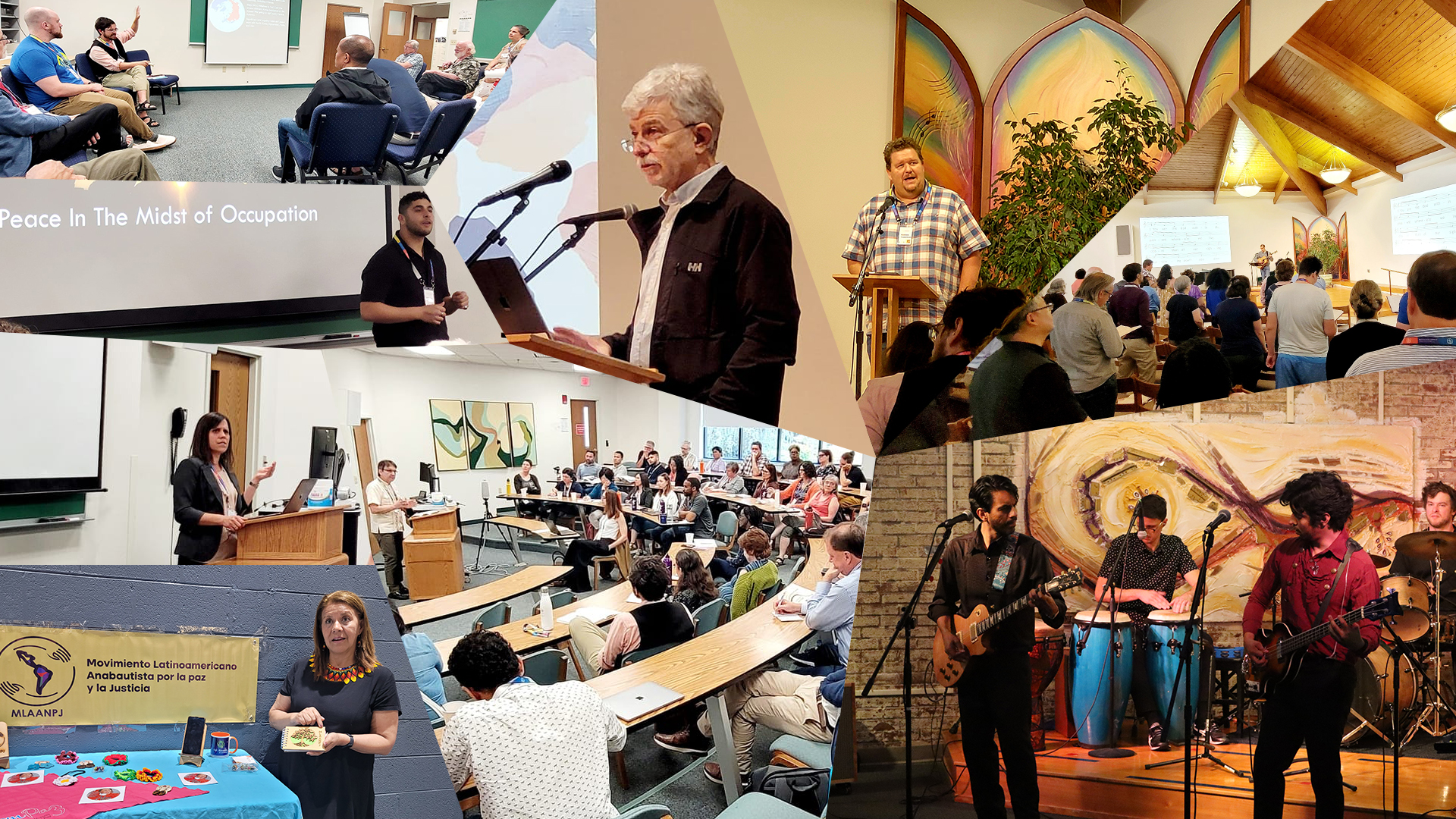
On June 15-17 I had the opportunity to attend the third Global Peacebuilding Conference and Festival at Eastern Mennonite University in Harrisonburg, Va. I had attended a previous edition of the festival in 2018 in Amsterdam, the Netherlands, when I got invited to perform music but didn’t get a chance to participate in the rest of the conference. This time, I got sponsorship from my local church and Anabaptist World to be more involved.
During the open plenary/worship, theology professor Joerg Rieger talked about solidarity. He said peace is possible if we work together in solidarity and form new systems that help us construct a more just world.
One of the workshops, “Peace in Places of Hot and Cold War,” led by Caleb Schrock-Hurst, talked about peace witness in the U.S.-China and U.S.-Russia global conflicts, from Korea and Vietnam to Taiwan and Ukraine, and how Mennonites have engaged in these wars. We heard the firsthand experiences of an older couple who served in Vietnam demining fields and working with local communities to support peace work.
In a panel session, “Exploring the Intersection Between Liberation Theology and Anabaptism,” Drew Hart, Sarah Bixler, Ryan Gladwin and my father, Cesar Moya, shared their doctoral papers and articulated a theology that calls for breaking the chains of oppression. They emphasized peace that is active and confronting, recognizing our different identities and our roles in peace work.
On the last day of the conference, I attended presentations of papers by doctoral candidates on “Contextualizing Peace”:

— Elizabeth Miller on “From ‘Social Action’ to ‘Life Abundant’: The Historical Development of Anabaptist Peace Theology Among Colombian Mennonites, 1970-2000”;
— Janna L. Hunter Bowman on “Immigration Peacebuilding”;
— Daniel Moya, my brother, on “Truth-Finding and Transitional Politics: An Analysis on Truth-Finding and its Relation to Post-Peace-Accord Contexts in Latin America, Through an Exploration of the Political Thought of Hannah Arendt”; and
— Anthony Khair on “Peace in the Midst of Occupation: A Palestinian Narrative of Peace and Resilience Amid Occupation.”
I was impressed with the participants’ involvement with immigrant movements, their data on human rights abuses and reports of what it is like to live in places of conflict.
I appreciated the emphasis on listening to and involving people from the Global South, who shared how peace is not only taught as a concept but also suffered, demanded and, for some, becomes a call to action in order to survive.
I got to meet with Adaía Bernal, a Colombian peace worker, theologian, pastor and singer who approached me after my band’s performance on the opening night. After talking with her about my work at Anabaptist World, she suggested we get together to share about her organization, the Latin American Anabaptist Movement for Peace and Justice (Movimiento Latinoamericano Anabautista por la paz y la Justicia).
This organization was formed by students of the SEMILLA seminary in Guatemala in hopes of networking with other organizations to promote peace and nonviolence in Latin American Anabaptist communities. She also mentioned the struggles of funding for peace work in Latin America. There is an abundance of human resources but a shortage of funding for grass-roots movements.
My band, La Repvblica, got to close the event in a night of cultural sharing with songs about love for humanity and nature. I believe music is a tool for peace. It depends on vibrations, rhythms and poetry to convey a message. It is a universal language. We invited other artists and friends to jump on stage and share their music. In a jam session near the end, Mennonite World Conference president-elect Henk Stenvers of the Netherlands played drums while we covered the Beatles song “I Saw Her Standing There.” I think the Holy Spirit was working!
Just like the ’80s band Tears for Fears said in their song about changing the world through “sowing the seeds of love,” I believe that we were sowing the seeds of peace and that exciting opportunities will emerge from it.


Have a comment on this story? Write to the editors. Include your full name, city and state. Selected comments will be edited for publication in print or online.