


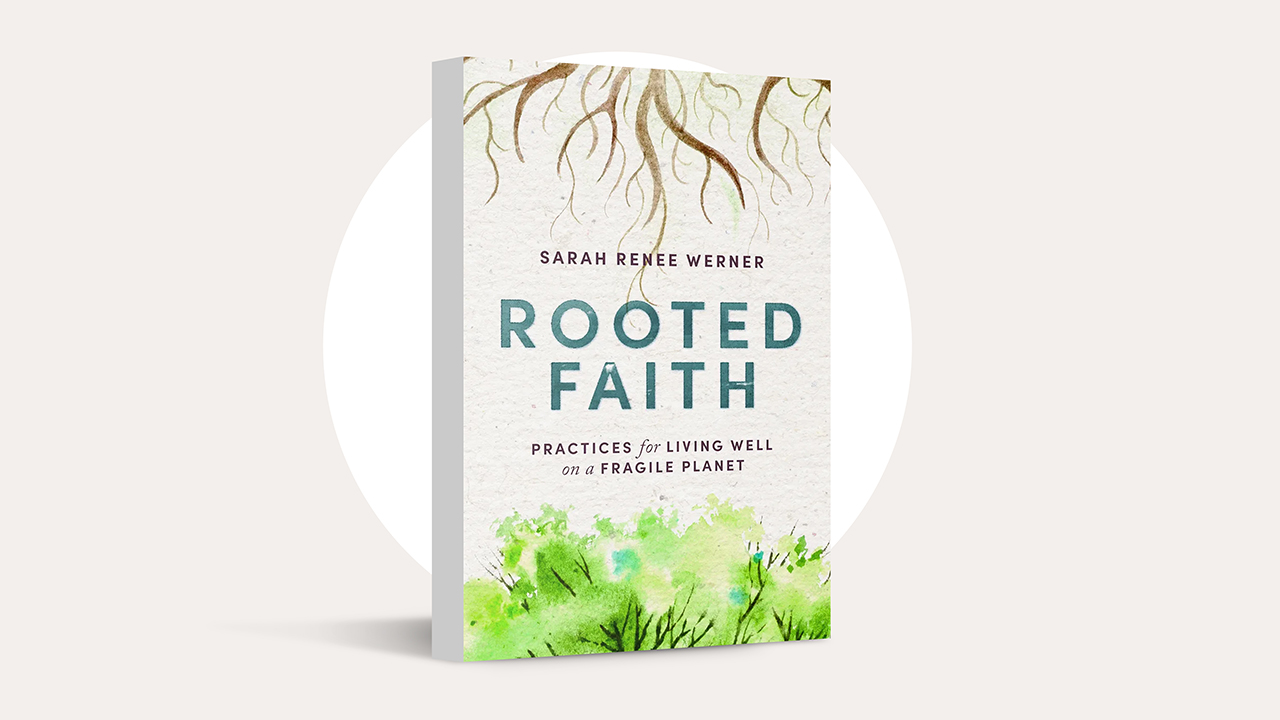
Although I’m a year-round outdoor runner in temperate Oregon, my favorite runs occur in late March, when I head for a hilly, forested route near my hometown. That close to nature, and with nothing better to do, I observe the bare branches, spotted with tiny green buds on the cusp of blooming, and I rejoice: another wet winter is nearly over. The last turn back home also overlooks my small town, spread across the valley, and I rejoice again, grateful to be living in a beautiful spot.
While reading Sarah Renee Werner’s Rooted Faith: Practices for Living Well on a Fragile Planet, I thought about my March ritual, one small practice to connect with creation and the Creator, as well as with my community and my embodied self. Werner argues that small acts of connectedness — practices of living well — can make us more fully alive to the world and engaged in healing what has been broken.
No doubt about it, our planet needs restoration. Werner returns to this theme often, noting the many ways climate change has caused (and continues to cause) ecological destruction, from erosion on strip-mined mountainsides to polluted waterways and outsized natural disasters caused, in part, by melting icecaps and rising sea levels. It’s easy to feel overwhelmed by so much destruction.
And yet, Rooted Faith is a hope-filled book. Rather than diagnosing a planet beyond repair, Werner suggests that small faith-filled practices can be the impetus for change. These practices grow out of our lament for all that’s been broken, challenging us to acknowledge the suffering of others, including people, animals, plants; and then to use that lamentation as motivation, because feeling the suffering of others “is the root of compassion that makes other actions possible.”
These other actions are grounded in a sense of awe for creation, both in terms of the creation stories in Genesis and in our experience of the created world. Rooted Faith turns on wonder at the biblical accounts of creation, as Werner draws from Genesis to argue that our interpretation of these stories shapes how we understand the Earth, as well as our relationship to the natural world, to each other and to our embodied selves.
As someone who has struggled to feel awe for my embodied self, I especially appreciate Werner’s words on reconnecting with the body as a way of living well. Werner deconstructs the mind/body duality prized by much of Western culture, a duality that disconnects us from our created selves and puts a premium on rational thought. This, in turn, has contributed to the destruction of our planet because it posits that humans have absolute dominion over all other things.
Her reading of Scripture leads to a different conclusion: Creation is alive and sentient (after all, in Scripture, hills sing and trees rejoice). When we celebrate the connectedness of all things, we live differently, aware that who we are and what we do shape the world and our place in it.
“Our brains were formed in intimate connection with our bodies, which are in constant communication with the land around us,” Werner writes. “Our true home is not in some ethereal mental realm but knee-deep in the beautiful muck of the earth. When we feel at home in our bodies and the earth, we are more aware of our connection to the sacred creation and to the Creator.”
As pastor of Olentangy Wild Church, Werner practices what she preaches. About once a month, some members of Werner’s Mennonite congregation gather in a park to worship, connecting to the Creator, creation and each other. If having church outside in a cold Ohio winter doesn’t seem like a sacred experience, Rooted Faith offers many other suggestions for finding rhythms for living well. Each chapter offers accessible ideas for how to put into practice the principles Werner explores, from taking nature walks to writing psalms to supporting climate-justice efforts in your area.
What I appreciate most about Rooted Faith is that Werner relies not on a toxic positivity that obfuscates suffering but on an honest reckoning with our fragile planet, as well as a way forward. Rooted Faith inspires us to reconnect with creation, of which each of us is an integral part, and encourages us to care intimately about the planet’s flourishing.
“We are only whole when we are grounded in an enlivened earth,” she writes. “We can only experience God when we are willing to be part of the beautiful, tragic whole of the cosmos.”
Rooted Faith is an invitation to living well that we and the planet need.
Melanie Springer Mock is professor of English at George Fox University in Newberg, Ore.


Have a comment on this story? Write to the editors. Include your full name, city and state. Selected comments will be edited for publication in print or online.