


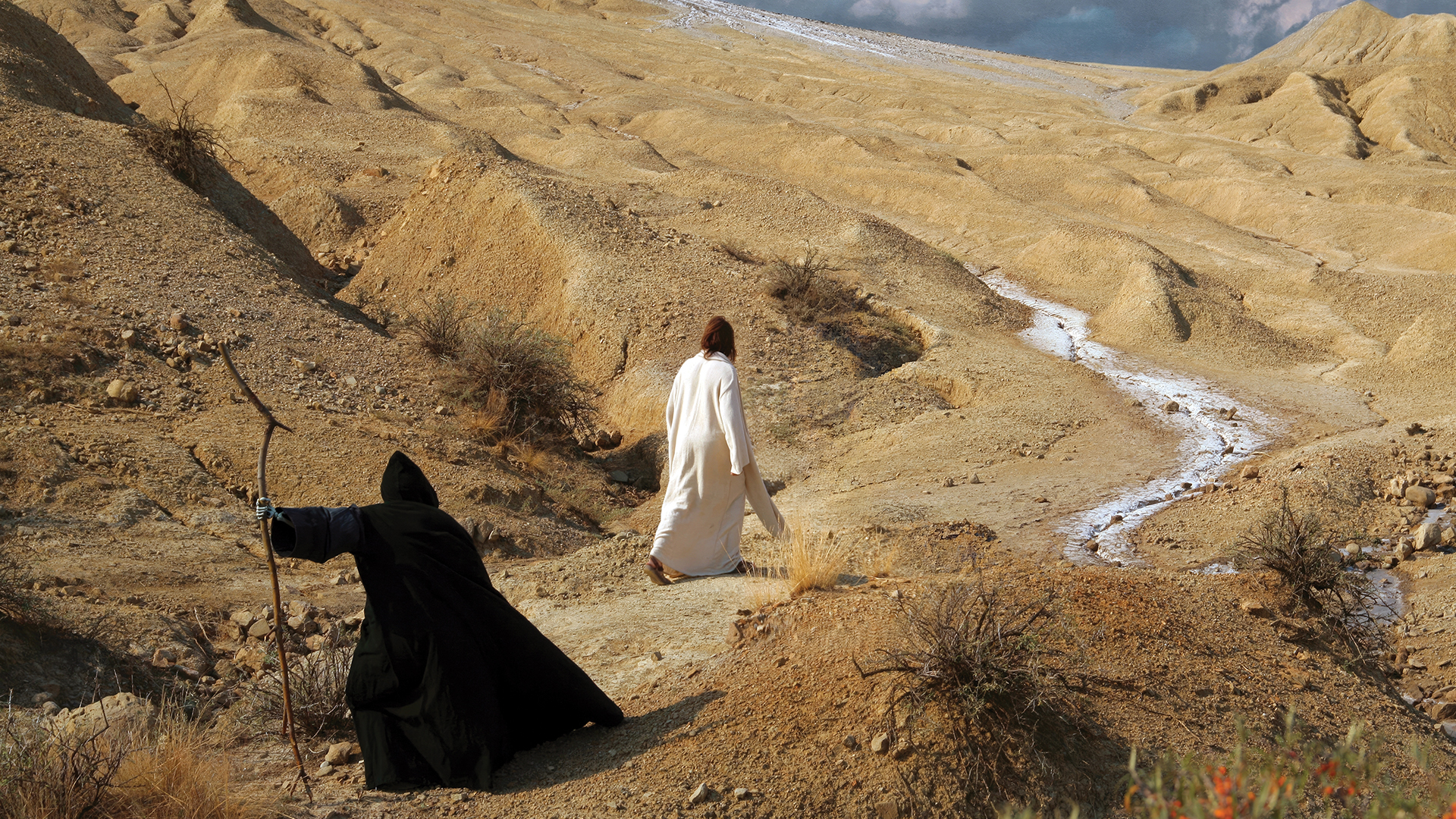
Then Jesus was led up by the Spirit into the wilderness to be tested by the devil. He fasted forty days and forty nights, and afterwards he was famished. — Matthew 4:1-2
Jesus, tired and hungry, undergoes the devil’s testing. The temptations present a question at the heart of the gospel: Is Jesus willing to be human, as vulnerable as the rest of us?
The Holy Spirit sends Jesus into the wilderness. Why? To acquaint him with his weakness, to invite him to feel his way into the fragility of his body, his dependency on the material conditions of creaturely life — to be earthly, a member of the created order.
Hunger gnaws from inside. Thirst chokes his spirit. He can’t ignore his neediness.
Jesus sees a rock, and his stomach begs him to turn it into a loaf of bread. All the other tests are summarized in this first one: the desire to get what he wants, now.
To escape the vulnerabilities of being human. To become the Messiah without enduring crucifixion. To settle the meaning of his life here at the beginning of his ministry, without having to live it out.
The devil tempts Jesus with the possibility of escaping his weakness.
These are temptations of evasion, of avoidance, of impatience with his life as a human being. He is tempted with quick fixes. Stones turned to bread in the blink of an eye.
But he refuses. Jesus chooses to live without quick solutions. He chooses a life of patience.
In the wilderness, Jesus commits to his humanness. He invites us to be human like him: to be confronted by our dependencies — our needs and desires — and refuse to grasp at them.
He invites us to refuse the desperation of power, of coercion, of getting what we want no matter who gets hurt, no matter what compromises have to be made, no matter what deals we have to make with the devil.
The promise of the gospel in this wilderness story is there in the first verse: “Then Jesus was led by the Spirit into the wilderness . . .”
It’s not like the Spirit takes Jesus to the desert and drops him off, wishing him the best of luck. The narrator doesn’t say the Spirit leaves him alone. Instead, where Jesus goes, the Spirit is already there.
That’s God’s promise to us as we wander — that the Spirit is with us, holding us up when we are weak. Though we are unsettled by this world, God’s Spirit is here, breathing life into our ruins.
Lent, which begins March 5, is a season in the wilderness. It is the season when we remember that we hunger and thirst, that we are exhausted by what needs to be done. We long for the goodness of God. We hope for the transformation of all things. Yet we stumble over ourselves as we push against a world that seems intransigent.
As we confront our weakness — our failures at changing this world of ours — we need to remember the truth of the gospel: We live by a grace that never ends, a grace that revives a new creation in the middle of this desolate one.



Have a comment on this story? Write to the editors. Include your full name, city and state. Selected comments will be edited for publication in print or online.