


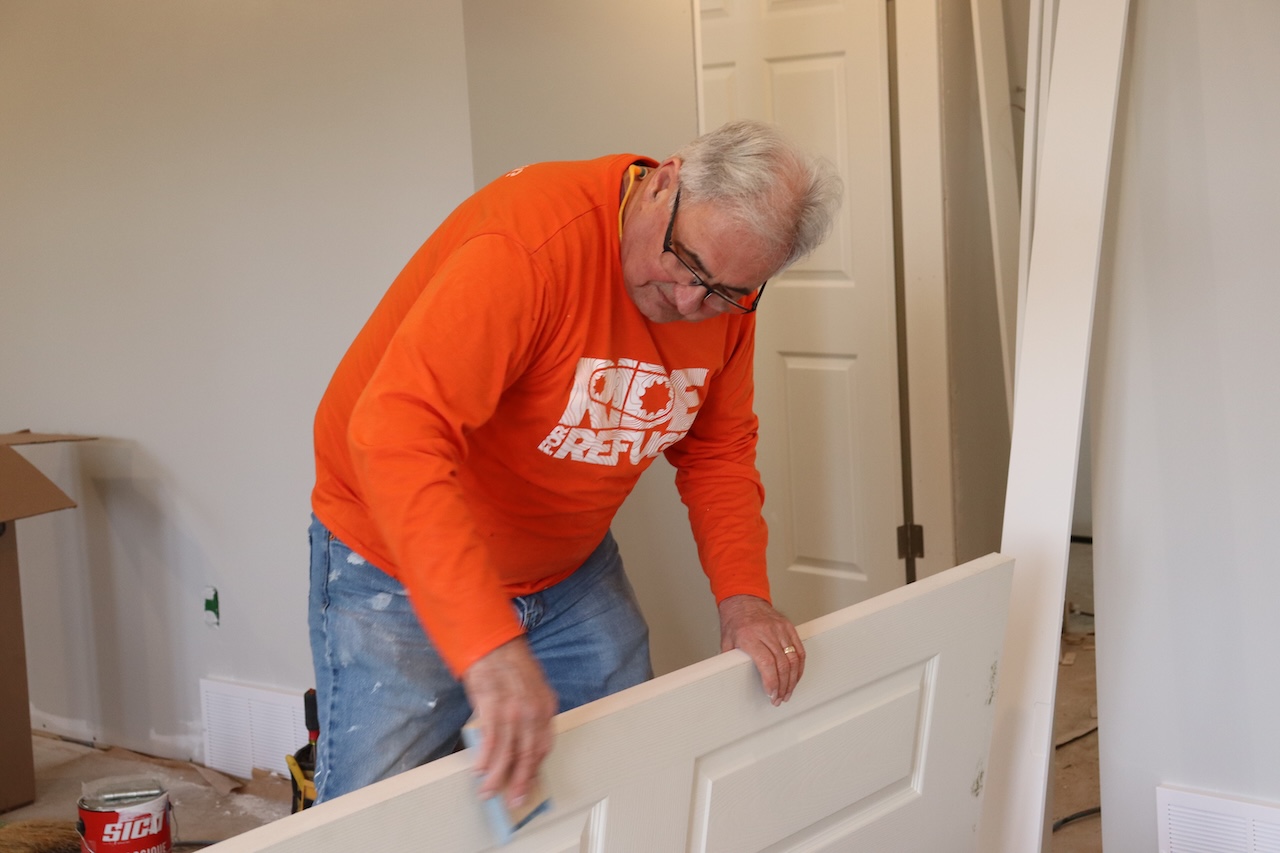
When God called Abram, our forefather in faith, he said, “I will bless you, and in you all peoples of the earth shall be blessed.” I take that to be my personal mission — called to be a blessing to others. Working with a Mennonite Disaster Service project is a natural way of doing that.
I’m a retired pastor and carpenter. My work with MDS brings together my two worlds. I was still involved as a pastor when I took the month and worked in Williams Lake. The fires happened in 2017. I didn’t get there until 2018. I arrived in the latter days of August and left at the end of September.
I flew from Toronto to Vancouver, then from Vancouver to Williams Lake. Flying over the mountains in a smaller plane, that’s when I began to see signs of a forest that’s been burned.
When I arrived, you could see the mountains off in the distance. As an Ontario boy, that was scenery I don’t see everyday. I recall wondering, “What’s all that white on top of the mountain?” Green was back, but the smell of smoke and charred trees was still in the air. We were taken to our camp, in the basement of a local church.
I got there just around dinner time. Seeing the other volunteers coming back from their day’s work I began to hear some of the stories firsthand, secondhand, sometimes even thirdhand of having lived through the fires. The town was evacuated. The pastor of the church talked about riding his motorcycle through the city, going down the streets full tilt, not worrying about hitting anything or anybody. By the time we were there, the streets were bustling again. They were very fortunate that the winds changed, and the fires didn’t come into town.
The houses we built were up in the mountains where the fires were. We worked on four fairly basic houses while I was there, about 1,000 square feet. We only finished the one. I was involved in directing the volunteers. Some come with building experience. Others don’t. The miracle of our work is seeing volunteers come with little or no experience, and then building a house from scratch.
One of our jobs was an hour-and-a-half west of Williams Lake. That was logging territory. We had to navigate trucks coming around curves through the mountains along the Fraser River. Hillsides were burnt out. You can’t underestimate the power of a fire.
One of the first days we went to the site, I recall seeing burnt-out trailer frames and metal furniture, and thinking, “Oh, this was once somebody’s home. This was somebody’s property.” There were lots of charred trees, burnt-out cars, yard equipment still standing there. The thing that was mystifying was seeing puddles of molten metal. I learned afterwards, that had been the aluminum blocks of car engines, lawn mowers, and garden equipment.
We are encouraged to put the hammer down and listen if we sense that a homeowner has a need to tell their story. That’s part of the experience of loss. Loss generates grief, and there’s a need to tell the story. The homeowner was a local cowboy. Assuming the water bombers were coming to protect his property, he was off helping another person. The fire jumped the river and burnt their property.
These folks had an underground cellar that they put items in, like some of her mother’s china and a sewing machine. He had quite a collection of cowboy hats, which he forgot to put in there. Those were lost. The couple continued to live on the property in a mobile home and were very involved in the rebuilding. There was the sense of all these things that we lost, but there’s also the things that were gained. There’s some small blessings still.
The homeowner of the house we completed in the month I was there talked about the time when the fires were coming closer to the area. She was told, “We’re evacuating.” She says, “Well, when?” “Immediately.” She went home and loaded her dogs in their car, left within about 15 minutes, and came back six weeks later. Her house was a pile of ashes. An ember had blown over the hill, fell on her house, and her house caught on fire.
This is her dream house that her late husband had built. The house burned, and not much else around it. Her son’s house was 300 feet away and wasn’t touched. When you see people losing their homes, it’s always devastating. You grieve alongside. After her house was finished, there was a renewed sense of hope.
Williams Lake was the first time that I had the most direct impact of a disaster as a result of climate change. For me, it’s a no-brainer to see that the increase in fires is a result of climate change. In terms of the magnitude of storms, tornadoes, and hurricanes, I’m convinced of that as well. The systems of our Western democracies drive climate change. The cat is out of the bag on that one. There’s something that’s been unleashed, but how do we slow it down? How do we stop it? It’s a very complicated thing.
MDS is tooled to respond to disasters. We haven’t been tooled to think in terms of how to get ahead of a disaster. I’m beginning to wonder whether we could. The irony is that we build with flammable materials within flammable areas. We have to rethink in terms of what we build with and where we build. We built one new house in Lytton, BC. The entire town burnt four years ago, and there was grant money available to build the house so it’s net-zero-ready as well as fire-resistant. I believe it was the first house of that sort built in Canada.
From the Mennonite perspective, faith is not an individual thing. Faith is something we live out in community, walking together with people. When there’s been devastation, and that sense of despair I described earlier, being together builds on that sense of community. Empathizing with folks in those times leads me to volunteer, to be ready to help rebuild. Seeing that move from despair to hope. That’s what gives me hope.
This article, told to Sophie Kunka and Caroline Tucker, was produced for the Climate Disaster Project, an international teaching newsroom based at the University of Victoria in British Columbia. The project works with people whose lives have been touched by climate disasters to share their experiences and ideas for solutions.



Have a comment on this story? Write to the editors. Include your full name, city and state. Selected comments will be edited for publication in print or online.