


The outbreak of measles in under-vaccinated communities has its beginnings in the conservative Mennonite community of Texas. In contrast to hesitancy today, these traditional and separated communities have had a close relationship to vaccines since the early 1800s.
Since arriving from Russia to Canada in 1875, Old Colony (Reinland) Mennonites have prioritized educating their children in German, focusing on basic skills — reading, writing, arithmetic and spelling. The Bible, a primer and a Mennonite catechism were their core texts. Their aim is to serve the country as a separated, “quiet” agricultural people, grateful and law-abiding. Suspicion of government intervention — especially when it challenges trust in God’s providence — is deeply rooted.
The Old Colony Mennonites came to Canada in 1875, later migrated to Mexico and some to Texas, carrying with them difficult memories of government interventions in Russia during the 1870s. These overshadowed other good memories from the 19th century, for which their ancestors were grateful — including vaccines and state health support.
Today archives in Russia, Ukraine and Germany allow us to tell some long-forgotten stories. The Old Colony Chortitza Mennonites — direct ancestors of some of these conservative cousins — were already vaccinating their infants and toddlers against smallpox in 1809 and 1814. We have the names of children vaccinated, including grandchildren of Jakob Höppner, who led Mennonites from Prussia to Russia in 1789, and grandparents of Old Colony Bishop Johann J. Friesen, who led the migration from Canada to Mexico in 1923 (note 1).
Ukrainian historian Dmytro Myeshkov notes that Chortitza began immunizing children in 1804 amid a smallpox epidemic. A nearby German village, Joseftal, lost 20 children to smallpox. Mennonites who arrived in Russia in 1804 and founded the Molotschna Colony, faced the same disease.
Chortitza Mennonites “begged” their government liaison, Samuel Contenius, for cowpox vaccines, which confer smallpox immunity. They also requested instructions to vaccinate independently. In response, a medical officer was sent to Chortitza in 1805 to administer vaccines and train locals. In March 1805, an official named Becker from the Ekaterinoslav (now Dnipro) Medical Office vaccinated children and trained the community. Old Colony Mennonites were not only vaccinated, they were taught to become vaccinators.

By 1808, Molotschna received cowpox vaccines, some local, some from Moscow. A committee in Ekaterinoslav was formed to systematize vaccinations, emphasizing education on their benefits. Myeshkov cites an official who believed this “saving remedy” could protect against smallpox’s cruelty and eventually eradicate it.
In 1817, records from the Molotschna Colony show that of 311 children born or unvaccinated that year, 197 were vaccinated. Twelve unvaccinated children died, and 102 remained unvaccinated, suggesting some hesitancy. However, other colonies (German, Swedish, Bulgarian) had worse vaccination rates. Irregular vaccinations likely stemmed from vaccine shortages (note 2).
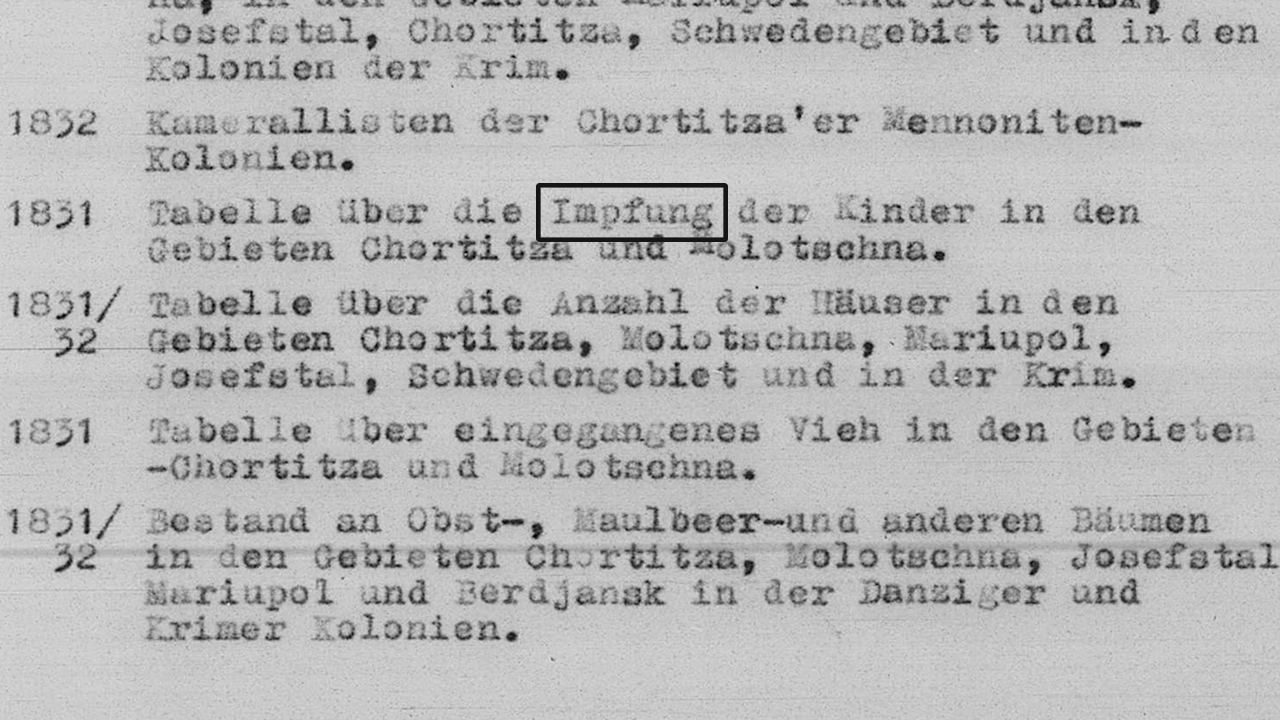
In 1831, Mennonites in both the Chortitza and Molotschna colonies once again vaccinated their children. A document from the Berlin Federal Archives includes a table of vaccinations from that year, which is evidence of a coordinated public health effort within the community. This came in the wake of a devastating cholera epidemic that swept through the Russian Empire in 1830-31, claiming countless lives. While no cholera vaccine existed at the time, the Mennonites’ prompt response reflected their respect for government guidance and their commitment to the best available health practices.
On Dec. 6, 1830, prominent Mennonite reformer and leader Johann Cornies instructed the Mennonite District Office to restrict travel and minimize contact with the Nogai population to help prevent the spread of disease. His letters from this period offer a vivid portrait of the crisis and the community’s mindset. “God alone knows what will befall us,” he wrote. “Our villages exist like an island in an ocean of cholera … All roads are blocked, and no one passes without quarantine. We cannot thank God enough for [the Tsar’s] fatherly guardianship” (note 3).
Months later, on Sept. 18, 1831, Cornies wrote again: “Our community has been spared, though we’ve felt under siege since May. … No doctor is God, no medicine Savior, but without God’s blessing, they neither nourish nor heal us.” This spiritual perspective — humble, reflective and full of gratitude — shaped Mennonite approaches to disease for generations. Cornies urged prayer to avert catastrophe, reliance on God’s grace and trust in the wisdom of the authorities, stating: “Whatever comes from God will serve our well-being.”
While he praised the state’s protective measures, Cornies also acknowledged tensions within the community: “We do not strive against God’s will by taking precautions. … Some here consider [them] sinful. Others indulge in frivolity.” For Cornies, faith, reason and loyalty to the emperor were not oppositional but deeply interconnected.
Minister Jacob D. Epp, born in the Old Colony and mentor to Johann Wiebe, the first Old Colony (Reinland) Church bishop in Canada, recorded vaccinations in his family in the 1850s. His diary, now published, shows that vaccination was a normal part of life (note 4).
Today, some Mennonites believe the conservative tradition discourages vaccination and shuns government health intervention. But the historical record tells a different story. Old Colony ancestors were not only vaccinated, they were thankful for it. They asked for help, learned to vaccinate others and praised God for the state’s support.
This is the conservative Mennonite tradition on vaccines. It is a good and important memory — one that deserves to be remembered, especially now.
Arnold Neufeldt-Fast is associate professor of theology and dean of the seminary at Tyndale University in Toronto and an ordained minister in Mennonite Church Eastern Canada. A longer version appeared originally in Die Mennonitische Post.
Notes:
Note 1: 1809 and 1804 immunization lists for the Chortitza Settlement, mennonitegenealogy.com.
Note 2: Dmytro Myeshkov, Die Schawarzmeerdeutschen und ihre Welten: 1781–1871 (Klartext, 2008).
Note 3: Transformation on the Southern Ukrainian Steppe: Letters and Papers of Johann Cornies, vol. 1, ed. by Harvey L. Dyck, Ingrid I. Epp, and John R. Staples (University of Toronto Press, 2015).
Note 4: A Mennonite in Russia: The Diaries of Jacob D. Epp, 1851–1880, trans. and ed. by Harvey L. Dyck (University of Toronto Press, 2013).


Have a comment on this story? Write to the editors. Include your full name, city and state. Selected comments will be edited for publication in print or online.