


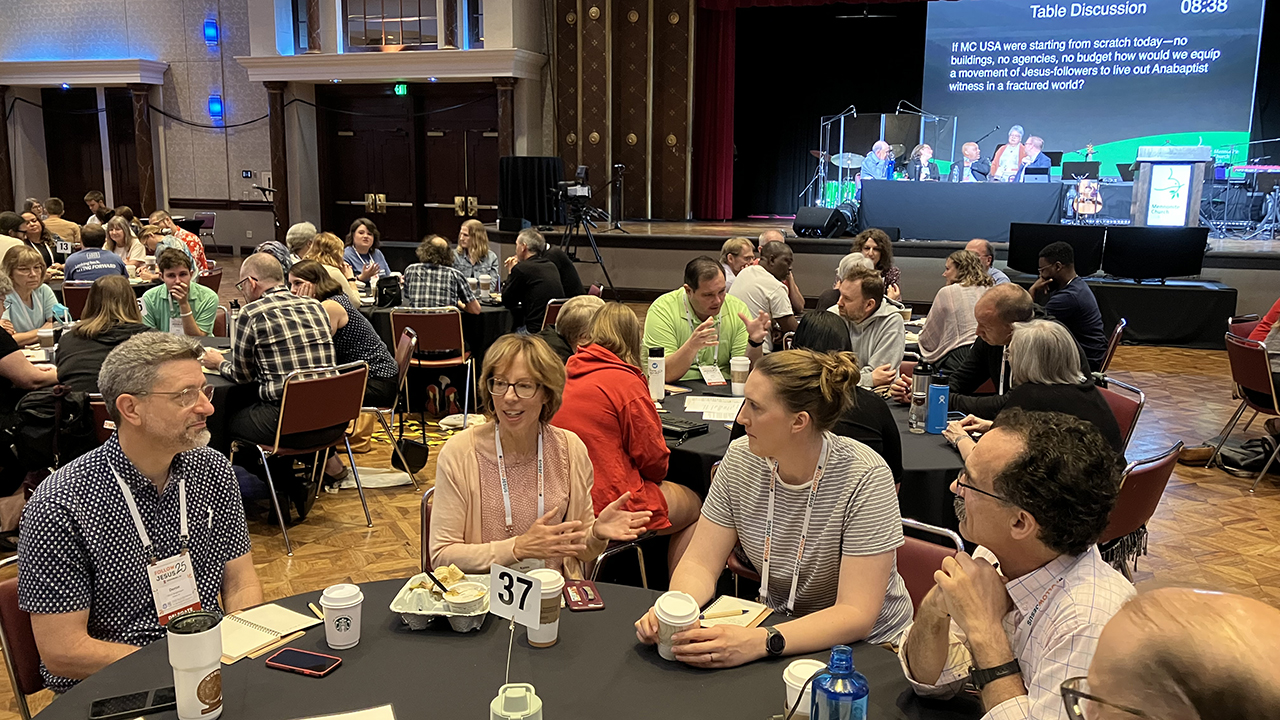
Mennonite Church USA delegates on July 11 reaffirmed their support for immigrants and approved policies to ensure that all conferences and congregations follow the same rules in cases of misconduct by credentialed leaders.
The Churchwide Statement on Immigration, which passed 353 to 1, is an updated version of a resolution first approved in 2003 and updated in 2014 based on delegate action in 2013. It calls for advocating “just and humane immigration policies” while “building intercultural relationships and diverse worshiping communities and treating immigrants and asylum seekers with dignity and respect.”
It suggests action steps such as offering “church facilities and volunteers for documentation services, language classes, mental health support, cultural celebrations, after-school homework help and other ministries” and providing “food, shelter, clothing, housing, transportation and other resources to immigrants and asylum seekers regardless of their status.”
Delegates expressed support for the statement’s call to build relationships.
One cautioned against an attitude of “we’re so glad we’re helping those people” and urged instead to recognize that “those people are a part of us. We have them in our congregations and communities. This is for our shared, collective liberation.”
Another said: “As Mennonites, we are mandated to welcome the stranger, and I hope and pray that as a denomination and as local churches we will respond to our undocumented brothers and sisters, even to the point that [we say] to obey God is better than to obey the government.”
The main changes to previous versions were a longer list of suggested actions and an updated list of resources.
The Prevention and Accountability Resolution, which passed 339 to 8, requires conferences and congregations to use the same policies and procedures for abuse prevention and accountability. Resources for this purpose are newly updated.
Leaders noted that the resolution is a denominational mandate and thus differs from MC USA’s congregational polity. When a delegate asked about “power from above rather than stewarding it together,” moderator Jon Carlson replied, “We recognize this is an innovation within our structure.”
Several delegates expressed support. One, who said she had seen the stress a misconduct situation puts on a conference minister, called it “a wonderful way to help our conferences.”
A key purpose is to build trust and increase safety by holding pastors to the same ethical standards in each conference.
“We are saying together that we are committed to ensuring that our congregations are safe places for vulnerable adults and children,” said Michael Danner, denominational minister for church vitality.
Delegates approved, by a vote of 334 to 9, a bylaw change that moves the functions of Mennonite Education Agency into the structure of MC USA under the Executive Board.
Schools at all levels have been operating more independently of MEA in recent years.
According to a summary for delegates, the bylaw change “establishes a new Leadership, Education and Development Center (LEaD), preserves MEA’s educational endowments and transitions current MEA staff into MC USA’s team. It also ensures continued focus on key areas like BIPOC [Black, Indigenous and people of color] scholarships, Hispanic ministries and higher education relationships.”
Several delegates affirmed the importance of educational programs in Spanish. Sandra Montes-Martinez of Western District Conference expressed concern about these programs’ future. Danner responded that constituents’ giving was a key to sustainability.
Responding to a question about educational resources that members need from the denomination, a delegate who homeschools said “homeschooling is a huge Christian nationalist enclave” and “it would be wonderful to have a progressive homeschool curriculum.”
Integration of MEA functions into the work of denominational staff is effective Aug. 1.
Delegates approved, by a vote of 321 to 11, a bylaw change that gives the Executive Board the authority to recommend the termination of executive directors of churchwide agencies (Mennonite Mission Network and MennoMedia). Final authority remains with the agency boards.
By a vote of 353 to 3, delegates approved a slate of nominees, including the next moderator-elect, Todd Lehman of Hesston, Kan. He will be moderator-elect in the 2025-27 biennium and moderator in the 2027-29 biennium. Lehman is executive director of Offender/Victim Ministries in Newton, Kan., and a former pastor.
Glen Guyton, MC USA executive director, announced that a process of “reimagining the church” will begin this year, with outcomes to be presented at the 2027 delegate assembly. A committee to focus on the national structure will begin meeting in September.
Guiding principles for change, Guyton said, are to be transparent, collaborative and adaptive, to follow Jesus, to witness to God’s peace and to experience transformation.
Marty Lehman, chair of the Resolutions Committee, reported that the committee rejected two proposed resolutions regarding the 1995 Confession of Faith in a Mennonite Perspective — one to revise it and the other to replace it with Mennonite World Conference’s 2006 Shared Convictions.
Lehman said MC USA does not have jurisdiction to change the Confession, since it is a binational document with MC Canada. Further, the committee “felt we have already adopted” the MWC Shared Convictions. She said congregations are free to use the MWC document as their doctrinal statement, either instead of or in addition to the MC USA/MC Canada Confession.
Lehman is also MC USA’s moderator for 2025-27. In an address to delegates at the end of the assembly, she noted events in the world and trends in the church can make it hard to be hopeful.
But, referencing this year’s celebration of the 500th anniversary of Anabaptism, she said: “Five hundred years later, we’re still here. While we may be a smaller church in North America, the global Anabaptist church is growing. . . .
“There is a lot of energy and hope in this convention. Five hundred years of doing justice, showing mercy and working at issues of peace — that gives me hope.
“During this next biennium, I invite all of us to be hopeful.”



Have a comment on this story? Write to the editors. Include your full name, city and state. Selected comments will be edited for publication in print or online.