


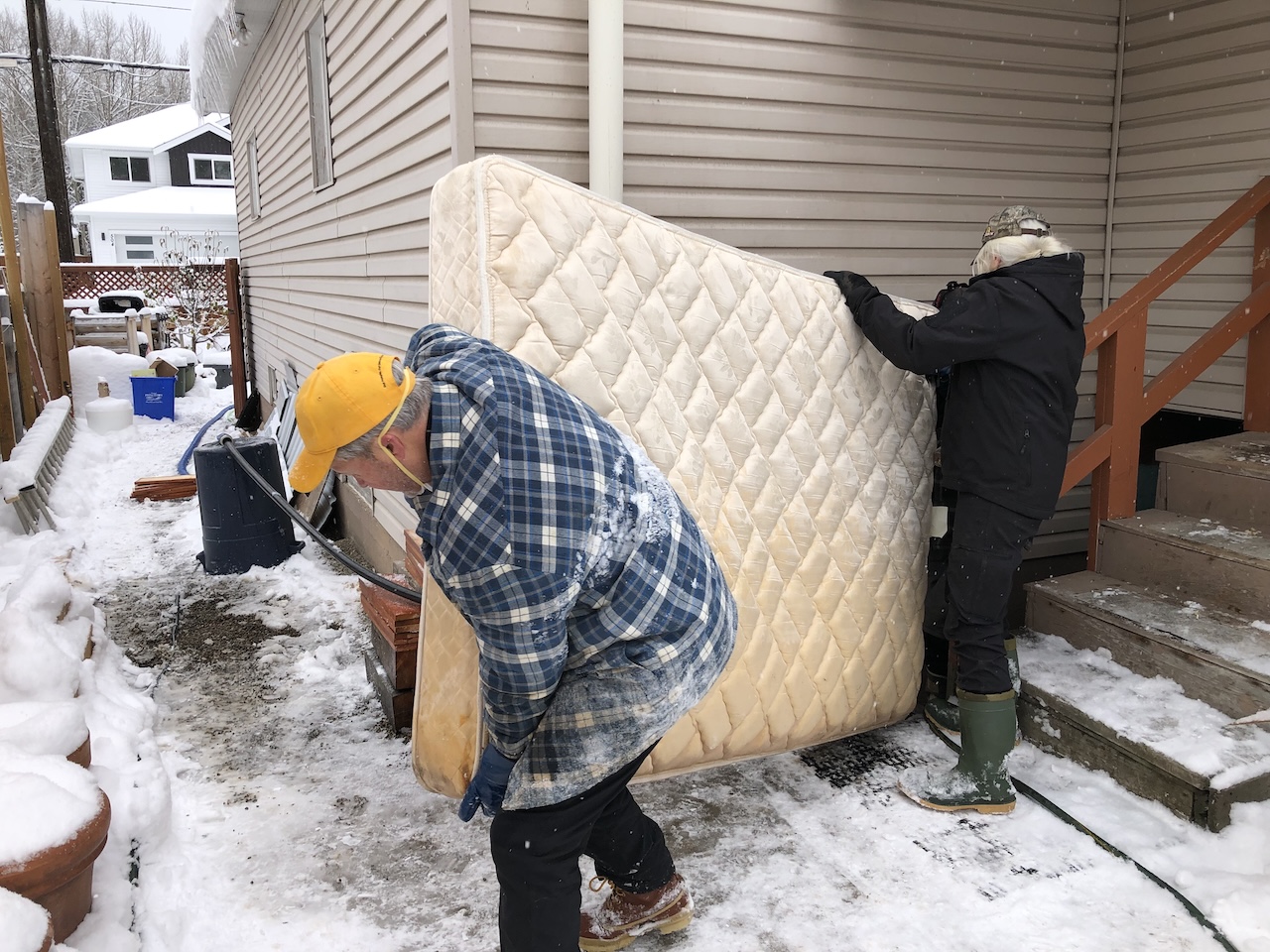
What hit British Columbia, they call it an atmospheric river. A friend of mine used to work for Environment Canada. They never used to call it that. They used to call it a Pineapple Express. We were getting them back in the ’80s but nothing like what we saw hit British Columbia. When Princeton got hit hard by the mother of all Pineapple Expresses, we got an email from our friend who was running the project. He said, “Hey, we’re going in, can you come help?” We were from the east, so for us to get into Princeton was easy. We knew we were going. Took all our winter gear because it was going to be cold.
You don’t really picture what Princeton’s like until you get down into the town and actually look around. The town sits low, and there’s these dikes where the two rivers come together, the Similkameen and the Tulameen. One of these dikes gave way. That water came in with force. The flood actually blew out the sliding patio doors in this one place where the rivers converged. You couldn’t tell what was in what room. Furniture was upside down in deep, wet mud. Things were thrown around, high up on the cupboards and stuff.
When we got there, there was mud, there was gravel, there was sand. I remember seeing a garage that had a sand dune inside it. It’s like, “Why did some guy pile that much sand in his garage?” No, that was deposited there because of the flood. You go a block away, and a lady’s backyard, it’s full of gravel. What probably hit me the most was the amount of mud there was. We’re talking feet of mud. It was cold and it was starting to ice up.

We were assigned to look after a fellow’s house. Going into the front of the home, it’s like frozen mud, but in the basement, it was dank and it hadn’t frozen in there yet. There was maybe about 6 or 8 inches of mud. We were going to start pumping mud out onto the street because that was the only place to put it. That idea went out the window. No pump in the world was going to pump this thing, at least nothing we had. It was buckets and shovels. Picture, maybe 600 square feet of mud that was eight inches deep that was taken out with five gallon buckets out onto the street and dumped, along with the contents of whatever was in the basement.
The owner was there. It’s always harder to remove contents when the owner is there because this is their life. As you’re digging through the mud, it’s like, “What’s this round disc?” Then you realize this person had an amazing record collection. There was Christmas decorations everywhere. Those decorations were important to his wife. He didn’t want his wife to come at the end of the day and see the pile, so we made sure that that was taken care of. You try to save what you can. We were able to save his fishing rods because they were good, and his cross-country skis.
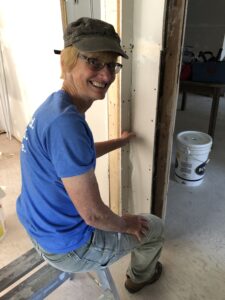
Then back to the camp. We had our meal, told our stories, and then back to it the next day. Just keep repeating until the place was cleaned. We power washed the whole basement until it actually looked pretty good. It was an unfinished basement area. Then proceeded to go upstairs. They’re older constructed homes, so it’s a bit of an archaeological dig because you can be going through drywall, and then you’ll get to the 1970s paneling. Behind that, you’ll get to the Donnacona that they used in the ’50s, to the shiplap, and then to the frozen insulation, which in some cases is sawdust. Some cases it’s nothing.
For the emotional part of it, the Princeton flood was the hardest place that we’ve ever worked. I think it was because we came in earlier than we had ever come in, a week later than when it actually hit. When we went to people’s places to muck it out, taking out anything that’s water damaged, it hurts to see something that you know means a lot to these folks. You see the sewing machine with all the fabric that’s just covered in mud. You walk into a kitchen, and there’s the frying pan, and there’s moldy sausages in it. Somebody was making breakfast when this happened, and they walked away. You learn a lot about people.
We were going through a gentleman’s house and clearly he was a musician or his wife was, or they both were. We’re going into his bedroom and there’s a banjo on the floor and mud on it. It was in pretty sad shape. I said, “Oh, there’s a banjo.” He said, “It’s done. I was able to rescue some of my other equipment, but not my banjo.” I said to him, “I know a guy in Trail who’s an amateur luthier,” which is a fellow who fixes stringed instruments. He said, “Well, that guy can probably use some of that banjo for parts.”
I took a photograph of it and I sent it back to my friend. He plays banjo in the band at our church. He said, “Oh, bring it home. Maybe we can do something with it.” Brought him the banjo. He takes it home and takes it right apart. He was praying about it, “How am I going to fix this thing?” He’s got a wood stove in the basement and he got this idea. “If I heat this thing up and I get some moisture on it,” and he gets the neck straight and reattaches the neck. He cleans up the metal components. He gets the drum back together. He actually bleached some of the stains out of the drum, and the neck.
I phoned this guy’s wife up and I said, “Hey, my friend rebuilt this banjo. We’d like to have you out to camp on Wednesday night.” We had dinner that night, then I had the pleasure to give this gentleman his playable banjo back. When you’re giving a musician back his instrument he thought was lost in the flood, it’s quite an emotional moment. It’s God’s providence. We do more than just rebuilding houses. We fix banjos too.
In Princeton, we were on about three different streets because they were the ones that really got hit. By the time mucking out was done, there was basically nothing left in those houses. They were a shell. Your bathtubs were gone. Your sinks were gone. Cupboards. Everything. Everything was gone. It was stripped down to nothing. We came close to hitting everybody’s house for muck out. For rebuilds, we never will be able to hit everybody’s house. We changed the lives of some people, but not everybody’s. The biggest thing is to listen to people’s story, because they need someone to listen to them. It’s a motto of MDS: “Put down the hammer.” It’s so important to have that ear and speak when you feel called to speak. I think that goes for anywhere we’ve been.
When we’re done, there’s usually a dedication ceremony. Because there were so many houses in Princeton, they just did one big town ceremony with everyone in the community that wants to come. Clients, the contractors that helped us, the hardware stores that helped us, all those people are invited to that too. Disasters bring communities together, it puts a bond between people that is lasting and it’s very real. There’s this one place that had a big banner, “Thank you, MDS.” We saw that every day. The same lady that was at that house brought us donuts almost every single day. Unfortunately, we weren’t at the final celebration, we had other commitments. For us, our end was wherever the house was at that point.
We were ready to come home. After that week, it’s like, “My jeans can stand up in the corner. We’re dirty and we’re tired.” Coming home is a funny thing. When you are there, you are focused on either taking the house down or putting it back together. You are with people that are all doing the same thing. Everything else in your life just goes. You don’t think about anything. There’s no TVs in there. There’s no newspapers coming in. Cell phones, we don’t even know where they are for a week. Any little responsibilities you have during the week, they’re all gone. You’re very focused and you’re living in this bubble world. It’s not a bad place to be. You come home and all of a sudden real life comes back to you and it’s like, oh yes, okay. Click out, click in kind of thing.
It affects you. It’s like, wow, there are definitely people around that don’t have what you’ve got. It makes you thankful. I have done nothing to deserve this any better than anybody else has. It can go any time. What’s important is the people that are around you, it’s the relationships. People say, “Oh, wow, you guys are great. You go do this and you do that.” It’s not that hard. We love it. I can truly say that we get more back from the experiences we have had with people in Princeton and everywhere else.
It feels that we did make a difference, like I have tried in a little way here to live what I believe. What I believe, as a Christian, that I need to help people. It’s not like, there’s a certain group of people I need to help or this or that. It’s like, that’s everybody. We’re not out there to look at, what’s your faith? What’s your belief? What’s this? What’s that? That’s not what it says. It says help. It gives us the opportunity to do that in something that we enjoy doing. Privileged. Privileged that we can actually do it. Privileged that they allow us to do it. Privileged that I got the strength to do it. It makes me thankful.
Climate change is changing what’s happening across our country. MDS used to have small projects in Canada. We got national projects going every summer here now. It seems these things are occurring more and more. Things are melting. We canoe a lot and we hike. We go up to the glaciers, the water coming off of those is tremendous. The force and the volume coming down there in summer is unbelievable. You start to think, are we going to have a flood? We’ve gone back to Princeton, we’ve sandbagged in Grand Forks two times after we rebuilt it. It’s never broken the dike again but two times we’ve gone in there to sandbag. Houses that we actually rebuilt, we sandbag them.
We all need to do our little part. It makes a difference. We build houses differently than we did. For fires, we build them differently. Codes are changing. We’re changing. I don’t think there’s any magic bullet. It brings me hope that there are people out there telling stories. They affect people more than graphs and numbers do. If there’s somebody who’s gone through this disaster and they tell you something, people don’t have the tendency to argue. Real stories are what makes a difference.
This article, told to Amber Fill and Rachel Willins, was produced for the Climate Disaster Project, an international teaching newsroom based at the University of Victoria in British Columbia. The project works with people whose lives have been touched by climate disasters to share their experiences and ideas for solutions.


Have a comment on this story? Write to the editors. Include your full name, city and state. Selected comments will be edited for publication in print or online.