


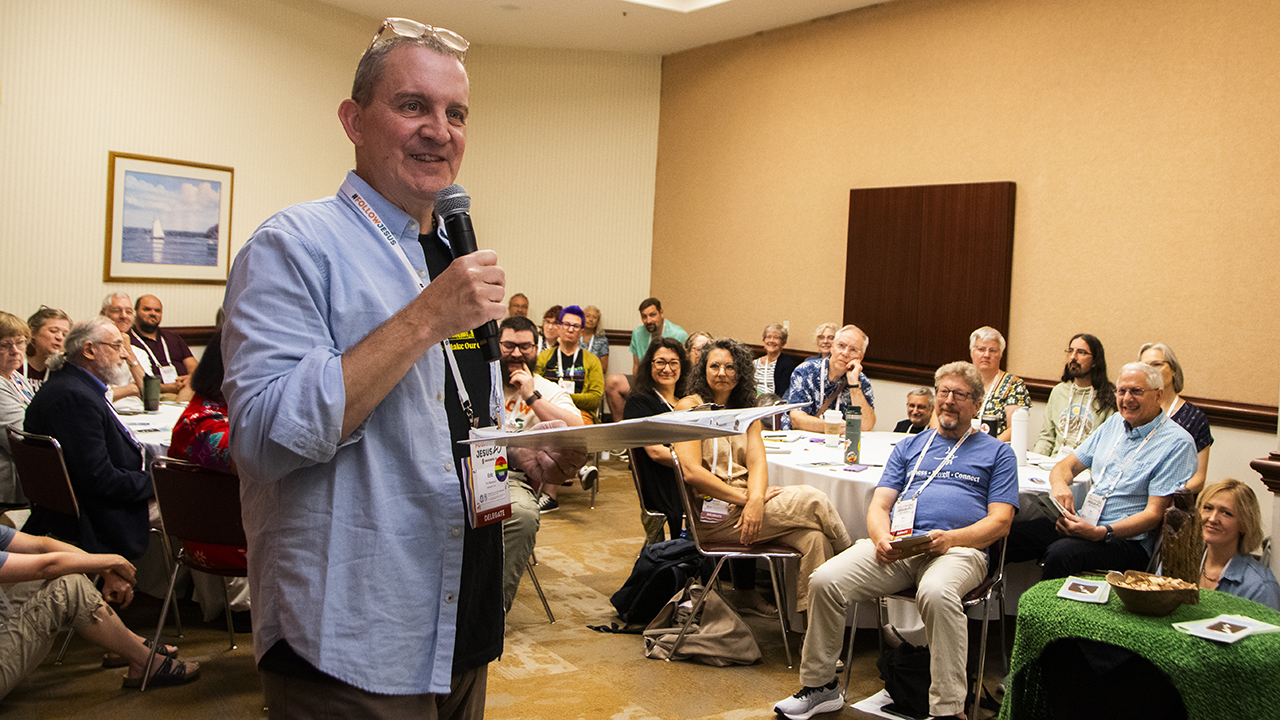
“Wooh, wooh, wooh.” With each rhythmic sound, the man in the center raised and lowered his arms. A young woman joined next, adding a pointing motion and a higher “oooh” between each beat. Before long, the group of 35 was moving together in a chorus of oms, beeps and vrooms, each sound and motion contributing to the “living machine.”
The mob drew curious looks from those passing in the hallway, and that was the point. These workshop participants at the Mennonite Church USA convention were practicing social organizing. Presenter Sarah Nahar explained back in the classroom that activism often involves doing something unusual that catches people’s attention.
This can make people nervous about joining in, she said: “That’s the number-one hurdle of organizing — getting people to leave their houses.”
Nahar’s workshop was part of a series inviting attendees to get out and act. The Heart Track, one of four learning paths at the convention, was geared toward those “passionate about making a tangible difference in the world while staying true to their faith.”
Activists, community leaders and peacemakers shared about Mennonite initiatives to address issues including environmental injustice, immigration policies, the Israel-Palestine conflict, gun violence, Christian nationalism and DEIB (diversity, equity, inclusion and belonging).
Sarah Augustine and Sheri Hostetler challenged participants to look beyond technological solutions to climate change and dream up a post-capitalist economic system based on different values.

Augustine is co-founder and executive director of the Coalition to Dismantle the Doctrine of Discovery, which works with churches to address harm Christians have done to Indigenous people and lands. She and Hostetler co-wrote So We and Our Children May Live, which advocates for an economy based on systems of life, not death.
They asked participants to brainstorm what values a new economic system should be built on and what its units and outputs should be. Augustine suggested the unit could be communities instead of individuals, and the output well-being instead of profit.
“The current economic system that we have was created by people,” Augustine said, “and those people are not smarter than we are. It was not created at the dawning of time; it was created about 200 years ago. We can do whatever we want; we’re alive right now and we’re not stuck.”
Dianne Garcia planted Iglesia Cristiana Roca de Refugio (Rock of Refuge Christian Church) in 2023 in San Antonio, Texas, to provide a place of belonging for people relocating from far away. The church’s mission branch, Nuevos Vecinos (New Neighbors), has served more than 400 of the most vulnerable immigrants, providing shelter and helping them integrate into the community.
Garcia encouraged listeners not only to get involved in helping care for immigrants in their communities but to do so in ways that help heal from their trauma.
Since January, San Antonio hasn’t received any new immigrants. But, Garcia said, “We’ve started to see families that were stable falling into crisis. . . . There’s nowhere safe, and it’s really hard to live in that type of stress constantly.”
Nuevos Vecinos has shifted to supporting existing community members whose lives have become more precarious. Mennonites around the country can join in by providing housing and rides, accompanying people to appointments, donating resources and visiting detention centers.
Garcia said it’s important to treat immigrants as neighbors, not just recipients of aid.
“We have to empower people,” she said. That requires asking, “How do we give them choice and the ability to lead, even in this darkest of times?”
Over 1 million olive trees have been destroyed by the Israeli military and settlers in Palestine. Steve Thomas of Mennonite Men invited Mennonites to help plant 1 million new trees.
Trees cool and clean the air, curb water runoff, store carbon dioxide, build soil, provide habitat for many species, improve human physical and mental well-being and reduce energy consumption, all while producing wood and food.
But trees are among the casualties of colonization, modern agriculture and war. Global tree cover has fallen by 46% since people began deforesting and tilling farmland. Thomas said that has consequences for the entire planet.
Mennonite Men’s Join Trees project is working to mobilize men — and others — to plant 1 million trees by 2030. They have helped plant trees at churches, on farms, along highways and in large-scale agroforestry projects around the world.
Thomas invited people to provide land for planting, help with tree planting and care and donate to leave a living legacy for future generations.
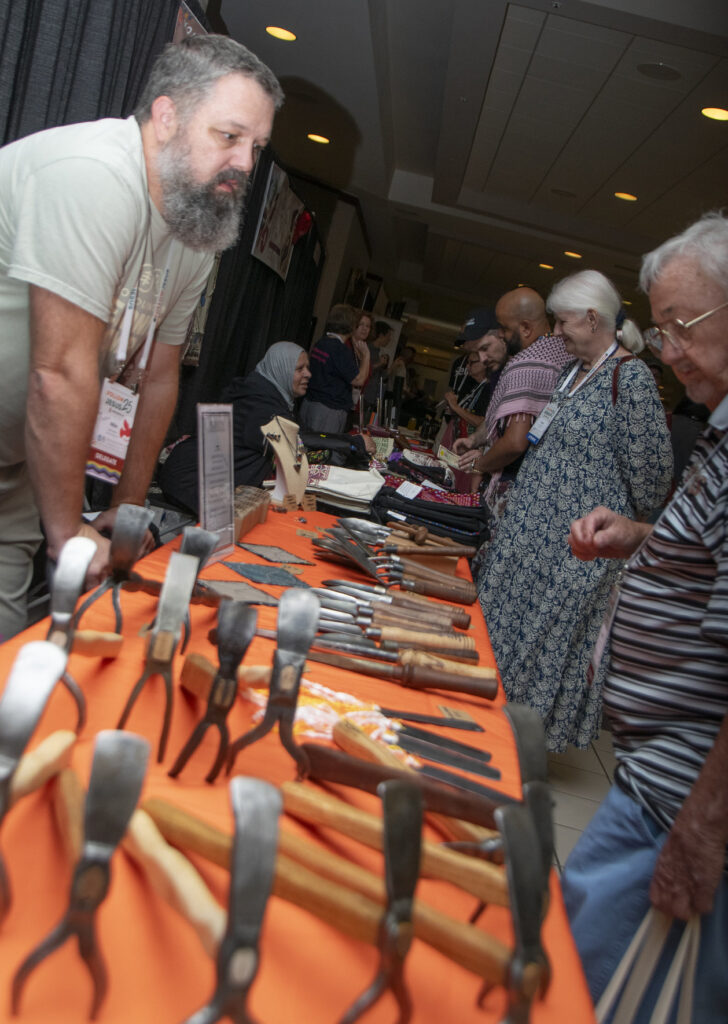
Because of school shootings, many young people don’t feel safe in schools. The U.S. Centers for Disease Control and Prevention reports guns are the leading cause of death for children under 18. RAWtools founder and executive director Mike Martin invited young people to help create solutions.
Gun violence isn’t just a gun problem or a person problem. It’s both, and it happens when someone in an escalated situation has access to a gun. RAWtools addresses the issue from both sides by teaching deescalation and conflict resolution while removing firearms from circulation.
A former youth pastor at Beth-El Mennonite Church in Colorado Springs, Martin came up with the idea for RAWtools while attending the 2011 MC USA convention in Pittsburgh.
Martin organizes drop-off events where unwanted guns can be exchanged for gift cards. It takes him about an hour to forge a gun into a garden spade or mattock.
In early 2024, 135 peace advocates were arrested for civil disobedience while singing hymns in a congressional office building in Washington. They were protesting the U.S.-funded war in Gaza, and they represented the growing Mennonite Action social movement.
Nick Martin and Reah Clymer said standing up against violence and oppression is something Mennonites have done for a long time.
“We think it’s so important to take action as Christians and as Mennonites to speak out against Christian nationalism,” Martin said, “because when Christians decide to speak out against harm that Christians are doing, we can actually undermine that harm.”
Hymn singing is essential to every Mennonite Action event. Singing familiar songs pulls people in because it feels comfortable. It also publicizes the group’s Mennonite identity.
“Being honest about who you are builds trust,” Martin said. “We’re hearing from folks that are walking into Mennonite churches around the country because they’ve seen Mennonite Action.”
In its less than two years of existence, the movement has grown to include over 30 local chapters in the U.S. and Canada and a mailing list of 10,000.
As participants left the Mennonite Action seminar, they were swept into a larger current of marchers already chanting down the hallway. Gathering in a large circle, the group followed Clymer in a song about the necessity for action:
“We resist, we refuse, to let hatred in. We rise up, we won’t back down. We’re in this ’til the end.”


Have a comment on this story? Write to the editors. Include your full name, city and state. Selected comments will be edited for publication in print or online.