



Question: What would you fight for? Answer: Nothing. Jesus said his followers would not fight, because his kingdom was not of this world (John 18:36). So, I literally won’t fight for anything, and using the word “fight” metaphorically often has dangerous connotations.
But I am passionate about peace. I felt that God called me to go to Vietnam in 1968 as a peacemaker during the war there, but I ran like Jonah. Finally, I bargained with God to allow me to attend seminary first so I could more clearly know the biblical basis for my beliefs. Peace is more than the absence of war.
I graduated from Associated (now Anabaptist) Mennonite Biblical Seminary in 1972 and arrived in Vietnam as a volunteer with Mennonite Central Committee that October. During my first week in Vietnam, I was asked to jot down ideas for my funeral in case I did not survive my three-year term.
Early in 1975, all U.S. citizens left Vietnam, except for me and a handful of others. Although vicious rumors created panic in many people, I continued to have peace in my heart because I knew God was not leaving Vietnam and that nothing could separate me from God’s love (Romans 8:38-39).
MCC affirmed my decision to stay. My family did, too. My Vietnamese friends supported my decision. Pessimistic friends told me, “You’ve been interested in our language and history, now stay and suffer with us through these days.” Optimistic friends said, “You need to stay and witness these historic days.”
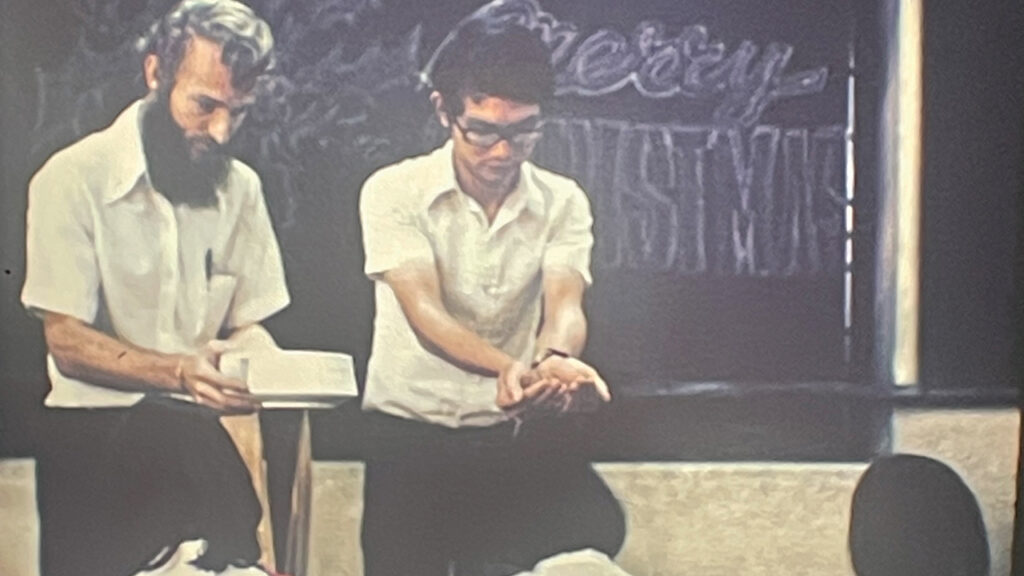
I stayed through the end of the war — the change of governments on April 30, 1975 — and the radical sociopolitical changes of the next year.

I returned to the United States in April 1976 even more convinced (if that is possible) that Christians must follow the way of peace and love as Jesus taught. Being bilingual in Vietnamese and English brought numerous opportunities to serve during the next decades.
With my wife, Ly, by my side, I pastored Vietnamese churches in the Dallas area for 20 years. I focused on peacemaking in my lifestyle and often in my sermons and Bible studies. To what extent I was successful is for someone else to decide, but I acknowledge that ambiguities plague peacemaking efforts.
For example, I had expected that my staying in Vietnam through the end of the war in 1975 would be a clear witness to my Christian pacifism. But in Vietnam, my friends said their friends thought the only reason I stayed was because I was part of the CIA (not true). In the United States, a neighbor told my mother, “They say he is a communist. Why else would he want to stay?” (Also not true.)
Right now, the gut-wrenching destruction, violent death and deliberate starvation in Gaza cry out for Christian peacemakers to seek creative ways to stop the tragedy. The initial triggers in that conflict were understandable but not justifiable. The war in Ukraine also needs to end. And the war in Sudan. And the injustice that Indigenous Nations and immigrants face in the United States. And the blatant lies and callous cruelty of the current U.S. administration.
All of these — and countless other terrible acts of injustice and violence — call for peacemakers to act.
If Jesus were telling the story of the Good Samaritan in the U.S. today, an undocumented immigrant might be the key character. What would you do if your family were in mortal peril due to violence or hunger, and fleeing to the U.S. looked like a beacon of hope?
Or consider the ambiguities of speaking for peace in Palestine. Supporting the Palestinians and calling for an end to the terrible bombing and the inhumane blockade of food and humanitarian assistance may be falsely interpreted as being antisemitic or supportive of Hamas. On the other hand, to empathize with Israelis who lost loved ones in the Hamas attack on Oct. 7, 2023, may appear to ignore the decades of Israel forcing Palestinians out of their homes to become refugees.

Where do I find hope?
In the Sermon on the Mount.
In the pages of Anabaptist World.
In the commitment of my nephew who went to North Dakota to stand with Indigenous people in protest of a pipeline.
In the courage of another nephew who teaches and preaches about peace.
In the older brother of those two nephews who asks insightful and challenging questions.
In Alexanderwohl Mennonite Church, my home congregation near Goessel, Kan.
In Episcopal Bishop Mariann Budde’s confrontation of the new president in January.
In the examples set by Martin Luther King Jr., Mother Teresa and Dirk Willems.
In the new pope’s refusal to acquiesce to the distorted values of Christian nationalism.
In the millions of people who participated in rallies like the “No Kings” demonstrations in June.
When I say, “Jesus is Lord,” it carries political overtones.
Peacemakers must follow the wise counsel of German theologian Karl Barth to “hold the Bible in one hand and the newspaper in the other.” Knowing the Bible and being aware of current events locally, nationally and internationally is crucial. Jesus said he did not come to save the so-called righteous but sinners who humbly acknowledge their need of a Savior.
A self-righteous president who holds up a Bible for a photo op (2020) contradicts that very Bible when he says, “I’m very greedy. . . . I love money” (2016). Jesus said, “Take care! Be on your guard against all kinds of greed” (Luke 12:15). The Bible warns that “the love of money is a root of all kinds of evil” (1 Timothy 6:10). Greed leads to injustice and violence.
Peacemaking is hard work. Every day we must choose whether to follow violent leaders or Jesus, the Prince of Peace, who said, “I have told you these things so that in me you may have peace. In this world you will have trouble. But take heart! I have overcome the world” (John 16:33, NIV).
James Klassen of Goessel, Kan., attends Alexanderwohl Mennonite Church. He still occasionally preaches in Vietnamese churches.


Have a comment on this story? Write to the editors. Include your full name, city and state. Selected comments will be edited for publication in print or online.