


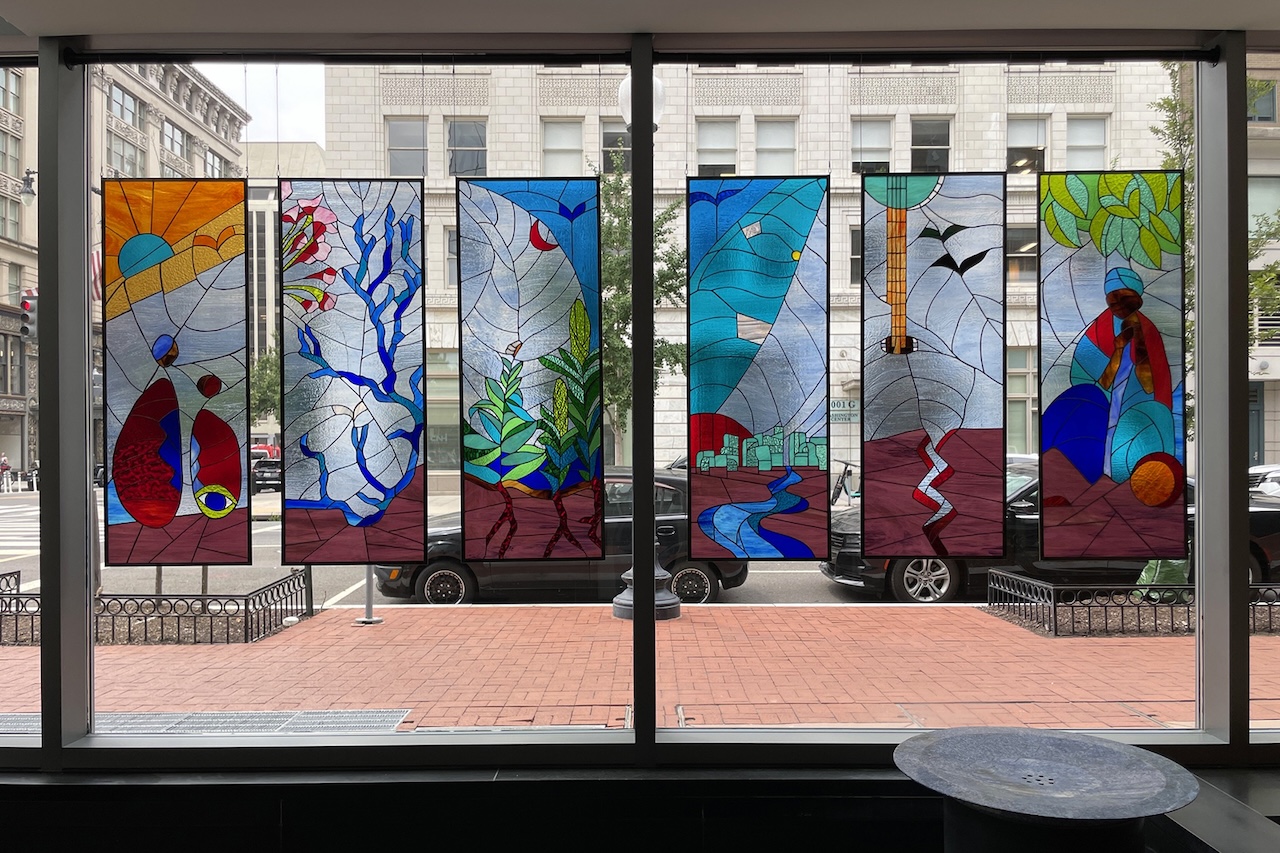
A predominantly white church that sought to learn about its racial history has now dedicated a memorial to the enslaved people who once worked on the building’s land in downtown Washington, D.C.
First Congregational United Church of Christ, which dates to 1865, dedicated six recently installed stained-glass panels, titled “Forever in the Path,” on Sept. 14.
A decade ago, the congregation began carefully studying its roots. Some members knew that the church’s founders were abolitionists and helped support the creation of Howard University, a historically Black institution in Washington. But when congregants marked the church’s 150th anniversary in 2015, Howard University School of Divinity professor Renee K. Harrison, the preacher for that occasion, challenged them to look deeper into its history, including into the former slave owners from whom the land was purchased.
Now, Harrison, who authored the book Black Hands, White House: Slave Labor and the Making of America, said the UCC church’s years-long initiative to investigate and share that history is “highly unusual” — especially as a predominantly white congregation.
“I think the most important thing is that a Christian institution, a white Christian institution, decided to celebrate the people that work the land — both the celebration of those that were there and those that are there,” Harrison said in an interview days before the dedication ceremony.
Kelly Brown Douglas, canon theologian of the Washington National Cathedral, said the use of stained glass can serve multiple purposes now, as it did in medieval times when windows were not merely decorative but told biblical stories to illiterate people who could not read the Bible for themselves.
“It’s important that these people are finding ways to bring the Black story into a sacred space,” she said upon learning of the project at First Congregational UCC. “What it’s saying is that this story is God’s story, and God’s story is found in this story. And these people, like any other people, are sacred.”
According to the DC UCC church, which describes itself as one of the city’s first racially integrated congregations, more than 40 people were enslaved by two families on its property, then a tobacco plantation, between 1750 and 1856.
In 2022, W. Antonio Austin, then a Howard doctoral student, researched the church’s history and in a report identified almost two dozen enslaved men, women and children who worked on the property owned by the Burnes family.
“Some of these individuals were enslaved by several generations of this family,” Austin wrote in his report, citing a document from the Maryland State Archives.
On All Souls Sunday in 2023, the church acknowledged the enslaved people, stating their names in a ceremony that featured candles, artifacts and blessings.
And in August, the stained-glass artwork, whose title evokes a portion of the last stanza of the Black national anthem “Lift Every Voice and Sing,” was installed. Jessica Valoris, a Washington-based artist who describes herself as being of “Black, Jewish and mixed ancestry,” has described the artwork as a means “to use commemoration as an invitation towards reparations, education, and communal reckoning.”
Harrison said the artist’s choice of stained-glass panels, which hang from a ceiling in front of clear windows, is fitting.
“In order for people to receive it, it has to be told with light,” said Harrison. “I think that there’s something about the sacredness of a story sharing light and needing light.”
Douglas, who is also a visiting theology professor at Harvard Divinity School and helped guide National Cathedral’s process that led to its new stained-glass windows, said the story First Congregational UCC is telling represents a process of reparations similar to that occurring in the Episcopal Diocese of Washington and among white churches in particular in that diocese, as well as in other regional Christian organizations and denominations.
“Anytime you say reparations, people think of money, but it’s about more than that,” she said. “It’s about planting the seed for a future so that we don’t find ourselves back in a predicament of having to talk about reparations. And one of the ways in which you do that is you change the narrative and you expand the narrative.”


Have a comment on this story? Write to the editors. Include your full name, city and state. Selected comments will be edited for publication in print or online.