


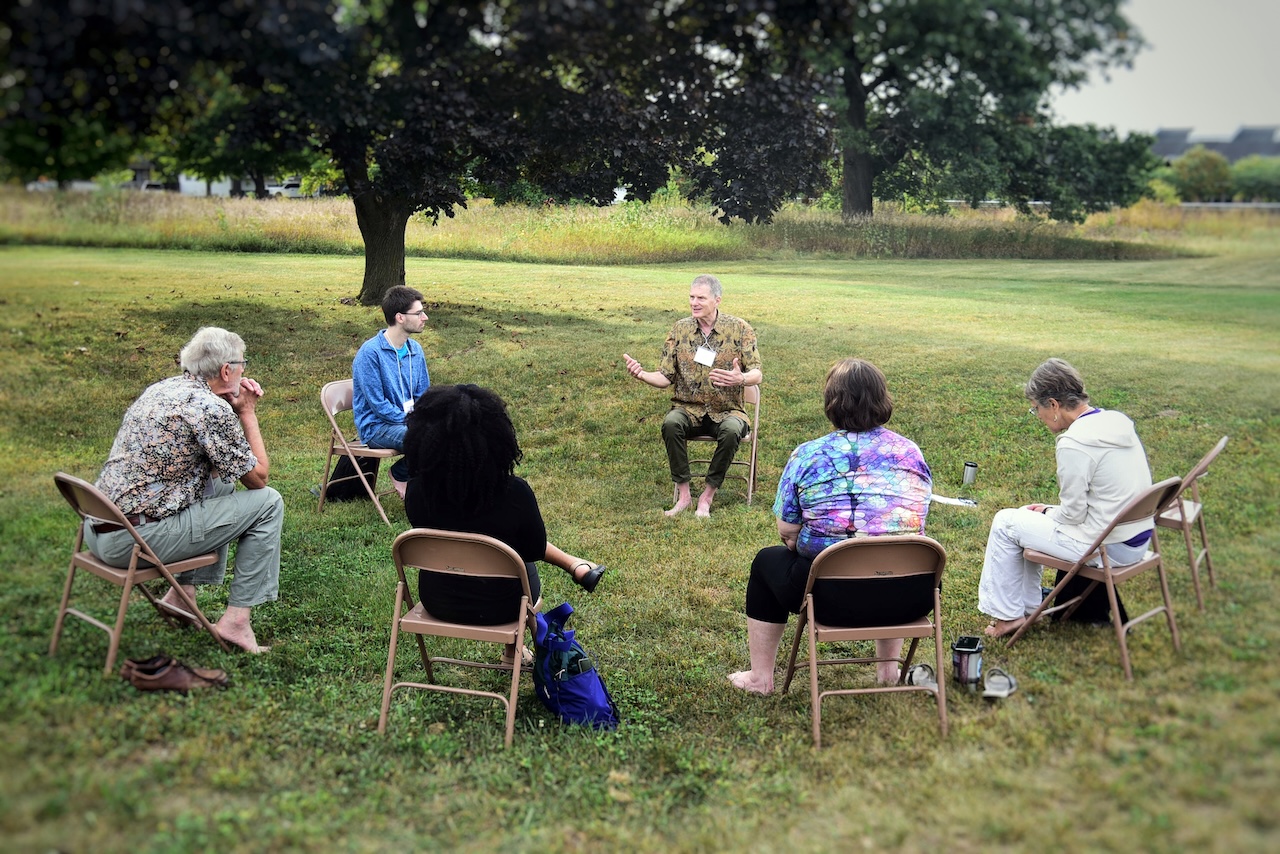
The Rooted and Grounded Conference on Land and Christian Discipleship explored kinship with all creation Sept. 18-20 at Anabaptist Mennonite Biblical Seminary.
“We recognized that one aspect of our environmental crisis is our failure to see the interconnections of all of creation,” said Janeen Bertsche Johnson, campus pastor and conference coordinator.
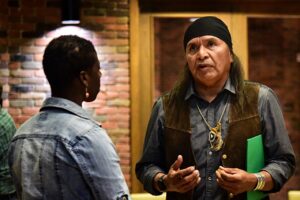
Keynote speakers Wendsler Nosie Sr., T. Wilson Dickinson and Douglas Day Kaufman called for a radical reimagining of community as the antidote to the colonization and exploitation that are at the root of today’s social and environmental crises.
Nosie is the founder and director of Apache Stronghold, an organization fighting to protect sacred sites like Oak Flat, and is professor of Apache studies at the American University of Sovereign Nations. He offered an Apache perspective on the current political and social moment.
Nosie said his ancestors narrowly survived annihilation in the 1800s. Even so, most of the elders were killed and the children were forced to assimilate in boarding schools.
“If anybody can evaluate this country the best,” Nosie said, “it’s us, because we’ve seen the transitions that have taken place that haven’t been good.”

Today, the land the Apaches depend on for physical and spiritual life is being contaminated and destroyed by a capitalist way of life that, Nosie said, is “not only killing people, it’s killing the land itself, and it’s going to kill all of us.”
In August, the 20-year legal battle to keep Oak Flat, or Chi’chil Biłdagoteel, out of the hands of the mining company Resolution Copper was once again prolonged when a federal appeals court temporarily blocked the land transfer while it reviews the case.
Instead of blaming White people for the devastation, Nosie turns to an Apache prophecy that foretold the return of an ancient evil force that had visited the continent once before. He believes that time is now.
Wilson Dickinson proposed sharing resources as an alternative to exploiting land and people. Wilson is director of the doctor of ministry and lay and continuing education programs at Lexington Theological Seminary. His talk drew from the book he is writing, Christ and the Commons: Transatlantic Theologies of Land, Labor and Liberation.
The early church in Acts 2 shared resources and cared for each other’s needs, eating and praying together.
“This ideal image of shared Christian life,” he said, “has often been a matter that has been marginalized.”
In today’s society where most resources, including land, are held by individuals, Dickinson said, “readers have often become so focused on the impossibility that all possessions could be held in common that they have looked past the power of the social practice of holding anything in common.”
In reality, many human societies throughout history have been structured around “commons” — land and other resources shared by community members. And congregations are already committed to the common good.
“This is where I think disciples who are interested in ecological and environmental justice should set up shop — where we should begin to be rooted and grounded,” he said. “These are the places where we experience a foretaste of the world that we both yearn and hope for, and these are the places where the power that we need is hiding in plain sight.”
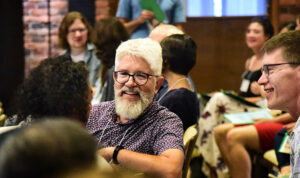
Douglas Day Kaufman, executive director of the Anabaptist Climate Collaborative, invited participants to consider an ecotheology in which God is alive and at work in all of creation.
The “Gospel of All Creatures,” taught by Hans Hut, a 16th-century Anabaptist theologian from Germany, is based on the idea that “Christ is not only present in the body of Jesus, nor only in the church, nor only in the Eucharist, nor only in humans, but in all creation,” Kaufman explained.
This has many implications for today’s social and ecological context.
“It connects Anabaptist theology more closely to the natural and social sciences and questions the dualism that is so often part of the Anabaptist tradition,” Kaufman said, and means all creatures — including humans — participate in the crucifixion of Christ by suffering and dying to self.
“The Gospel of All Creatures reminds us that God is at work,” Kaufman said, “even among the critters in the river bottom or the soil community of microbes, in worms and insects that are taking the death that is placed on the earth and resurrecting it into life. In fact, God might even be especially at work in these simple processes that bring life.”


Have a comment on this story? Write to the editors. Include your full name, city and state. Selected comments will be edited for publication in print or online.