


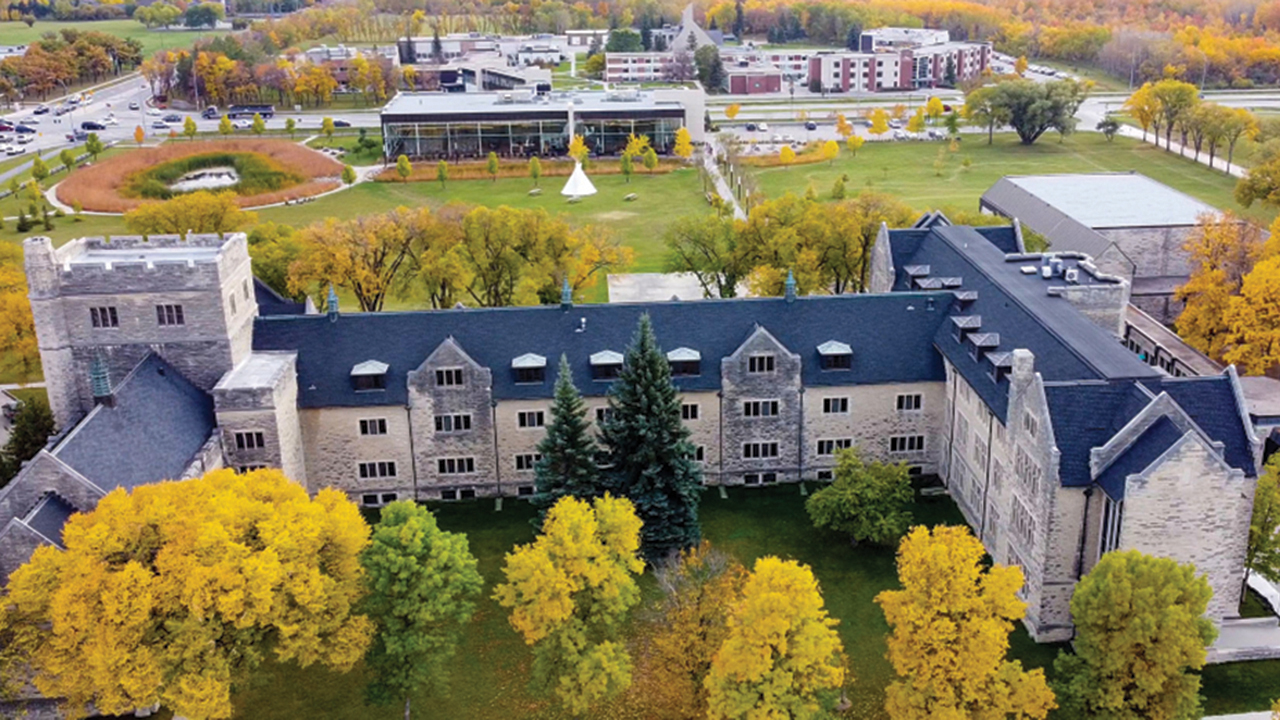
A mix of vision, necessity and desire for unity led the Mennonite Brethren Church of Manitoba and Mennonite Church Canada to merge their colleges in Winnipeg to create Canadian Mennonite University in 2000. And that spirit continues today.
Serious discussions about the merger of Canadian Mennonite Bible College, founded in 1947 to serve the General Conference of Mennonites in Canada, and Concord College, founded in 1944 as Mennonite Brethren Bible College, began about a decade earlier.
They were joined later by Menno Simons College, an independent institution founded in 1989 and associated with the University of Winnipeg.
At the time, all three colleges were facing uncertain futures with declining enrollments and fragile finances.
“It was embarrassing that we weren’t working together more closely as schools,” said Gerald Gerbrandt, who was president of CMBC. He noted Mennonites were known for cooperating in organizations like Mennonite Central Committee and Mennonite Economic Development Associates. “If Mennonites could do it to help others through aid work, why not also through higher education?”
A Memorandum of Understanding was signed in 1998. CMU was chartered the next year by the provincial government, with the ability to grant degrees in arts and theology.

The next question was location. Across the street from CMBC was the former Manitoba School for the Deaf, a historic structure owned by the province. The government sold it to CMU and provided a grant to renovate it.
“Getting the building for the new campus was critical to CMU’s success,” said Art DeFehr, who participated in merger discussions.
The provincial government also promised CMU an annual operating grant. It was $2.6 million that first year; it is $4.3 million a year now.
Menno Simons College became a program of CMU in 2003 and continues to offer conflict resolution courses.
While some thought a merger might be difficult due to theological differences, former Concord President John Unger said there were no significant concerns in either conference.
“We saw Mennonite Church Canada churches as spiritual cousins,” he said.
Gerbrandt agreed: “I am not aware of any point where theological differences between the two denominational groups became contentious.”
There were challenges. Gerbrandt noted Mennonite Brethren tended to focus more on evangelism, while MC Canada members were more mindful of social justice. But that wasn’t a problem for CMU.
“My goal was to merge the Mennonite Brethren emphasis on piety and evangelism with the Mennonite Church emphasis on social justice,” he said. “For me, one of the huge benefits of CMU was coming to appreciate an alternative way of emphasizing or viewing similar theological convictions.”
Gerbrandt kept copies of both denominations’ Confessions of Faith on his bookshelf, comparing them often.
“Seldom, if ever, did they directly clash with each other,” he said.
That doesn’t mean there weren’t practical issues to deal with, such as how students at CMBC used hymnals while Concord students sang off screens. But those were secondary challenges, amicably resolved.
Looking back, “there were some who didn’t give CMU a chance of succeeding,” Unger said. “But when I see what it is today, and I hear the testimonies from the students, I know why we did what we did.”
As CMU marks its 25th anniversary, it has 799 students studying toward degrees in arts, social work, business, communications, music, conflict resolution, music therapy and biblical and theological studies. An education degree is planned for 2026-27.
Thirty percent of students say they are Mennonite or Anabaptist — 15% Mennonite Church, 9% Mennonite Brethren and the remainder Hutterite, Evangelical Mennonite Conference, Evangelical Mennonite Mission Conference or another Anabaptist church.
Biblical and theological studies “continues to be at the heart of our education,” said CMU President Cheryl Pauls, “even if every student doesn’t do a full major in it as when we started in 2000.”
All students still have to take courses in BTS and Anabaptist studies. The university also continues to offer theology at the graduate level.
Support still comes from the two conferences, with MC Canada providing $180,000 annually and the Mennonite Brethren Church of Manitoba $32,000. Members from both groups serve on the board.



Have a comment on this story? Write to the editors. Include your full name, city and state. Selected comments will be edited for publication in print or online.