


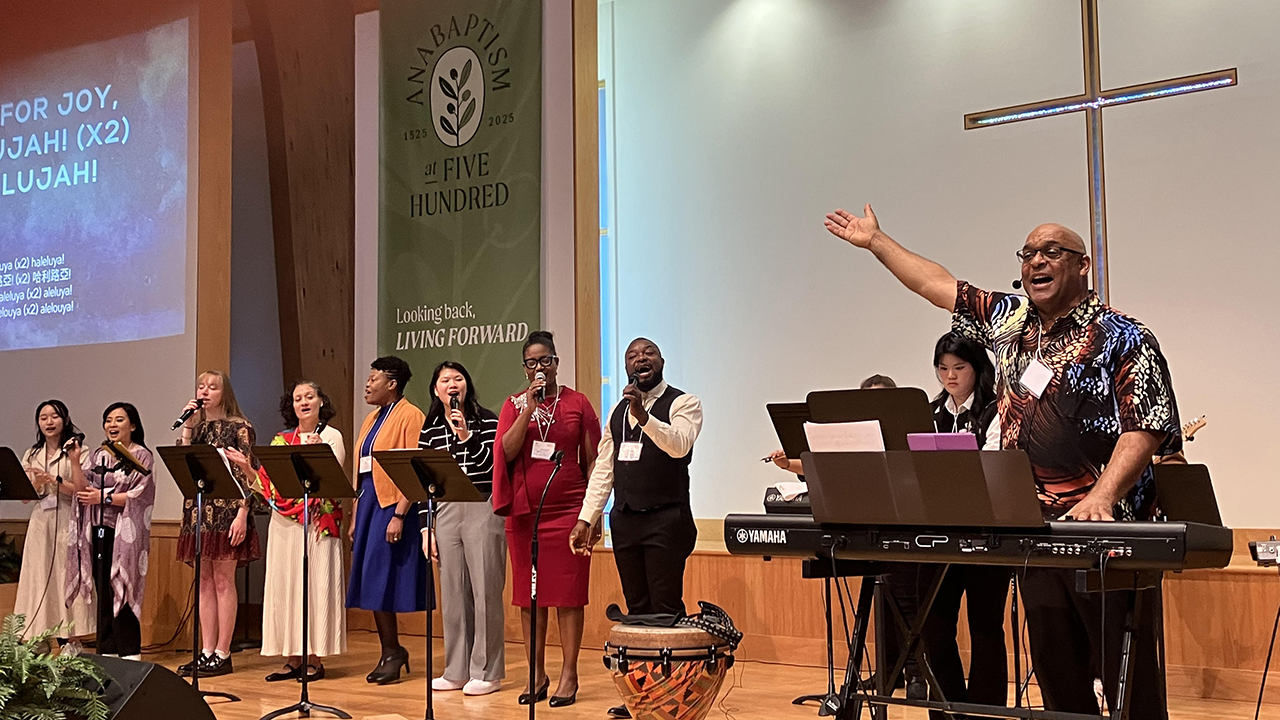
Mosaic Mennonite Conference delegates on Nov. 1 voted nearly 3-to-1 to leave Mennonite Church USA and to be a partner with it and other Anabaptists.
“This was a both/and vote: to discontinue membership and to build healthy, mutual partnerships,” said executive minister Stephen Kriss after the vote during Mosaic’s annual assembly at Souderton Mennonite Church in Pennsylvania. “The work for us will be to stay at the table, to maintain and extend those relationships further.”
Of the 165 delegates, 64% voted “green” (affirm the recommendation), and 10% voted “yellow” (yield to it). Both categories counted as yes votes, for a total of 74%, exceeding the two-thirds required for a bylaw change. Twenty-three percent voted “red” (no) and 3% abstained (counted as no).
The change takes effect Nov. 3.
The recommendation from the conference board says Mosaic will “cultivate healthy mutual partnerships with Mennonite Church USA, Mennonite World Conference and other Anabaptist communities.”
Mosaic becomes the second conference to spin off from MC USA and become independent. The first was LMC, formerly Lancaster Mennonite Conference, in 2017.
Four other conferences that have withdrawn since the creation of MC USA in 2002 — Franklin, Southeast, North Central and South Central — have merged into other entities or disbanded.
With about 7,500 members in 60 congregations, Mosaic was one of MC USA’s largest conferences. Based in Lansdale, Pa., it has members from coast to coast and international partners. About 40-50% are people of color, Kriss said.
Without Mosaic, MC USA membership is about 39,000. (The official number this summer was 46,329.)
Speaking to delegates before the vote, leaders expressed frustration with what they described as MC USA’s lack of responsiveness to Mosaic’s ideas for structural change and hopes for improved relationships.
“When we discussed intercultural dynamics that have been hurtful and condescending, we were met with dismissiveness, minimization and rigidity rather than creative reconciliation,” said moderator Angela Moyer Walter.
Roy Williams, assistant moderator of Mosaic and a former moderator of MC USA, said: “This has been a sad year, because MC USA is no longer what I helped put together in the late 1900s. . . . Now that they are in desperate need to update their structures, rather than working with us to find solutions, they chose to stick with their outdated structures. We can’t allow their rigidity and unwillingness to navigate the changing demographics of the church to negatively influence the health and life we find in Mosaic.”
MC USA did not send a representative to the meeting. Several delegates said they regretted the absence. Two who gave reports from their table groups noted that they had heard only Mosaic’s side of the story.
Two days before the meeting, MC USA moderator Marty Lehman and executive director Glen Guyton notified Mosaic that MC USA representatives had decided not to attend. In an email, they said that “select Executive Board members have been asked not to attend the conference gathering, a strong message that we are not welcome.”
Moyer Walter told the delegates that no one from MC USA was disinvited. Kriss told AW that an MC USA representative would have been welcome to speak at the meeting.
Lehman and Guyton wrote: “Given the tenor of recent communications, MC USA [Executive Board] members and staff do not feel confident that our participation would foster healthy or constructive engagement, particularly in a forum where differing accounts cannot be discussed openly.”
They disputed Mosaic leaders’ description of interactions with MC USA. “We do not believe the narrative from Mosaic Mennonite Conference leaders is accurate or aligned with the conversations we have had,” they wrote. They called the situation “disheartening and demoralizing.”
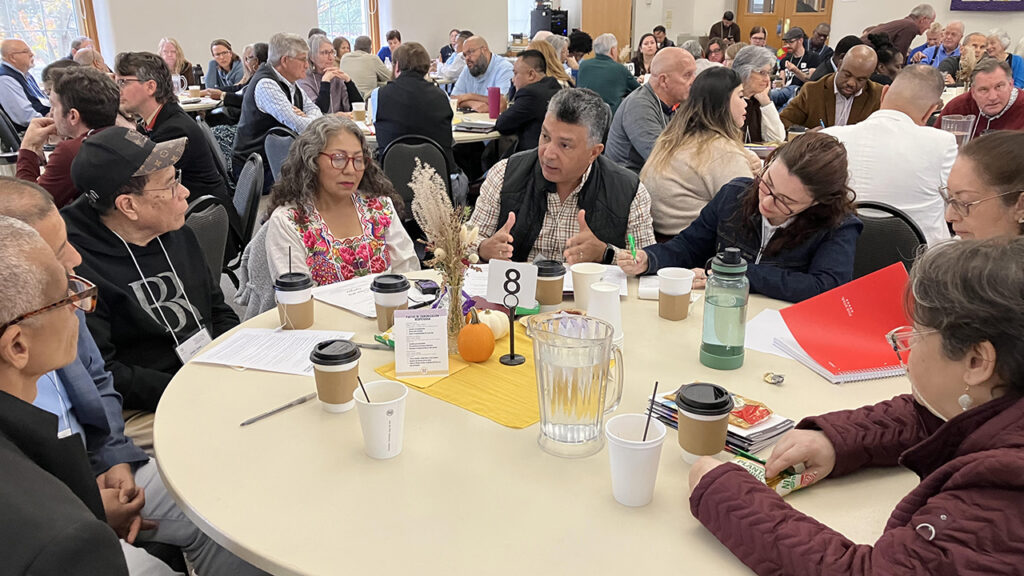
In interviews, several delegates spoke of pain and sadness over division and damaged relationships.
“It breaks my heart that there cannot be dialogue and mediation between these two groups,” said Sarah Bergin of Hatfield, Pa. “We are Anabaptists and should be working together. I really believe we need to be together as a unit. Division is never good.”
Josh Landis of Zion Mennonite Church in Souderton said he loved the MC USA convention this summer and wanted to stay with the denomination.
“I have relationships throughout the denomination that are important to me,” he said. “I would rather be part of the conversation about structures and what our future might be, particularly in our global witness.”
Andrew Zetts, associate pastor of Salford Mennonite Church, said his congregation included people with a wide range of views about MC USA affiliation.
“For those with strong relationships in Mennonite Church USA, it’s a feeling like they’re divorcing their family or severing relationships,” he said. “For others, MC USA has never felt like home, especially around cultural issues, and we want to take that seriously. How do we weigh both things together?”
Before the vote, Dave Moyer of Souderton said he expected any decision would lead to the loss of congregations that disagree with it. “Regardless of how the vote goes, congregations will leave on either side,” he said.
Several delegates estimated about 10 congregations would want to stay connected with MC USA. Congregations have options: 1) leave Mosaic and join an MC USA conference; 2) remain in Mosaic and join an MC USA conference too; 3) participate in MC USA events and support its ministries without being a member.
Marisa Smucker, executive director of Mennonite Mission Network, told AW her agency works with nonmember partners, including LMC.
“We are the outreach arm of MC USA,” she said. “We’ve partnered for years with people outside of MC USA, and we can continue to do that.”
Delegates who supported the recommendation to leave MC USA cited agreement with Mosaic leaders’ direction and a desire to resolve matters between Mosaic and MC USA.
Beny Krisbianto, pastor of Nations Worship Center in Philadelphia, said “it takes two to dance” and MC USA hadn’t stepped up.
“This process has been long, and every time we discuss, it sucks the energy and prevents talking about our mission,” he said. “We will not be enemies with MC USA, but we will work together to explore something new, to work together in new ways.”
Delegates who reported from their table groups offered words of conciliation and hope.
Tomás Ramirez, pastor of Iglesia Menonita Luz y Vida in Orlando, Fla., speaking in Spanish with a translator, compared the situation to the Apostle Paul separating from Barnabas and John Mark in the Book of Acts.
“They didn’t separate to fight,” he said. “Paul went to preach with another disciple, and John Mark went to preach with another one. We believe that Mosaic will continue preaching.”
Jeff Wright, pastor of Blooming Glen Mennonite Church, said his table group talked about “not wanting to polarize but to find new ways of relating in the future. We see dysfunction in both conference and denomination. We wonder where we need to continue to forbear with one another. We wonder about calling new pastors who may have differing views over issues around LGBTQ inclusion.”
Sonya Stauffer Kurtz, pastor of Zion Mennonite Church in Souderton, said people at her table had felt sad at different times in recent years, including after MC USA’s 2022 special assembly when delegates approved an LGBTQ-affirming resolution. She said people at her table felt the recommendation to relate differently to MC USA was a movement of the Holy Spirit.
Mike Derstine of Plains Mennonite Church in Hatfield said his table group was saddened by the conflict and was “hoping we can all get together again at some grand point in the future.”
At last year’s assembly, delegates extended Mosaic’s two-year discernment process about affiliation for a third year to explore ideas for a partnership with MC USA, either as a member or not.
This year, Mosaic received three new member congregations. Two transferred from South Central Mennonite Conference, which withdrew from MC USA in 2023 and joined LMC in 2024. They are Iglesia Menonita del Cordero (Mennonite Church of the Lamb) of Brownsville, Texas, and Iglesia Fuente de Agua Viva (Fountain of Living Water Church) in Los Fresnos, Texas. The third is Redemption Church of Bristol, Pa.
Responding to AW’s request for comment after the meeting, Guyton wrote: “While this step marks a change in our structural relationship, Mennonite Church USA will continue to embody community, reconciliation and the good news of God’s mercy. As our formal affiliation concludes, MC USA remains open to new forms of shared witness when possible.
“As Mennonite Church USA, we commit ourselves to our mission: to nurture diverse congregations, to invest in leadership, and to equip the church for the future, knowing that the body of Christ is wider than any one organization. We pray for Mosaic’s leadership and congregations as they navigate this transition, for clarity, peace and flourishing ahead.
“For our part, we will continue to learn from this process, to reflect on the concerns raised, to strengthen our structures and culture, and to move forward with rising hope and creativity.”


Have a comment on this story? Write to the editors. Include your full name, city and state. Selected comments will be edited for publication in print or online.