



In 2525, Mennonites will celebrate having helped prodigal Christianity return to the Jewish faith of Jesus. Such courage will have required the same audacious mettle shown by the first Anabaptists in Zurich 1,000 years earlier when they broke from 12 centuries of Christian nationalisms in various forms.
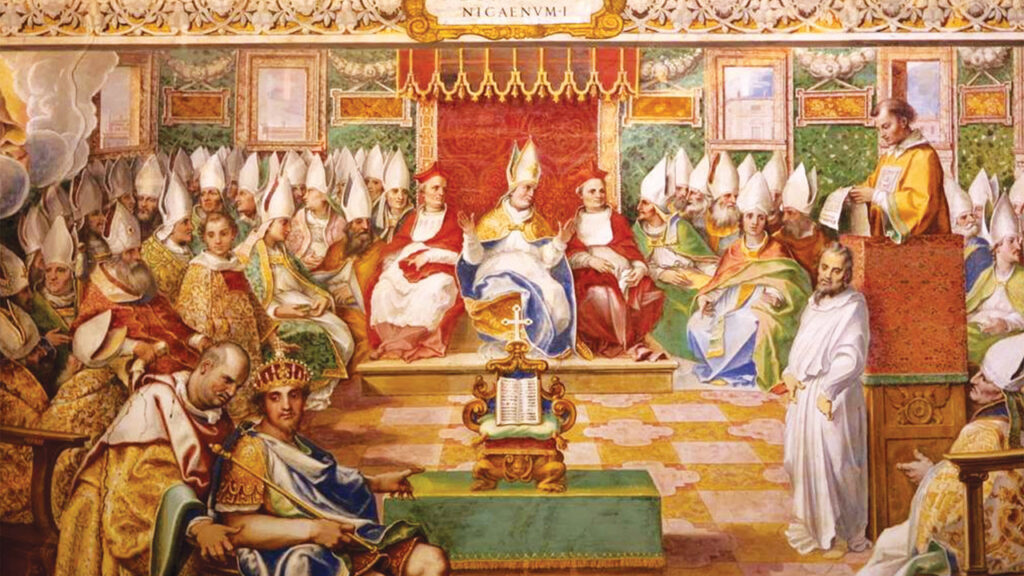
We rightly honor those early Anabaptists for escaping state-sanctioned coercion of belief and practice at the hands of Catholic, Lutheran and Reformed authorities. Why, then, would we not also honor these imagined 26th-century Mennonites for challenging the doctrinal framework coerced into existence by Emperor Constantine in 325 CE at the Council of Nicaea — an event that cemented the schism between Jews and Jesus-followers?
Constantine wished to compel unity upon the fractious Christian communities of late antiquity and upon the squabbles among the bishops of his empire. The struggle for orthodox conformity was real and brutal. The debate — and this is no exaggeration — hinged on the Greek letter “i” (iota) in defining exactly how the divine nature of Jesus was to be understood.
More followers of Jesus than ever before — including many Jewish followers of Christ for the previous 300 years — were killed by this newly professed Christian Empire for disagreeing with the Council’s conclusions.
Clearly, Constantine, with the support of his Bishop Augustine of Hippo, would agree with the later English expression that “not one iota of difference” would be tolerated when it came to defining Jesus as both fully human and fully divine or to the unity of the Empire’s Church. Never mind that 125 years later another council (Chalcedon) had to be called to further narrow the definition.
In truth, when pressed, most confessional assertions and creeds dissolve in claims of “mystery” and “paradox” as a final resort to what have always been tough calls. By logic and precedent, then, our many and varied responses over time should be one of gracious orthodoxy at minimum, certainly not excommunication or extermination.

From Nicaea’s coercive foundation flowed centuries of Christian nationalism, supersessionism (the belief that Christians replaced Jews as God’s people) and antisemitism — tragic consequences of defining Jesus against Judaism rather than within it.
The political consequences and fate that the early Anabaptists faced many years later looked much like that of the “heretics” so defined at Nicaea. The Martyrs Mirror of 1660 dutifully describes these early martyrs as forerunners in faith of early Anabaptists, who would also be executed as apostates for refusing the orthodoxies of their time.
Anabaptism was never simply a radical move to the left of the Catholic-Protestant state-church continuum. It ruptured the entire coercive enterprise of state control over faith, conscience and civic life. It grounded itself in a simple commitment: Follow Jesus as revealed through his readings of the Torah (the first five books of the Hebrew scriptures) and as recorded in the Newer Testament, come what may.
Anabaptists insisted on soul freedom, Bible freedom, church freedom and religious freedom. Some even published works by the so-called Jewish heretic Spinoza, arguing that the right of dissent — even of unbelief — was essential for “rightly dividing the word of truth.” Without hearing the alternatives, how could one discern truth at all?
Anabaptist advocacy for voluntary noncoerced faith helped seed theological and political pluralism, tolerance and diversity — hallmarks of the Western democratic experiment. Truly, they were ahead of their time.
Two and a half centuries before religious liberty or the separation of church and state was enshrined in any Western democracy’s constitution, Anabaptists proclaimed these freedoms as self-evidently biblical. Their public adult baptism on Jan. 25, 1525 — the first since New Testament times — functioned as an emancipation proclamation, bought with the blood of its martyrs.
Given this history, it is unsurprising that our 500-year commemorations emphasized the revolutionary nature of religious freedom. There is indeed much to celebrate in freedom from state-church and church-led coercion and in the right to interpret scripture for oneself and within a voluntary community.
But during these celebrations, we have rarely asked a more uncomfortable question: If Christendom required such radical reform five centuries ago, why did Anabaptists so readily accept the 1,700-year-old doctrinal framework produced by the Nicene Creed, whose anniversary many Christians celebrated this year as well?
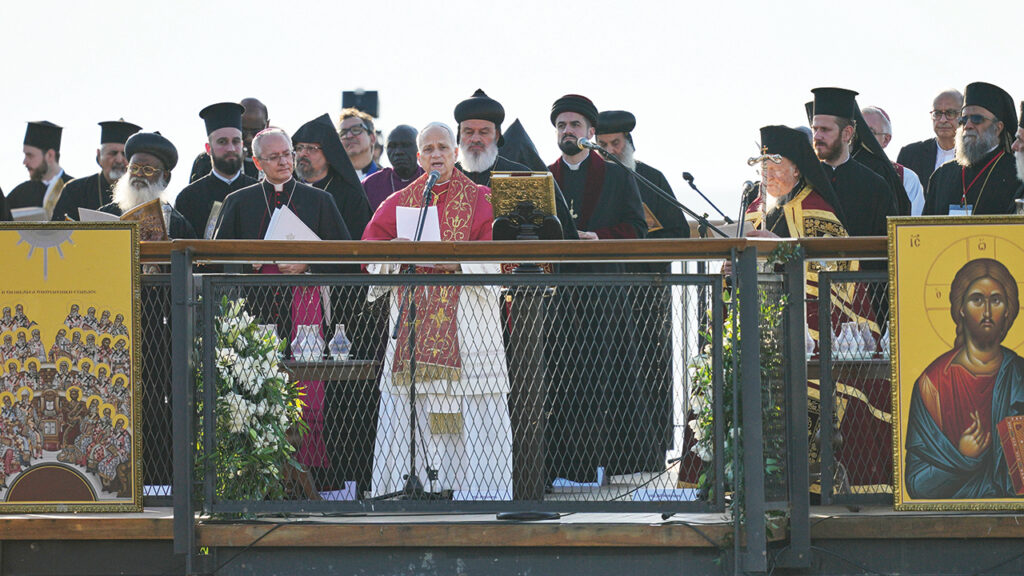
Pope Leo, in recent comments honoring the anniversary of the Nicene Creed, noted its responsibility for the rift between Eastern Orthodox and Roman Catholic churches and expressed his hope for a future unity among these ancient Christian traditions. For my part, I hope the same might be said for the breach between the Christian and Jewish faithful.
“We must leave behind theological controversies that have lost their raison d’etre,” he said, “in order to develop a common understanding and, even more, a common prayer to the Holy Spirit, so that the Spirit may gather us all together in one faith and one love.”
Despite Anabaptists’ insistence on being non-creedal, Nicene formulations about the supposed exact nature of Jesus’ divinity appear nearly verbatim throughout Mennonite confessions of faith.
Why do we police our theology according to a fourth-century coerced imperial settlement? Why have we so seldom explored the vibrant, theologically diverse first three centuries of Jesus-following communities before Constantine’s Nicaea imposed its brutal forced consensus?
Jesus’ core teachings did not break fundamentally with Jewish tradition. Scholars are challenging long-held assumptions about a parting of the ways between Jews and Christians.
For at least four centuries, Jesus-following Jews remained simply Jews. What we now call Christianity was largely the result of political coercion and doctrinal standardization under Constantine. He ruthlessly suppressed alternative understandings of Jesus’ identity and the meaning of the Torah to instigate a great schism that need not have happened.
Anabaptists once risked their lives for the freedom to rethink what Christianity could be. We might yet do so again.
Perhaps the next act of Anabaptist courage is to take up the cross of Jesus the Jew and return to his faith tradition, which itself has evolved to welcome prodigal Christians seeking to come home.
Anabaptists are uniquely positioned to lead such a return and to seek reconciliation with our Jewish siblings of faith.
First, Mennonites emphasize the humanity, teachings and ethical life of Jesus within the context of a covenantal community. Our focus on the Sermon on the Mount and efforts to care for the poor and oppressed align with Jewish traditions that prize concrete obedience to God’s way.
Both communities value orthopraxy (right action) over abstract doctrinal speculation. The early Jewish-Christian movement led by James, the brother of Jesus, practiced this alignment for well over 400 years: an ethical life was the expression of trust in Christ. It may be time for Gentile Christians, shaped heavily by Paul, to reengage this more Jewish grounding of the Jesus movement if true reconciliation is to occur.
Second, Mennonites prioritize community, shared commitment and mutual responsibility — a pattern deeply consonant with Jewish communal identity. Our witness of nonviolence and justice echoes the prophetic vision of shalom and the Jewish calling to tikun olam (repair of the world).
Third, Mennonites have a deep wariness of creeds and a historical suspicion of rigid doctrinal precision. This hesitancy leaves room for understandings of Jesus’ divine presence that resemble the rich diversity of early Jewish-Christian thought more than Nicaea’s mimicking of the imperial hierarchical dogmas of Rome, with its divine rulers and incarnational gods.
The upside-down Spirit-filled reign of Jesus of Nazareth claimed by Mennonites invites Constantinian-influenced Christians to retrieve Jewish ways of speaking of God’s presence — in, with, above and through creation. In this way, Jesus’ divinity is disclosed in his life, witness and storytelling, a profoundly Jewish mode of divine self-revelation.
Fourth, Mennonites have often been accused of “works righteousness,” a charge parallel to the caricature of Judaism as legalistic or graceless. Yet both traditions understand obedience as a response to covenantal relationship, not an attempt to earn God’s favor.
Law, for both communities, is experienced as grace when it protects the vulnerable, safeguards the poor, rescues the immigrant and frees the imprisoned. Both communities know what it means to be persecuted minorities, suffering exile, exclusion and martyrdom at the hands of dominant Christian authorities who justified a cheapened grace to excuse their treacheries.
Jesus summarized the Torah and the Prophets with two Torah commandments: Love God and love your neighbor. How simple a creed is that? Mennonites and Jews share a profound ethical core, a costly faithfulness, over and above abstract doctrines.
Standing together, we might also offer a renewed witness against the idolatries of religious nationalism — whether “Christian” America, “Jewish” Israel or any other ethno-religious nation that confuses its flag and imperial power with God’s design for human flourishing.
In this emerging future, Mennonites could once again be pioneers — this time not simply in the cause of religious liberty but in the healing of Christianity’s relationship to its Jewish roots. In this emerging future, Mennonites could lead the way to a deeper oneness under God among all faiths. In this emerging future, Mennonites could remind others that Jesus never argued for his own supremacy. Nor need we.
Such a future may require the same courage shown in Zurich in 1525. But if prodigal Christians are ever to return to the household of Jesus’ own faith, who better to lead the way than those who once risked everything simply to follow him?
James E. Brenneman is president and professor of biblical studies at Berkeley School of Theology in California. A longtime professor of Hebrew Bible and an ordained Mennonite minister, he is a former president of Goshen College.


Have a comment on this story? Write to the editors. Include your full name, city and state. Selected comments will be edited for publication in print or online.