


A learning tour in Guatemala and El Salvador reshaped assumptions about who gives and who receives in global church relationships.
The CASAS study and service program of the SEMILLA Latin American Anabaptist Seminary organized the tour.
Participants visited churches and organizations shaped by SEMILLA’s theological and pastoral training.
An encounter of unexpected solidarity left a lasting impression.
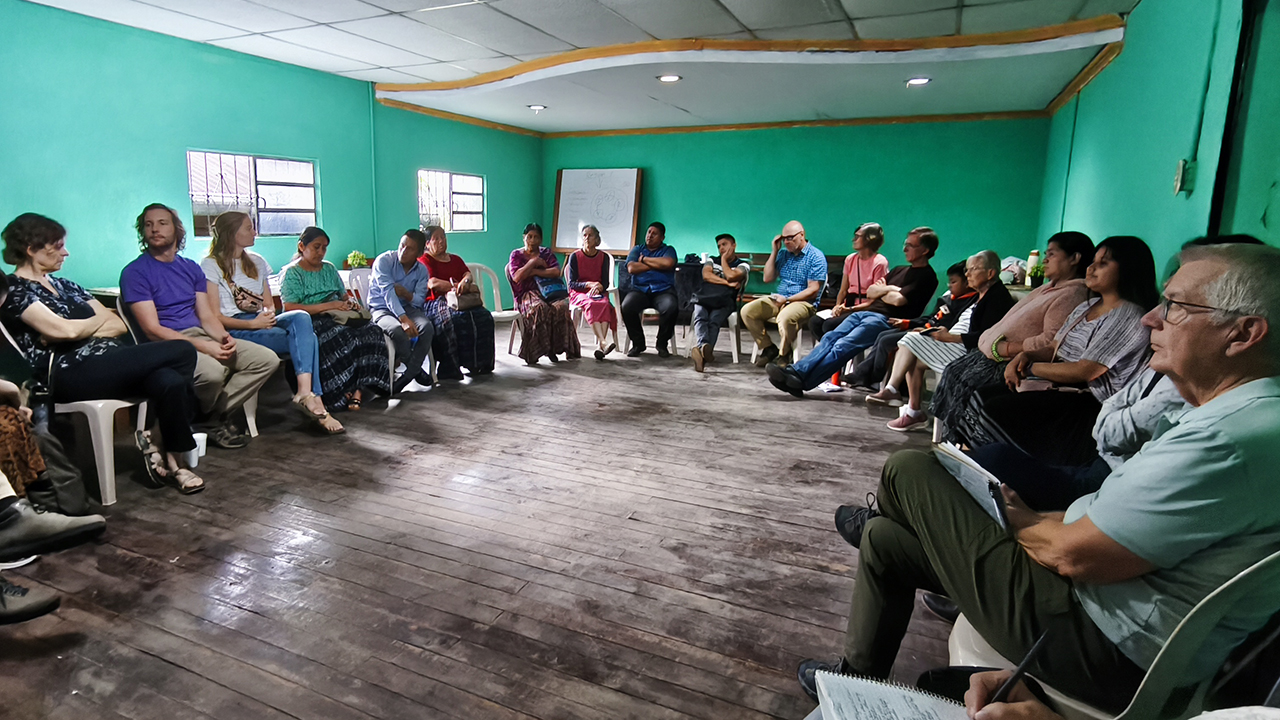
Five conference pastors and leaders from K’ekchi’ Mennonite Conference met the group Oct. 16 at the conference headquarters in Alta Verapas, Guatemala, to share about their journeys as SEMILLA students and the realities facing their congregations.
They talked about poverty, inequality, corruption, environmental degradation, marginalization and lack of access to basic resources and services, migration and the increasing size of urban hubs.
SEMILLA ambassador Karla Cuca said the tone shifted when one of the leaders, Gerardo Cabnal, gently interrupted and said: “We also want to ask you questions. We also want to learn.”
The North Americans began to speak about their own churches’ struggles: declining membership, polarization over political and social issues, and the challenge of integrating faith meaningfully into everyday life.
Bill Christenson of Foothills Mennonite Church, in Calgary, Alberta, said the sharing revealed a cultural gap.
“Our churches are so influenced by secular culture,” he said. “It took a bit of understanding on their part to see that the church isn’t at the center of the culture.”
What followed surprised many in the group.
“Immediately,” said Cuca, “the pastors responded with compassion. ‘We will pray for you,’ they said. And then they went further.”
The K’ekchi’ leaders pledged a week of fasting and prayer for the unity of churches in North America. For tour participants, the gesture was moving.
“We were the well-off Westerners, and they had many problems, yet they were the ones to pray for us,” said David Janzen of Valleyview Mennonite Church in London, Ont.
The moment of mutual vulnerability and care has continued to resonate. For some participants, it has prompted questions about how relationships between North Americans and Central Americans might move beyond one-directional service or learning.
Christenson wondered what it would mean to pursue relationships marked by reciprocity and longevity.
“What would it look like to connect more deeply than we have in the past?” he asked. “Rather than sending our youth simply to have a cultural experience, what would it look like to actually build mutual and long-term connections?”
Danika Gingerich is Mennonite Church Canada liaison for Guatemala.


Have a comment on this story? Write to the editors. Include your full name, city and state. Selected comments will be edited for publication in print or online.