



A few years ago, I stood on the eastern road of Jerusalem (from Bethany/Bethphage), witnessing the expanse of the city. This is the road where Jesus was praised by many people. From this road, Jesus also wept over Jerusalem because of the destruction the city would experience (Luke 19:41–44). This event took place on Palm Sunday, when the crowd welcomed him with palm branches and spread their cloaks on the road, shouting “Hosanna!” as he rode a young donkey as a peaceful king.
One reflection I had while standing on that Jerusalem road was how the crowd acted together to welcome Jesus. John F. Kennedy once said, “Ask not what your country can do for you, ask what you can do for your country.” This statement reflects a spirit of sacrifice and responsibility.
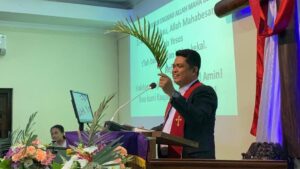
In the life of faith, this principle is also relevant. We should not only ask what God gives us, but also what we can give to God. Giving comes from a willing heart. Many people are able to give, but not all do so with joy. The Palm Sunday celebration at my Javanese Mennonite church reminds us that giving is a response of faith to God’s love that we have first received. Here are some reflections.
1. Inner initiative
Mark 11:2-3 says, “Go into the village ahead of you. As soon as you enter it, you will find a young donkey tied there, which no one has ever ridden. Untie it and bring it here. If anyone asks you, ‘Why are you doing this?’ say, ‘The Lord needs it and will send it back here shortly.’” What is interesting is that the owner of the donkey did not refuse. He was willing to give what he had for God’s use. Even an ordinary donkey became a tool to fulfill God’s plan. This teaches us that God does not always ask for great things. He often uses simple ones. Giving is not only about money. God also needs our time, energy, thoughts and even our whole lives for his glory.
2. The obedience of the disciples
The disciples obeyed Jesus’ command, even though it was risky. Seeing that the donkey had no saddle, they took the initiative to place their cloaks on it. Their awareness and initiative reflect sincere and willing hearts. This is a picture of active faith not only waiting for instructions, but being sensitive to needs and acting voluntarily. Giving is not only about what is asked, but also what we can do without being asked. Like the widow of Zarephath (1 Kings 17:10–13), we can give even in lack, but with faith. God values a willing and obedient heart.
3. Everyone can give
Mark 11:8 tells that many people spread their cloaks on the road, while others cut branches to welcome him. Each person gave in their own way. This shows that everyone can give according to their ability. What matters most is their willingness and involvement. In today’s church, giving can take many forms: offering our energy for ministry, giving financial support, dedicating time to serve others and showing care to those in need. Giving is a shared calling, not just for a few individuals.

4. Simple things for noble things
In the story of the triumphal entry, God used two simple things: a donkey and palm branches. Palm branches symbolize victory, joy and life, while the donkey symbolizes humility and simplicity. Why did Jesus not choose a warhorse like the kings of the earth? Because he came not with arrogance, but with gentleness. In the Old Testament, God used a donkey to rebuke Balaam, Samson used a donkey’s jawbone to defeat enemies and Zechariah 9:9 prophesied a king coming on a donkey. This means God can use simple things for great purposes. If God can use a donkey and palm branches, what about our lives?
5. Jesus, the ultimate example of giving
Palm Sunday is often understood as the celebration of welcoming Jesus as king. People rejoiced, waved palm branches and spread their cloaks. However, Palm Sunday is not only about how people welcomed Jesus, but about how Jesus first gave himself. Jesus came not as a king to be served, but as a king who gives: giving life, love and salvation. Amid the celebration, Jesus knew his path would lead to the cross because of his great love for humanity. The essence of Christ’s example is giving not because it is easy, but because of love.



Have a comment on this story? Write to the editors. Include your full name, city and state. Selected comments will be edited for publication in print or online.