


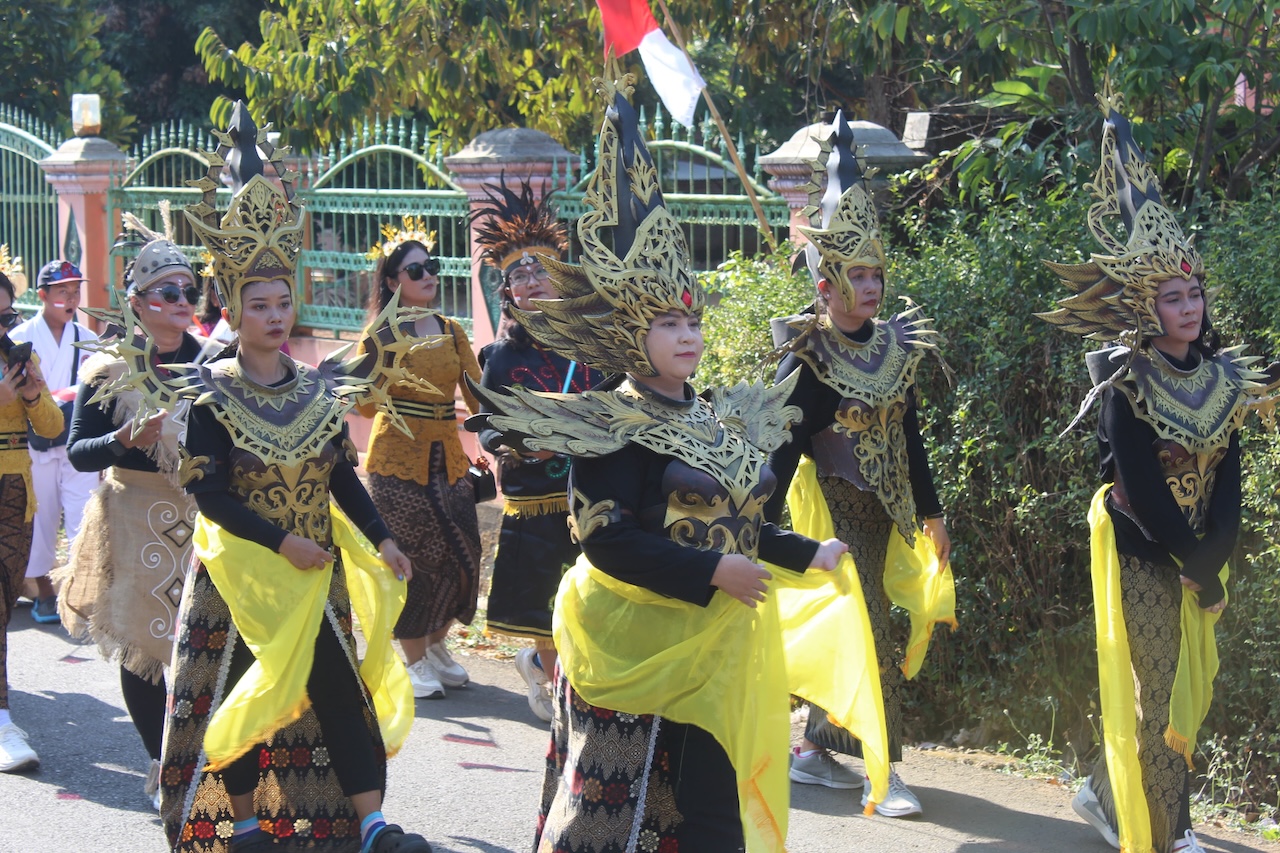
Every August, villages across Indonesia suddenly come alive with communal cooperation (gotong royong). House fences receive a fresh coat of paint, red-and-white national flags and colorful banners flutter along streets and neighbors organize traditional games and neighborhood arts stages. This joyful atmosphere is a familiar sight as communities gather to mark Independence Day.
From what I understand, many Mennonite brothers and sisters in North America view national independence celebrations with a critical eye. Nationalism is often seen as carrying the risk of entangling believers in compromises with militarism, state violence and political idolatry, blurring the clear boundary between loyalty to the Kingdom of God and allegiance to the nation state. In Indonesia, however, particularly within the Javanese Mennonite Church (GITJ), the narrative takes a different turn.
For a local Anabaptist community living as a minority in a multicultural nation with the world’s largest Muslim population, Independence Day celebrations are transformed into a stage for public witness and reinterpreted theologically to reaffirm the church’s commitment to peace, justice and interfaith fellowship.
Here are five meaningful ways Mennonite churches in Java creatively and theologically engage with Independence Day.
1. Celebrating togetherness through practical action
Independence Day serves as an ideal opportunity to practice deep-rooted local wisdom, specifically gotong royong (joint community work). Leading up to the national holiday, residents of all religious, ethnic and social backgrounds take to the streets together to clean the neighborhood, paint gutters and beautify public spaces. Mennonite churches actively encourage their congregations to participate in these workdays as a tangible expression of faith. This shared labor becomes a concrete and inclusive space for interfaith dialogue, melting away exclusive boundaries between majority and minority groups so that “you” and “I” become a collective “we” caring for a shared home.
2. Celebrating playfulness as a space for peace
One of the most distinctive features of Indonesian Independence Day is the array of lighthearted neighborhood games. These are not intense athletic competitions; they are festive activities designed to provoke laughter, such as tug-of-war, sack races, eating crackers hanging from a string while blindfolded or soccer matches where men wear traditional sarongs or house dresses. Many Mennonite congregations embrace these festivities. For instance, the GITJ Banyutowo congregation organizes the traditional panjat pinang (climbing a greased nut-palm trunk), where teams must work together to reach prizes tied at the top. Meanwhile, GITJ Kedungpenjalin hosts a cultural carnival featuring colorful traditional attire. This playfulness offers a genuine pathway to peace. The true antidote to violence is not rigid doctrine, but creativity and joy capable of thawing frozen relationships among neighbors.

3. Living out public spirituality through interfaith encounters
On the eve of August 17, communities across rural villages host an evening gathering known as tirakatan (a night of prayer and reflection). Neighbors in local residential blocks sit together humbly on mats laid out on village streets. At the center of the gathering sits tumpeng, a cone-shaped mound of yellow rice surrounded by a variety of side dishes like chicken, eggs, and vegetables. The tumpeng carries deep symbolic meaning: its upward cone points to a God-centered life, while the diverse side dishes represent societal plurality. As people of different faiths sit together around the dish, communal equality is reaffirmed. During tirakatan, everyone prays according to their own faith tradition for safety, harmony and mutual well-being. For Mennonite churches, this is public spirituality in action, where prayer and community naturally converge amidst pluralism.
4. Affirming the peaceful political theology of a kingdom community
Nearly all GITJ congregations hold a special Independence Day Thanksgiving service, providing a dedicated space to echo and reflect on Anabaptist political theology. Living as a minority group in Indonesia shapes how Mennonite churches understand their calling as a community of the Kingdom of God in the world. Two central theological themes emerge in our service at GITJ Jepara: participation and transformation. The church is called to actively participate in God’s saving work by engaging with social and humanitarian issues. Though small in number, congregations are invited to embrace their role as salt and light, transforming their social environment by bringing Kingdom values, upholding justice and extending Christ’s unconditional love to all people.
5. Expressing freedom to serve
Freedom must go beyond the historical nostalgia of “freedom from” Dutch colonialism. True freedom must be lived as a calling of faith toward “freedom to” serve others, as written in Galatians 5:13. This calling manifests in social action that directly benefits the broader public. The GITJ Kedungpenjalin congregation, for example, offers free healthcare service for the people around the church. Similarly, youth from GITJ’s Western District (spanning roughly 20 congregations) organize relief drives to distribute basic food supplies to families in need and lead beach cleanup initiatives. Remarkably, these environmental projects are carried out in collaboration with youth from local Islamic organizations, serving as a positive and constructive dialogue of action.
A concluding reflection
For Anabaptists in Indonesia, commemorating Independence Day is not about glorifying state power or chauvinism. Instead, the celebration is transformed into something far more substantial: an affirmation of equality, brotherhood and human dignity. Through a combination of social action, interfaith prayer and theological reflection, Mennonite churches in Java demonstrate that celebrating national independence can become a means to reaffirm the call of Christian discipleship, cultivating God’s shalom in the world.


Have a comment on this story? Write to the editors. Include your full name, city and state. Selected comments will be edited for publication in print or online.