


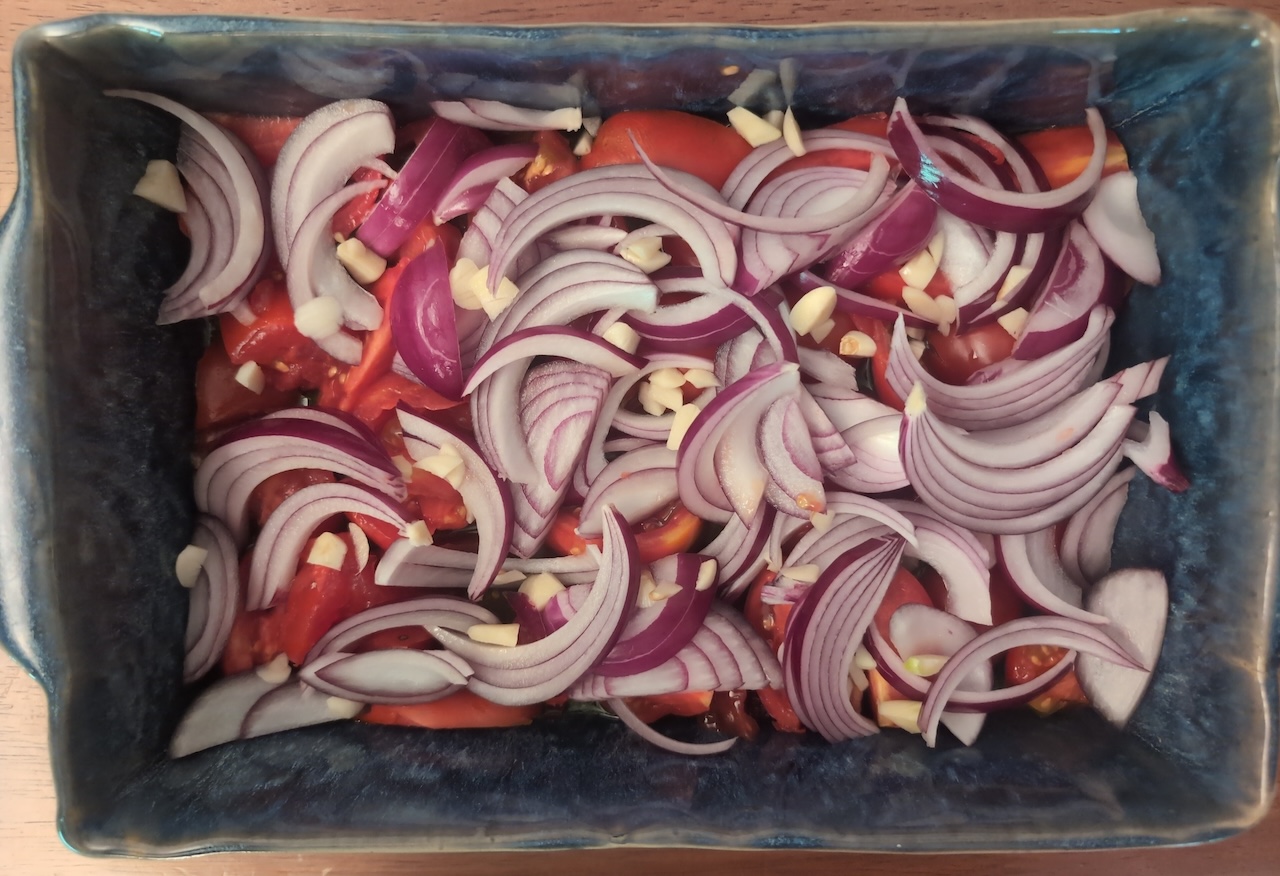
The most delicious meal of my recent trip to Europe was the simple Greek dish briam, which consists of eggplant, zucchini, potato and tomato roasted in plenty of olive oil with onion, garlic, parsley and salt. So flavorful and satisfying! I ate until I was full, and then sopped up the last of the oily residue with the last triangle of pita. My stomach was unpleasantly stretched, but I don’t regret a bite.
A week later I found a recipe and made briam for my belated birthday dinner. Despite the red bell pepper and extra garlic I’d added, it was bland, though still pleasant. After all, these are wonderful vegetables. But in Greece the flavors were swoon-worthy. What was I missing?
I added more salt, plus dried oregano and basil, and baked some more. It was a little better, but nothing memorable. I added sesame oil, paprika and crushed red pepper. Then more – with enough spicy additions we enjoyed the meal.
But I wanted to try to get more flavor from a traditional recipe – without all the herb and spice additions. The general advice is: Use more salt and more (and/or better) olive oil.
Can that which is tasteless be eaten without salt,
or is there any flavor in the juice of mallows? Job 6:6
You can spend $2-50 on a small bottle of olive oil. How do you choose? Corruption, including counterfeiting, in the food industry is rampant. Check out a documentary like this one, or articles like this to explore why it’s so easy and lucrative to counterfeit food.

Listen! The wages of the laborers who mowed your fields, which you kept back by fraud,
cry out, and the cries of the harvesters have reached the ears of the Lord of hosts. James 5:4
Mixing higher quality with lower quality olive oils, as well as adulterating with anything from soybean to hazelnut oils, may be common. Related, a UC Davis study found that 73% of tested olive oils failed taste tests because they were rancid or “fusty” (fermented).
Differing weights are an abomination to the Lord,
and false scales are not good. Proverbs 20:23
I’ve read a variety of arguments about olive oil, and I have no expert advice. The industry claims that it has improved. A reasonable approach is to just use what you like the taste of and not to worry about what’s in the bottle. A taste test demonstrates that many of us prefer the taste of adulterated and even rancid olive oil – presumably because that’s what we’re used to. UC Davis reports: “The study found that 74 percent of the consumers did not like what the expert tasters identified as high-quality oil — those that were bitter, pungent and free of defects. Bitterness and pungency are two of the positive sensory attributes of high-quality olive oil, as identified by International Olive Council standards.”
You love righteousness and hate wickedness.
Therefore God, your God, has anointed you with the
oil of gladness beyond your companions . . . Psalm 45:7
You could also just buy what you like! But adulteration and subpar processing of olive oil can turn a health food into a junk food, or even something dangerous. In one famous case, a chemical additive not approved for cooking oil was added to mimic the color of olive oil. So if you’re hoping to buy high quality, unadulterated olive oil, consider this:
- Look for a harvest date on the bottle. Not a “best by” date, but a harvest date. Use within two years of harvest.
- The bottle shouldn’t be clear, but a tinted color (ideally of glass rather than plastic).
- Store with the lid and out of sunlight, away from heat.
- Look for a single origin because that may decrease the chances it’s been adulterated.
                                                                 You therefore, beloved, since you are forewarned, beware that you are not
                                                   carried away with the error of the lawless and lose your own stability. 2 Peter 3:17
Instead of trying to avoid subpar olive oil, you could seek out exceptional olive oil. If you can afford it, use organic Palestinian olive oil from Equal Exchange. While a few reviewers say it’s “too peppery” you may love the taste, or at least find a way you like to use a more flavorful oil. Personally, I like the flavor and don’t think it’s strong. I’m glad my mother gets it for us for Christmas! Remember, authentic olive oil should have more flavor than soybean, canola or other common oils (and therefore adulterated olive oil).
                                                          You anoint my head with oil;
                                                                                                                                                my cup overflows. Psalm 23:5b
When it comes to briam, here are some things I’ve tried. I use more tomatoes than any other vegetable (potatoes, eggplant and zucchini) since the tomatoes have a brighter and bolder flavor than the others. I don’t mean use more tomatoes than the rest combined, just more tomatoes than potatoes, etc.
Another tip is to put tomatoes and onions both on the top and the bottom of the rest of the veggies, since (without a scientific test) it seems like their flavors will infuse the dish more effectively that way.
Tossing the potatoes, eggplant and zucchini in an olive oil/salt mixture before layering is a better way to coat them with flavor than just sprinkling, pouring and hoping they get coated.
While many recipes say to add the parsley before roasting, I suggest adding some at the beginning and more at the end.
And don’t skimp on the olive oil – whatever variety you prefer, use plenty. I’ve seen recipes call for as little as ¼ cup and as much as 2 cups for the equivalent of a 13×9 pan. I opted for ¾ cup because I just couldn’t bear to use more – it seemed like it would be hard to digest! But this recipe is considered ladera in Greek (λαδερά): a category of vegetable dishes cooked in olive oil in Greek, Turkish, and Arabic cuisines. The name in all these languages means “with olive oil.”
Briam (Mediterranean roasted summer vegetables)
Ingredients
- 5 ripe tomatoes or 1 quart of canned tomatoes, or splurge on plain pasatta (high-end sauce)
- 2 medium or 1 extra large potato, in bite-sized pieces
- 2 small or 1 large eggplant, in bite-sized pieces
- 1 medium zucchini
- 2 small or 1 extra large red onion
- 5-8 cloves or garlic, minced or chopped
- optional: 1-2 bell peppers, in bite-sized pieces
- about ¾ cup olive oil
- ½ cup (or more) fresh parsley, chopped
- 1 teaspoon each, salt and pepper
- oregano, basil, rosemary or other herbs and spices
- Slice all the ingredients with categorical uniformity. The onion, eggplant and potatoes should all be about ¼ inch in thickness and in similarly bite-sized widths. Tomatoes and zucchini slices can be larger since they have more water and will break down more. If using peppers, bite-size pieces are fine since the vegetables are thin. Garlic should be minced or chopped.
- Preheat oven to 375 degrees. Coat a 13×9 or large casserole dish with olive oil. Spread half the tomato, onion and garlic on the bottom. Optional: Sprinkle extra herbs or spices.
- Toss the eggplant, potato, zucchini and bell pepper (if using) in the rest of the olive oil, plus at least 1 teaspoon salt and 1 teaspoon pepper. Taste and add more seasoning if desired.
- Either pour this mixture on top of the tomatoes, onion andgarlic and spread evenly, or arrange one slice at a time for satisfying presentation. Add at least half of the parsley.
- If you took the time to arrange the veggies, you’ll want to arrange the second half of the tomatoes, onion and garlic as well. Otherwise, you can just pour them on top and spread out. If there’s any olive oil left in the bowl you tossed the veggies in, add that too. If not, sprinkle some more salt and pepper on top. Cover with foil, tenting it so it won’t stick to the food.
- Bake 30 minutes. Take out, remove foil and check a couple different ingredients for taste and texture. If you want to add more flavors, go for it. If any veggies are quite firm, leave the foil on for another 10 minutes. If they’re all getting soft, leave the foil off and return to the oven for about 15 minutes.
- Check again for taste and texture. You may want to broil for just a couple minutes for a pleasant brown top. This may also happen without broiling.
Serve with any of the following:
- The rest of the parsley
- pita
- rice
- feta or other cheese
- hummus
- tzatziki
- homemade Ladelemono (Lemon garlic oil)
- herbs and spices for individual enhancement



Have a comment on this story? Write to the editors. Include your full name, city and state. Selected comments will be edited for publication in print or online.