


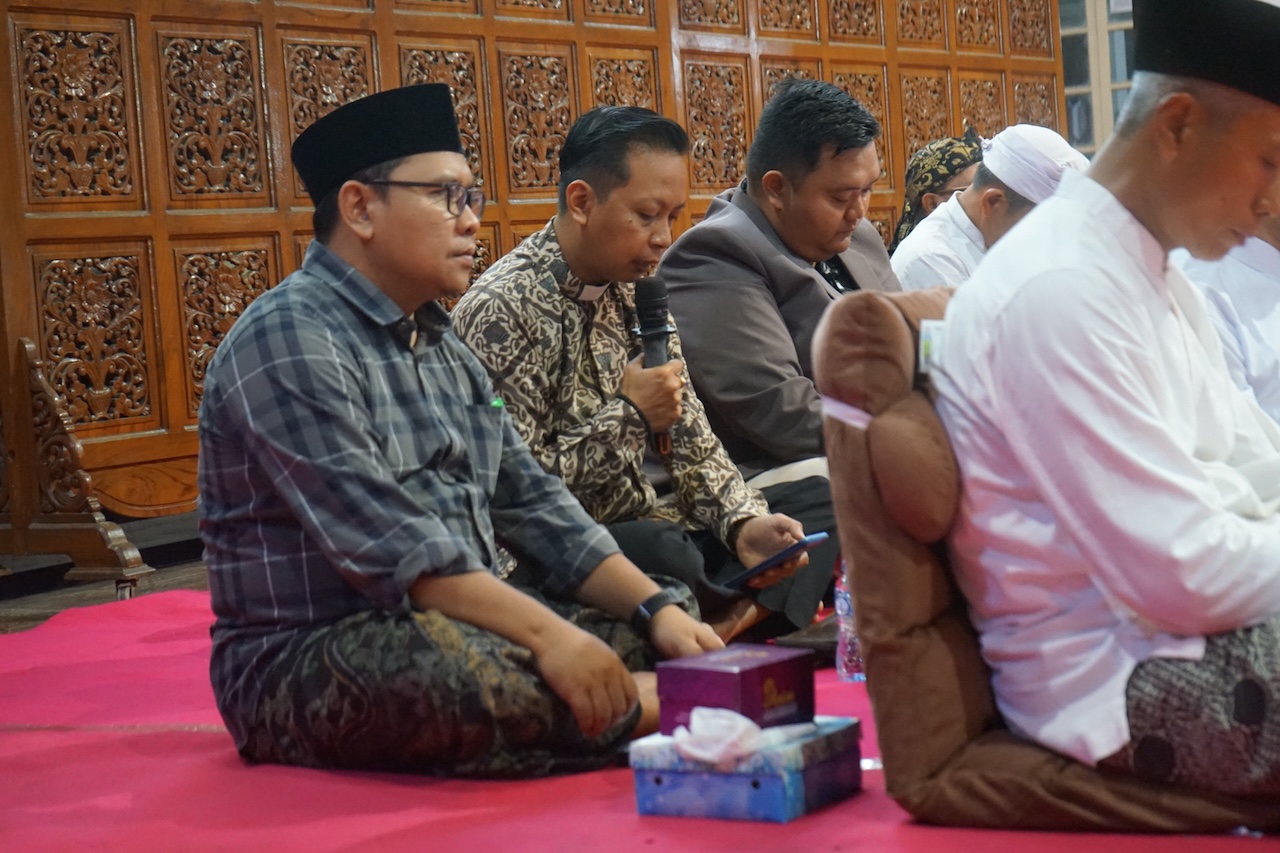
As a Mennonite, I must admit that I am often skeptical of ceremonial events. When the Ministry of Religious Affairs in Jepara Regency, an administrative region in Java, Indonesia, invited me to represent the local Christian community at an interfaith prayer gathering commemorating Hari Santri (National Santri Day), I accepted with a degree of hesitation. Events of this kind, especially those hosted at the seat of local government, can sometimes feel like formal stages designed to project an image of interfaith harmony without building genuine relationships among ordinary people.
Yet I asked myself: Could there be something meaningful behind this ceremony? Around 300 people gathered at the Jepara Regency’s pendopo, a traditional open-air pavilion that serves as the center of local government and public life. Most attendees were Muslim, as this was a celebration honoring the Islamic tradition, alongside local officials and representatives of other religious minorities. As the gathering unfolded, several insights broadened my understanding of the church’s presence in the public square. Here are five lessons I received.
1. The public square can be a space for prophetic witness
When the event took place in mid-October, Indonesia was in the grip of an environmental crisis caused by land and forest fires across several provinces. Communities in Kalimantan and Sumatra were forced to live encircled by dense smoke that threatened their health and livelihoods. The recurring nature of this disaster raised serious questions regarding civic responsibility, environmental governance and the systemic greed destroying creation.
Interfaith prayers are often filled with safe, normative phrasing. However, I decided to use my allotted time on stage to voice these urgent concerns before our civic leaders. In my prayer, I acknowledged humanity’s failure to care for God’s creation, pleaded for mercy for those who suffer and called for justice for the victims of environmental negligence. That prayer transformed a routine ceremonial space into a moment of moral accountability before God.
I was reminded that a Christian presence in the public square is not fully realized merely through polite words about harmony. The church must also have the courage to speak to suffering, critique injustice and oppose the greed that harms creation. Prophetic witness cannot be separated from the call to peace and justice.
2. Learning from other religious traditions
Prayers were offered sequentially according to the traditions of each recognized faith: Christian (Protestant), Catholic, Hindu, Buddhist and Islamic. Hearing prayers offered in Sanskrit, Pali and Arabic brought a rich diversity of spiritual expressions. I was not merely observing the rituals of others, but learning to listen deeply.

During the gathering, a Muslim leader emphasized how vital it is for santri (students of Islamic tradition) to study the Quran diligently. He expressed concern that easy access to technology and quick information might weaken a student’s devotion to deep scriptural reflection. In our context, the devotion of a santri closely mirrors our calling to Christian discipleship. As Mennonites, we often emphasize the practical dimension of discipleship: living out the teachings of Jesus through concrete, everyday action. Yet this encounter served as a timely reminder that faithful discipleship also requires rigor in reading, understanding, and delving deeply into the Word of God.
Encountering other religious traditions does not mean abandoning our own convictions. On the contrary, such encounters can help us rediscover dimensions of our own faith that we may have overlooked.
3. Room to build real friendships
The formal program on stage was brief. However, the most meaningful moments took place away from the official proceedings. Afterward, we sat together in the pendopo, sharing coffee, exchanging news, laughing and discussing local social issues.
In that informal setting, our relationships were no longer bounded by titles or religious protocols. We were present simply as human beings listening to one another and enjoying each other’s company.
Harmony cannot be built solely through official statements; it requires friendships that grow through everyday encounters. When religious leaders form genuine friendships across lines of faith, those relationships set a visible example for the broader community, helping to break down prejudice and build a shared life.
4. Faith in the public square
Jepara Regency’s Pendopo is more than just an administrative building. It serves as a meaningful space where political power, local culture and community life intersect. Being present there poses a fundamental question: How should a faith community participate in public life?
Historically, the Anabaptist tradition has held a strong commitment to the separation of church and state to safeguard the church’s freedom to follow Jesus rather than to become an instrument of political power.
Yet we also affirm that God is actively at work in the middle of the world. The church’s calling is not to isolate itself, but to participate in God’s work of embracing the world to bring about shalom and justice. If we recognize that God works beyond our institutional boundaries, then the church needs the humility to be present and collaborate with all elements of society. This participation requires a critical posture, marked by a clear faith identity, a willingness to listen and the courage to speak against injustice. This joint prayer was a simple, yet meaningful, manifestation of the church’s care for its city.
5. Radical hospitality and the vulnerable guest
What touched me most was that this event was hosted entirely by the Muslim community. The vast majority of participants were Muslim. They were under no obligation to provide space for religious minority groups. Yet they chose to invite us, share their space and listen attentively to our prayers.
I experienced this as a profound form of radical hospitality. We often understand hospitality from the perspective of the host: how the church opens its doors and welcomes the stranger. But this experience reminded me of hospitality’s other side. Sometimes, we are not the hosts opening the door, but rather the guests being received.
As guests, we were present without hiding our Christian identity, yet without projecting spiritual superiority. We came simply to pray, to listen and to receive the warmth offered to us. I call this the courage to be a vulnerable guest. Being a guest means entering a space we do not control. We must be open to listening, learning and allowing ourselves to be transformed by the encounter. Hospitality is not only the courage to open our doors to others, but also the humility to step inside the home of another.
True harmony is not born simply because religious leaders stand together on a stage. It grows through a willingness to listen, to learn, to speak against injustice, to cultivate friendships and to receive one another across our differences. For me, Christian witness does not always begin by playing the host or setting the terms of engagement. Sometimes, that witness begins simply by accepting an invitation, entering a space owned by another community and learning to be a guest, all while bearing faithful witness to Christ and our shared call to care for life together.


Have a comment on this story? Write to the editors. Include your full name, city and state. Selected comments will be edited for publication in print or online.