


What if? It’s one of the great history games, speculating on alternative outcomes if events had happened differently.
What if Abraham Lincoln had decided not to go to the theater on April 14, 1865? What if the Boston Red Sox hadn’t sold Babe Ruth to the New York Yankees? What if the Watergate intruders had been more competent?
What if the General Conference Mennonite Church had located its seminary in Freeman, S.D., instead of Chicago?
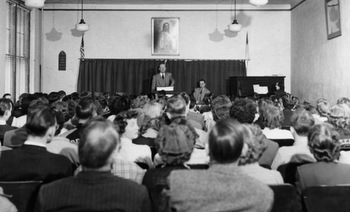
The denomination’s first venture in theological education was Witmarsum Seminary in Bluffton, Ohio, 1921-31. A decade later, after it closed, GCMC leaders wanted to restart a seminary program. But where?
John D. Unruh, the president of Freeman Junior College, proposed his own rural small town in 1942. He alluded to Witmarsum’s inter-Mennonite composition, as it included board representation from five other groups in addition to the GCMC.
In a letter to A.S. Rosenberger, one of the people trying to re- establish the seminary, Unruh pointed out that a similar diversity existed “within a radius of 25 miles” of Freeman: seven GCMC congregations, two independent Mennonite congregations and one each affiliated with the Mennonite Brethren, Evangelical Mennonite Brethren and Krimmer Mennonite Brethren. Plus one Hutterite colony.
“Besides, Canada is not too far distant,” Unruh added.

Unruh’s idea obviously didn’t go far, if anywhere, as the denomination in 1945 opened Mennonite Biblical Seminary in Chicago, where it was affiliated with the Church of the Brethren seminary.
But what if his proposal had been accepted? The results could have produced a markedly different North American Mennonite landscape.
For example, the seminary’s presence might have ensured the health of FJC and its affiliated academy. Financial pressures forced the college to close in 1986, while the high school and the elementary school added later have continued to struggle. But as students and employees came to the seminary, they might have brought children and spouses to fill the classrooms of the college and academy, as well as their coffers.
The 21st-century GCMC merger with the Mennonite Church would have also felt the impact of a Freeman seminary. Because of changing dynamics in Chicago, MBS moved to Elkhart, Ind., in 1958, where it joined with the MC Goshen Biblical Seminary to create Anabaptist Mennonite Biblical Seminary, which then became key in fostering closer relations between the two denominations and their eventual merger.
But if MBS had not been in Chicago, it might not have felt compelled to relocate. This probably wouldn’t have stifled the formation of Mennonite Church USA and Mennonite Church Canada, but it would have affected how they developed. At the very least, a laboratory for crafting common theological understandings would have been absent.
While a Freeman seminary might not have developed close ties with the Mennonite Church, it could have connected with the Evangelical Mennonite Brethren and Mennonite Brethren. Both groups (including the Krimmer Mennonite Brethren, which united with the Mennonite Brethren in 1960) supported Freeman Junior College and Academy.
The Mennonite Brethren didn’t start a seminary until 1955, 13 years after Unruh’s proposal. Could the Freeman school have served the denomination and maybe even pre-empted the eventual seminary in Fresno, Calif.?
Similarly, the seminary might have also been able to provide instruction to the Evangelical Mennonite Brethren. The effect on the EMB could have been profound. By the 1970s, the denomination was drifting away from Mennonitism toward evangelicalism, in no small part because it lacked schools to train its leaders. It changed its name to the Fellowship of Evangelical Bible Churches in 1987. But that could have been prevented if EMB pastors had a Mennonite identity resulting from education at a Mennonite seminary.
Freeman’s location might have been advantageous for drawing students and support. It was reasonably accessible to GCMC, MB and EMB members elsewhere in South Dakota as well as in central Nebraska and southwestern Minnesota. The town was also equidistant between the major Mennonite communities in south-central Kansas and southern Manitoba.
Of course, any game of “what if?” also includes the negatives, like an Uno card instructing the player to skip a turn. The seminary might never have appealed to the more evangelical-minded MB and EMB constituencies, despite their proximity. Freeman’s rural environment might have turned off would-be students and employees. And how would the seminary have been affected by the horrible agricultural economy of the 1980s?
But then Unruh might have known he was proposing a fantasy that could be discarded. He concluded his letter, which included other ideas and observations about a new seminary, by counseling Rosenberger, “I hope you have a large waste-paper basket!”
Rich Preheim is a writer and historian from Elkhart, Ind.


Have a comment on this story? Write to the editors. Include your full name, city and state. Selected comments will be edited for publication in print or online.