


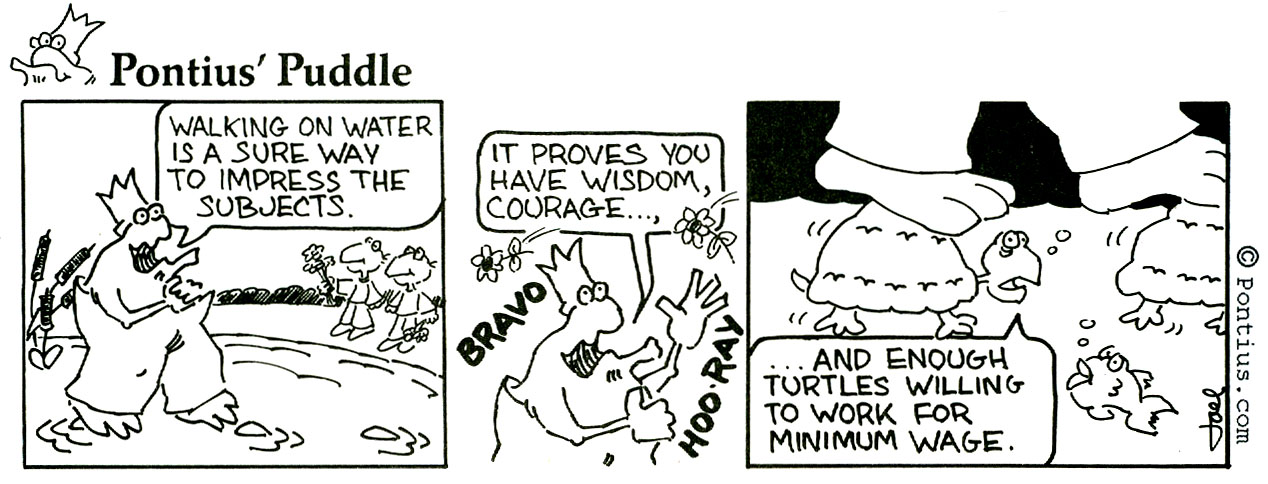
Image credit: Pontius Puddle cartoon from September 8, 2009 by Joel Kauffmann
Yesterday—May 14, 2015—marked eight years of blogging here for The Mennonite, mostly on my own for the first seven years, and now, for the last year, with a wonderful array of other bloggers.
I started this experiment a little over a week after my 26th birthday and now I’m nearly halfway through my fourth decade.
That’s more than half my adult life, so I believe some reflection is in order.
For a few years now, when I think about this work I’ve been doing of writing and engaging with you, my community, the term gadfly has come to mind.
However, I’ve been a bit shy about identifying with the word.
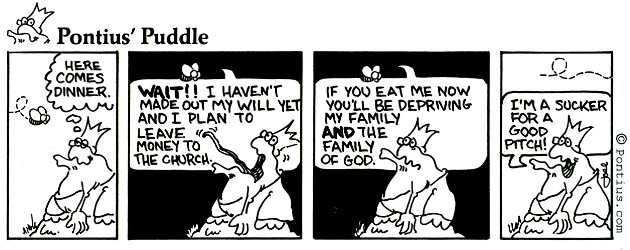
Then today I was on the “Pontius’ Puddle” web site and discovered that Joel Kauffmann’s tag line for his work was “Gadfly Cartoon Parables.” If as eminent a writer and humorist as he could use the term, then so can I.
So, in honor of Pontius and Joel, who tragically passed away a week ago today, let’s explore the character of the gadfly a bit further.

Getting schooled by the gadfly
As far as I can tell, Socrates was the first in Western literature to bring up this lowly creature in the way we use it today.
In his defense before he was executed, he said:
Indeed, men of Athens, I am making a defense hardly at all for my own sake, as someone might suppose, but for yours, in case you do something wrong concerning the god’s gift to you by condemning me. If you were to execute me you would not easily find another person like me, who is—although it is rather funny to say—attached to the city by the god just as though to a horse that’s great and noble though somewhat sluggish because of its size and needing to be provoked by a sort of gadfly, which is just the way, I think, the god attached me to the city, the sort of person who never ceases provoking you and persuading you and reproaching each one of you the whole day long everywhere I settle. You won’t easily
get another person like this, gentlemen, and if you are persuaded by me, you will spare me.
Jeremiah brought up this little critter to poetically prophesy the destruction of Egypt’s beautiful heifer of an empire.
More recently and relevantly, Martin Luther King used the term “nonviolent gadflies” to describe the kind of tension that was important for social change in his “Letter from Birmingham Jail” after he was accused by the clergy of Birmingham of stirring up conflict:
Just as Socrates felt that it was necessary to create a tension in the mind so that individuals could rise from the bondage of myths and half-truths to the unfettered realm of creative analysis and objective appraisal, we must we see the need for nonviolent gadflies to create the kind of tension in society that will help men rise from the dark depths of prejudice and racism to the majestic heights of understanding and brotherhood.
As we prepare for the Mennonite Church USA convention in Kansas City in six weeks, I keep on reading posts, blogs and articles from people who are anxious about our gathering. Jessica Schrock Ringenberg went so far as to say, “I am dreading convention.”
I can’t help but hear echoes of these sentiments in the letter from the eight clergymen who King was responding to in his letter. They accused the civil rights movement in Birmingham of “actions as incite to hatred and violence.” Their whole letter is well worth a read.
I don’t mean to pick on Ringenberg.
I think she speaks for the majority of Mennonites who equate difficult and messy conflict with badness.
Too often we think we can skip the “social advocacy and confrontation” and go right to the Dialogue and Conciliation without Jesus’ direct action in the temple.
Which brings us back to gadflies and why the church needs us irritating as we are.
We as Mennos need some creative tension to our community.
I’ve done my best to do that with as much respect and compassion as I can muster and stay in relationship with my critics.
May we as a church continue to learn from the parable of Pontius Puddle.
Godspeed, Joel. May you find many flies and lilypads on your journey.


Have a comment on this story? Write to the editors. Include your full name, city and state. Selected comments will be edited for publication in print or online.