


In an effort to highlight the many Anabaptists engaged in important work and ministry across the country and around the world, we’re starting a new series. Most Thursdays, we’ll publish a seven question interview with a different Anabaptist talking about their life, work, spiritual journey, etc. You can view past interviews here.
Name: Jessica Sarriot
Job title: Associate organizer with VOICE (Virginians Organized for Interfaith Community Engagement)
Home congregation: Hyattsville (Maryland) Mennonite Church
Hannah Heinzekehr: You first interacted with The Mennonite during your time with the Weather Vane student newspaper at Eastern Mennonite University (Harrisonburg, Virginia). Would you tell me that story?
I’m part of the class of 2011 and I was attending EMU after living in Jerusalem for two years. My dad works in public health. One of the core realities of my university experience at EMU was that I was deeply angry and hurt at the Israeli occupation and the fact that nobody seemed to know about it.
Larisa Zehr, Krista Johnson and I founded the Students for Morally Responsible Investment in Israel/Palestine. It was originally aimed at getting EMU to change its investment policies and pull out its investments from organizations directly supporting the Israeli occupation. We knew that EMU was invested in a pool with other schools, and we got the list of organizations and got into the room with President Swartzendruber and also organized a public action. We had 40 students that were going to be in silent vigil outside the office where I and the other leaders were meeting with the president and representatives from the board of trustees.
We wanted to make sure that anything that happened there was well reported. That was the first time that I asked the Weather Vane to link with broader Mennonite readers through The Mennonite.
In that particular meeting, President Swartzendruber came out to speak with the people holding vigil and said, based on the conversation with student leaders, that he agreed that we needed to rethink our position on Israel/Palestine. He couldn’t make that decision to pull out because of the way they were invested.
I frankly don’t know where that conversation is at in terms of the investment pool that EMU was a part of, but that article in The Mennonite and that action had ripple effects. MCC [Mennonite Central Committee] was able to use the student organizing and pressure as a way to help them divest. Larisa and I and other students got an e-mail at the end of our senior year letting us know that we were a critical part of MCC making that decision.
HH: How did that work set the tone for the work you do now?
A few months ago I had the opportunity to preach at the North Virginia Mennonite congregation, and this question was exactly my topic.
I’m not “ethnically Mennonite.” I didn’t grow up in the Mennonite church. I didn’t know who the Mennonites were, but I went to EMU because I wanted to study peacebuilding and I wanted to go to a Christian university. EMU had a phenomenal peacebuilding program.
I thought Mennonites were like any other denomination, but I was angry and frustrated at Mennonites my first year because it felt like such an in-group. It felt like cheating that many of my classmates had come from high school together and knew all the same acronyms and went to conventions together, etc.
One of the important things that happened to help me feel accepted was engaging issues of divestment. Also, Peter Dula was my mentor and got me reading John Howard Yoder and I just sort of fell in love with Mennonite theology. I came to college in part because I was trying to figure out the role of faith in my life.
EMU was able to reintegrate me as a person. It gave me a theological framework that would hold while I was an adult.
HH: How would you say that your faith impacts the work you do?
My dad’s in public health, and when I was in second grade, my dad was working with slum communities trying to prevent child and maternal death. The way I tell my story as an organizer is that I was told that everyone is the same in God’s eyes, but I lived next door to people in makeshift shelters who were poorly nourished. I was living in an air-conditioned concrete house and going to a private school.
I realized that God sees us the same way, but we sure aren’t treated the same way. And this is not coincidental. Systems make this happen. We colonized countries and took all their resources.
The basic fact of unfairness and the underpinning of its creation is maddening to me. I see the parallels between the Roman Empire and the current neo-liberal power of western nations over others. When I’m working with a tenant on affordable housing, I’m also hearing their story of being displaced in El Salvador and I can trace that back to a story of gangs and migration.
Every single time this happens and people are displaced, we’re not loving our neighbor and we’re not living into the upside-down kingdom. The people I’m organizing with are God’s children and some of them are really rich and some are really poor, but we all agree that the world as it currently is isn’t as it should be.
HH: Who have been key mentors for you in this work?
Honestly EMU was so formative. Lisa Schirch [professor at EMU’s Center for Justice and Peacebuilding] is someone I’ve admired a lot, especially professionally and for how she sees the world. She’s worked a lot with the military. One of the things that can be frustrating in the “Mennonite world” is this “white glove approach.” We want to keep ourselves pristine. I’ve seen her own and totally live into the radical pacifist belief and understanding of what we’re called to and how we’re supposed to be.
Martin Trimble, the lead organizer of VOICE when I was hired who has been organizing for over 20 years has been a critical mentor in learning the craft of organizing. Meg Brauckmann and Larisa Zehr, my classmates, were incredibly influential to how I processed understanding my faith and how to put it into action.
HH: What does a normal day look like for you?
One of the things I love about community organizing is actually that there is a typical day in a certain sense, but it’s also always different. By and large most of our work is to have one-on-one relational meetings and try to get to know the leaders and potential leaders in our community.
I don’t have an office. I see my supervisor maybe once a week. By and large I am in the community, in coffee shops, in churches, at mosques, etc. I’m either calling and trying to set up meetings or having meetings and talking to folks about who I am and what motivates me to create change and learning about them and what motivates them to create change.
I’ll spend a lot of nights doing listening sessions with 10-20 people in a room asking them what they most want to see changed. I attend lots of night meetings in community rooms of affordable housing properties or church basements.
We don’t pick the issues that we organize around; we just know that we want to build power. You need to be more worried about figuring out who the leaders are and how to move them and then figure out what the issues are from there.
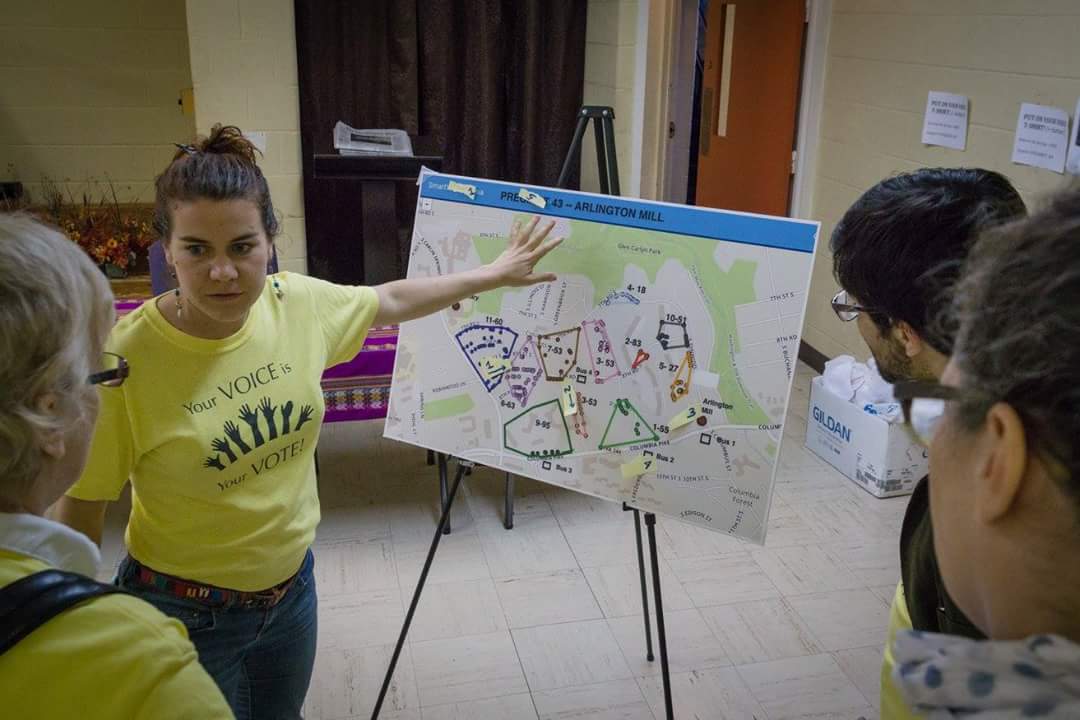
That being said, there are issues that come up over and over again related to affordable housing, immigrant rights, and access to healthcare and educational services. I just organized with some low income parents to come out to a county board meeting and advocate for passing the affordable housing plan in Arlington, Va. We want to make sure interests of people who need affordable housing aren’t being ignored, and we got that plan passed five votes to zero.
HH: How do you understand the importance of interfaith work?
I respect people that put their faith into action, period. I used to dismiss the Unitarians, for example, as sort of wishy-washy, but I’ve been working for two years now and the Unitarians really put everyone to shame in terms of social justice. They just do it; they don’t just talk about it.
There’s a Jewish temple that I work with and I drove up and there was a sign that said, “We support Israel.” That hit me really hard in the gut, but I went in there and I organized with that temple because it’s not about Israel/Palestine, it’s about what they want to do in their local community. People are complex.
I don’t think God is tribal. That’s a basic concept for me. I don’t believe that only Christians are saved and going to heaven, and I don’t think you have to claim Jesus as the son of God to do good or even follow Jesus’ message. I know a lot of Muslims that are trying to follow Jesus’ methods. I’m relating to people and working on the things that matter side-by-side. The best interfaith work doesn’t have to be discussing the nuances of your theology. The best interfaith work is working together around something that you both care about.
HH: If you had to pick the top three texts-music, books, poems, etc.–to recommend to someone, what would they be?
- The Brothers K by David James Duncan
- The Essential Rumi (a collection of poetry)
- Engaging the Powers by Walter Wink
Photo of Jessica by Jim Coates Photography.


Have a comment on this story? Write to the editors. Include your full name, city and state. Selected comments will be edited for publication in print or online.