


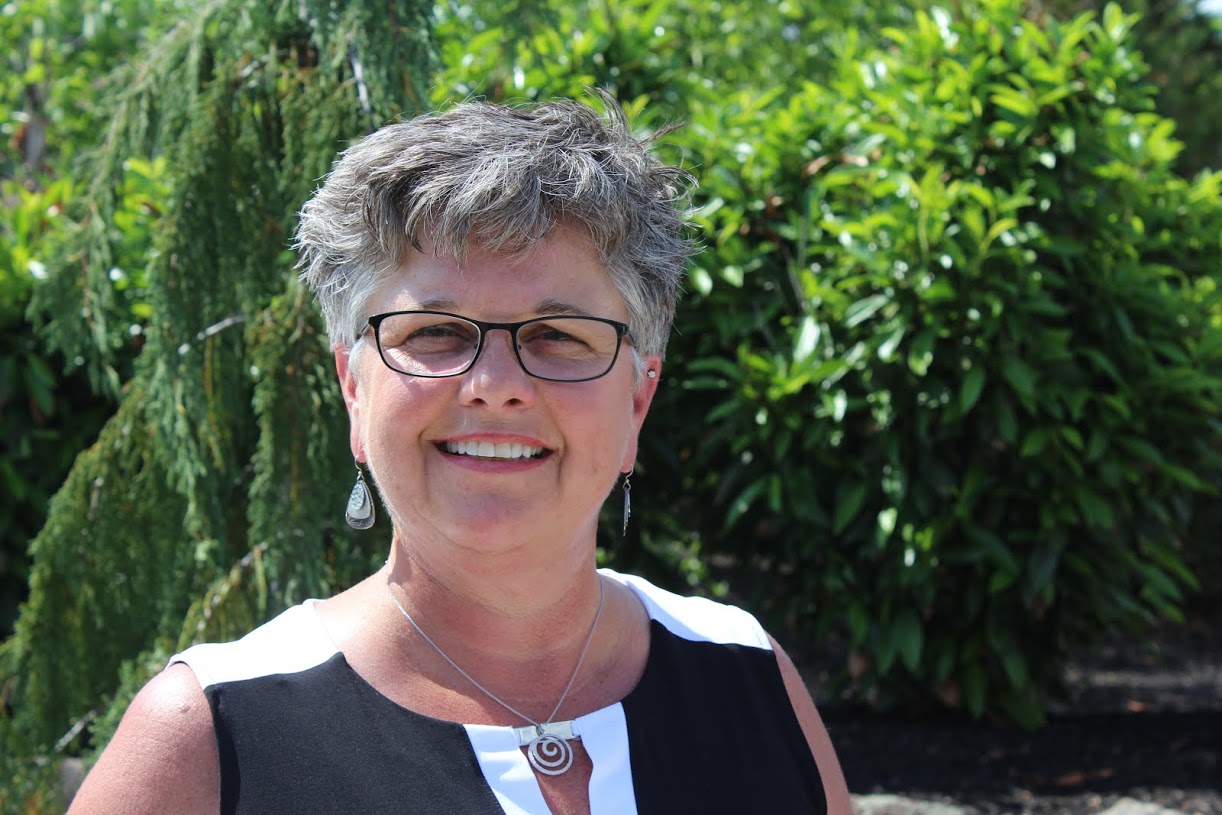
In an effort to highlight the many Anabaptists engaged in important work and ministry across the country and around the world, we’re starting a new series. Most Thursdays, we’ll publish a seven question interview with a different Anabaptist talking about their life, work, spiritual journey, etc. You can view past interviews here.
Name: Marlene Frankenfield
Occupation: Spiritual director, part-time host coordinator for international students at Christopher Dock Mennonite School, former congregational and conference/campus youth pastor
Congregation: Salford Mennonite Church, Harleysville, Pennsylvania
Hannah Heinzekehr: You’ve spent much of your career ministering to youth and young adults. Who were important people or mentors for your own faith formation growing up?
I was thinking about my faith formation in those early years and what I came up with was that the faith formation included messages about God as a judge versus the God of love, and being a follower of Jesus was more about guilt and shame versus unconditional love. It just felt like the focus of my early years of faith formation were more about fear and making sure you were saved from going to hell when you die and less about having a relationship with God and Christ.
I think probably one of the most significant traumatic experiences that connects to my faith formation was when my cousin was killed in a car accident. We were the same age; in seventh grade and we went to the same church. I remember our pastor saying in a sermon, soon after the funeral, where would you be if that was you? He was looking straight at me. So out of fear, I became baptized. At the time there was an ongoing argument about why I needed to wear a head covering to be baptized. People weren’t wearing them as much, but for whatever reason my father was insistent about this. I always wondered why that sacred water had to wash over that covering before it hit my head. I remember that I had a lot of questions at that time, and questions weren’t welcomed. It was more about having the right answers, and I became really skeptical and cynical.
I still can’t come up with any one person in those years that I felt really understood or listened to me. That’s what gave me the passion for faith formation in children and young people. Those years are really formative and stick with you. I spent many years trying to change my image of God.
Later on there were mentors. When I got into youth ministry, there were very few female youth pastors that I knew. There were only a few women pastors in our conference, maybe two. I remember in the early 90’s, Princeton Seminary had just started the Youth Ministry Institute. I enrolled not knowing anyone, but I knew I wanted to go there and I met Kenda Creasy Dean. She had a team of ordained women around her and they were leading the institute. While there I watched these women lead and I loved hearing the women preach each day. This was one of the first times I had heard a woman preach, and these women were honored and respected and they used inclusive language. It was just a breath of fresh air and I finally felt like I belonged. Later on, I was lucky enough to get to know Kenda. I would call her a mentor. I loved her passion. She’s an amazing teacher.
I was always noticing women who were kind of blazing trails in the church. I wondered what they had inside themselves that gave them the courage and the passion. I always wanted that. One of my mentoring relationships that just so happened was Elaine Moyer, she attended Salford and at the time was the principal at Christopher Dock Mennonite High School. Our sons were on the same soccer team, and we talked on the sidelines at the soccer game. I remember our husbands took the kids home and we stayed and talked and she listen to what was going on in my life. Later she invited me to lunch, and we got to know each other and she journeyed with me. She welcomed my doubts and help me make sense of life and faith, she encouraged me, and she later ended up hiring me for the joint position as Franconia Conference youth minister and [Christopher Dock] campus pastor. I learned so much from her and she helped me to have courage to take risks and lead.
HH: As you discerned your own call, why did you choose to focus on youth ministry?
It’s really an amazing story. I feel like I didn’t choose youth ministry; it kinda choose me. I think it’s really God’s sense of humor.
As I reflect on how I got into it, I think maybe God used some teens to connect with me at a time when I was not into God, faith and church. At the time, my husband and I were an emotional mess. We had three young kids, my husband had a second round of cancer, and at the same time, some really difficult issues came to light within my biological family. We went to church because we wanted to take the kids to Sunday school and I put on my church smile, but it was really a difficult time.
While the kids were at Sunday school, I would sit out on the sidewalk. There’s a historical building across the parking lot where youth Sunday school happened, so youth would walk from church across the parking lot, and they would say hi and stop and talk to me. They would sit down next to me and tell me about their lives, what they did on Saturday night, they talked about school issues and some of their problems with parents. Sometimes they would skip Sunday school and sit on the curb with me.
It was during those times when life didn’t seem so heavy. It seemed fun. I was listening to them and they had no clue what was going on in my world, it was a distraction from my life heaviness. Soon one of the youth sponsors came to me, and asked if I would be a youth sponsor, “because you’re already doing it.” It was a hard decision, because I was not into organized church and I didn’t know what I believed about God, faith and prayer.
It took me awhile and I finally agreed, and the rest is history. It pulled me right in. I was reading everything I could about youth ministry and adolescent spirituality. After four years of being a volunteer, sponsor, the church started a search committee for a youth pastor and I was invited to be on the committee. At the second meeting they said, “How about you?” I wasn’t expecting it all. I just wanted to be a volunteer and help a young youth pastor that would lead the ministry.
I remember there was a group of women friends and Elaine was a part of that, along with a sponsor and another local female youth pastor. We gathered for a time of group discernment. Each one took a turn and they talked about my gifts and they affirmed me. They also talked about challenges they knew I would face and they prayed for me and the process. It was just a really meaningful, important time of discernment for me and it gave me the courage to say yes. That’s how I stepped into being a paid youth pastor at the church.
HH: What’s one story from your work that you always tell over and over? It can be moving, quirky, funny, whatever.
When the story of call comes up, I do talk about feeling like God used teenagers to call me into ministry. That’s probably one of the stories that I tell the most.
HH: How do you think congregations and conferences could or should be engaging youth and young adults in decision-making processes? Are there models you’ve seen of congregations or groups modeling intergenerational conversation well?
One of the things I’ve been thinking about is vocation and how young people choose a vocation. Who helps them discern? We went through this with our own kids and it’s challenging. . In my own high school experience, I had very little guidance about vocational discernment. My sister was a dental assistant and sometimes I’d hang out at her work after school was finished. When I wondered what I was going to do, I thought, I guess I’ll go be a dental assistant. One day I skipped school and went to visit local dental offices and asked if they needed an assistant and I landed a job. Nobody helped me think about my gifts or helped to explore some possibilities with me. .
For young people, it’s too expensive to go to college and figure out their vocation along the way. I wonder how the church could come alongside young people and help them discover their gifts; maybe connect them to mentoring or help them find internships in areas they are interested in. I think there are some models and some of the high schools are now incorporating vocational discernment in curriculum and I wonder if the church could team with the schools to assist young people to be more intentional about discover who God created them to be and how to make life choices that best use their gifts.
I wonder if there would be ways to work at some kind of internship program. Experience learning can be so much better than just sitting in a classroom. Could there be a vocational database within the church for young people to search for internships? I think there could be some exciting possibilities
HH: Now you are focusing in on spiritual direction. Sometimes it seems to me that there is some confusion out there about what spiritual direction is. How do you define or describe this word?
I really don’t like that title, but it seems to be the language that most of the training programs use and I think it limits what it is. I like to think spiritual direction more like a spiritual companion or spiritual midwife. It’s a person that walks with another assisting them on how to listen and be attentive to their spiritual life. , . It’s about soul tending and discovering or rediscovering the holy and sacred in everyday life.
I like to look at life in seasons. I think we experience God or we have spiritual emotional longings that are different in each of our life seasons. I know how important it was for me to have a spiritual director—I had different ones at different times—that were really helpful in the different seasons of my life.
I have this quote that hangs in my office that I love. It’s from Douglas Steere, a Quaker. It says, “To listen another soul into a condition of disclosure and discovery may be almost the greatest service that any human being ever performed for another.” I think this quote speaks to spiritual direction. It’s really an honor to provide a safe space to listen to the sacred, soulful conversations and to be a spiritual companion as people question, doubt and seek to discover meaning in daily life.
HH: What are spaces or places of hope for you right now within Mennonite Church USA?
Even though I’m not hands on involved in youth ministry right now, I think I will always be interested in what’s happening with youth ministry in MC USA and beyond. I think back on Youth Ministry Council gatherings and for so many years we were advocating for a person to lead youth ministry in the denomination. I have been very excited and love the way that Rachel [Springer Gerber, denominational minister for youth and young adults] is leading and providing resources and support to those that minister with youth It is exciting that the church is paying attention to faith formation in young people and I’m hopeful that youth ministry will continue to be included in the core vision of the Mennonite Church.
I also find hope in the ways that leaders and the Mennonite press are speaking out about sexual abuse. I’m hopeful that the church may be a safer place for persons to share their stories and for persons not to feel like a victim when they share their painful stories. I continue to have hope that the church will be more of a place for healing than it has been in the past.
I see hope at my home congregation, Salford. Pastor Joe Hackman, the staff and church board are leading in a way that is attracting passionate young people that have a desire to grow and live faithfully. It’s exciting to see new faces and young families with small children showing up and becoming involved in the life of the congregation.
HH: What book are you reading right now?
I’m in the middle of one right now called the Good Earth by Pearl Buck. It’s a classic and I read it a long time ago. I thought I’d read it again since I’ve been working as host coordinator for international students. It’s about the changes in the life of ordinary Chinese people in the twentieth century, and it gives me some background and peeks into family life during that time.


Have a comment on this story? Write to the editors. Include your full name, city and state. Selected comments will be edited for publication in print or online.