


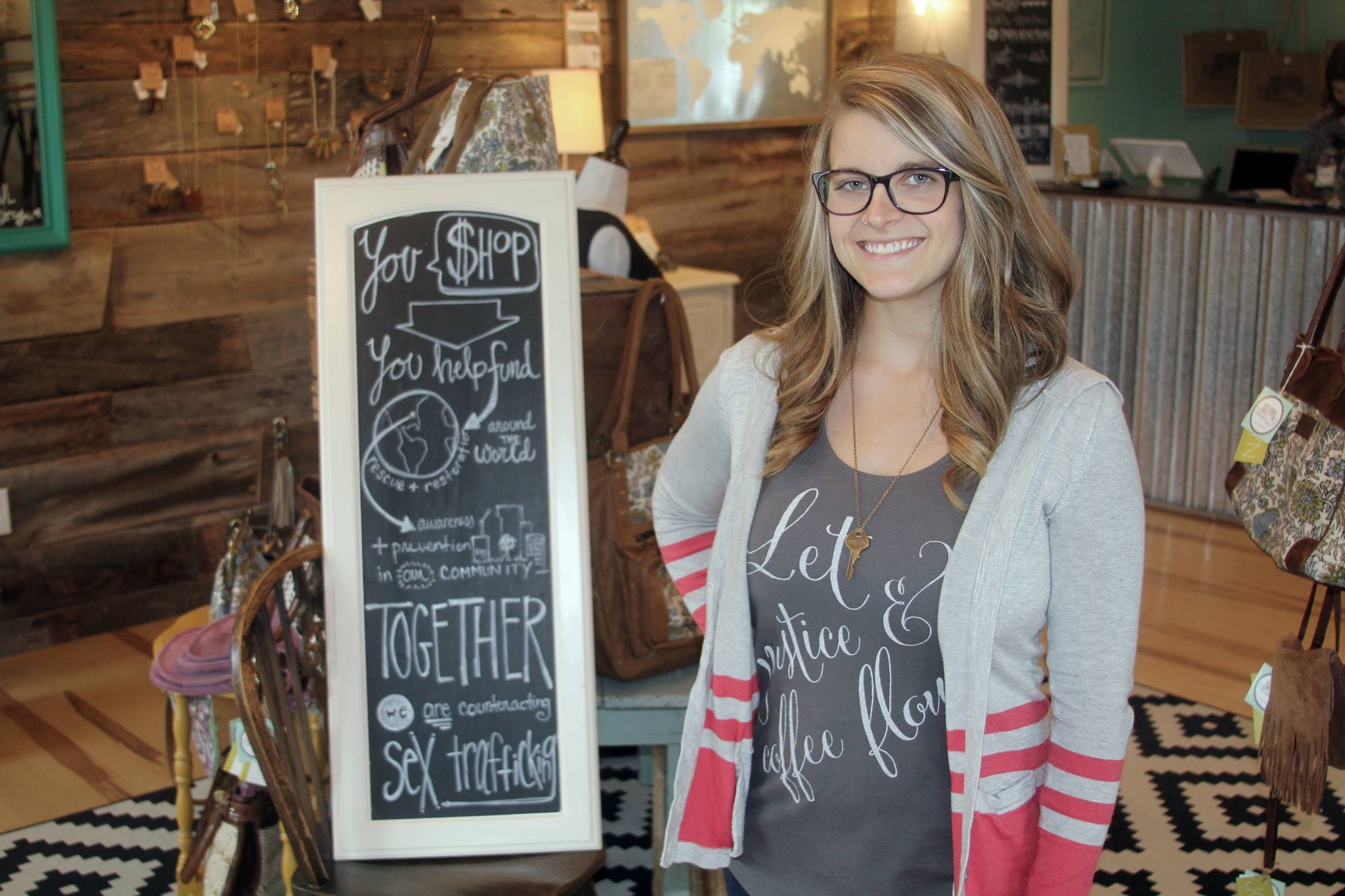
Name: Caitlin Tice
Occupation: Director of administrative and volunteer services at New Creation Virginia
Congregation: Eastside Church
Location: Harrisonburg, Virginia
1. What are the things that have kept you connected to the church?
I would definitely say the people. There have been a few people throughout my life that have encouraged and challenged and uplifted me. People who did the hard work of holding me accountable when I needed it most. If it wasn’t for those people, I might be in a very different place.
2. What college did you attend? What was your favorite class and why?
I attended Goshen [Indiana] College and then I took some classes at Eastern Mennonite University [Harrisonburg, Virginia] for a Graduate Certificate in Nonprofit and NGO Leadership. One of the classes I took at EMU was Organizational Behavior taught by Dave Brubaker. This was the first class that I took for this certificate at EMU and I felt like I had no idea what I was doing. I had gotten my undergrad degree in social work and this was part of the Masters of Business program, so I felt out of my element.
This class was a perfect bridge. It brought behavioral and social aspects into conversations with business practices. I loved being able to think about what I had previously learned in undergrad and bringing that into the business sector. My favorite piece was to think about using different personalities and gifts to maximize the productivity of the organization.
3. You served for a year in San Antonio, Texas. What drew you into the Mennonite Voluntary Service program after you finished college? Tell me about the coffee shop and after school program that you helped to start there.
I moved home for a year after college and then I did Mennonite Voluntary Service for a year after that. During this year at home was when my church, Eastside, was first launched. It was the relationships I built during this time that challenged me to look outside myself and not get settled into a routine just yet. So I decided to apply for MVS.
When I first moved to San Antonio and started my MVS year, the coffee shop where I was placed was already in existence. But about a week after I started, they closed their doors for a renovation project that was supposed to take five weeks and ended up taking nine months.
So essentially we started from scratch when we opened the doors again. Previously it was just a small coffee bar that served as an after school hangout for local youth, but when we reopened, we had a full-size kitchen and we served breakfast and lunch. We also had a conference room and a space for students to study quietly after school. We also had 12 computers in the main room for students to use in their studies.
During the time when we were closed, I did a lot of research on new equipment we needed. We did a lot of planning and dreaming for the kind of programs that we wanted to start after we reopened. Eventually, the after school program that we helped to start grew large enough that it separated from the restaurant/coffee shop and moved across the street.
4. You currently work with an organization that seeks to prevent and address human trafficking. How big of a problem is this in the Shenandoah Valley? What do you think is most important for people know about human trafficking in the United States in general?
The thing about human trafficking is that it’s designed to be hidden, so it’s hard to know how big of a problem it is. Here in the Shenandoah Valley, we have really large interstates that run through Harrisonburg and nearby areas. There’s a big network of highways that allow traffickers to travel from state to state, which then makes them harder to catch. Another complex piece is that these highways cut through many different jurisdictions and agencies that have to work together and coordinate efforts.
What people most need to know about human trafficking is that it’s not just something that happens only in Africa or India or overseas; it happens here in the United States and in our communities.
Again, many people aren’t aware of this because it’s designed to be hidden. The more aware we are, the more likely it is that we’ll be able to notice suspicious activity and do something about it.
I would also tell people that if you see something suspicious, don’t ignore the problem: do something. Signs can include things like not making direct eye contact, somebody not having access to identification, somebody not allowing the person they are with to have any say (speaking for them) or signs of physical abuse.
There was a case in New Kent, Virginia, recently where a trucker was at a truck stop and noticed nearby that there were men going in and out of a camper every couple of minutes. He thought this was suspicious, especially when he saw a girl’s face peek through the curtain of the camper. He called 911 and he really saved this young girl’s life. Had he not been paying attention and being aware and then been brave enough to call and do something, who knows what would have happened? These behaviors are not something to be ignored.
5. How did you get involved in this work?
Well, long story short, it was definitely the Lord that drew me to it.
I was at a crossroads in my life. I was taking classes at EMU and wanting to go further into getting my MBA, but not getting the financial assistance I needed. I was frustrated with where I was at. Several people told me about this woman in the community who was operating “business for the greater good”, which was the whole focus of the MBA program I was in. All these people kept telling me about this woman and telling me that I needed to meet her.
One day I was in my apartment, hanging out with Ryan (then my boyfriend, now my husband), and he told me he had met this woman that day during his work with a local news station. They did

a story on her because her organization had recently purchased a former pornography shop and were turning it into another business. I remember Ryan said, “Maybe you don’t need educational experience or classroom experience right now, but maybe you need to get out there and learn by experience.”
So I e-mailed Sabrina, who’s the director of New Creation. When we met, she introduced me to the organization and brought me over to the building that they had just purchased, and that’s how I got started. There was an awesome business in my local community that was doing good and I wanted to be a part of it. I was focused not just on making money to pay my bills, but I wanted to be making a difference.
The fact that I get to hear stories in our organization about how God is moving in our staff member’s lives, in our community and with survivors of human trafficking is powerful. Luke 4 is a verse I like to go back to often to remind myself of the importance of our work. It’s when Jesus reads from Isaiah at the synagogue, and he reads about bringing good news to the poor, recovery of sight and setting the oppressed free. I love that in this verse Jesus is calling us to join in his mission.
I started working with NC in a volunteer role. We have a retail store that sells items made by survivors. Before we had this building, we would take their products on the road and participate in vendor events. I would help with those events and started working as a volunteer coordinator. As time went on, the organization realized that having only one staff member was not going to be sustainable. We started talking through some options.
I met with staff from Virginia Mennonite Missions as one option. Now I’m a full time mission worker through VMMissions. I raise support through individuals and churches. My first year I did a program called TranSend, which is an intern program. There’s a matching grant, so you don’t have to raise quite as much. That was really easy. I asked friends and family and the fundraising was basically done.
A year later, when my term was about to end, we looked into doing a long-term mission assignment with VMMissions. I started a two-year term on September 1, and am still in the heart of fundraising!
6. What does a normal day at work look like for you?
There’s not really a normal day. I do a lot of sitting at my desk and working on a computer. I do a lot of behind the scenes things. I manage books, volunteers and interns. I work on ordering supplies, sending e-mails, etc. Occasionally I do some awareness-building events in local churches and clubs.
The building we own is a two-story building. The second story is our offices and the first story is the retail shop, and we have volunteers that staff the “Shoppe.” I often like to head downstairs to talk with customers and check in with our volunteers.
7. If you were making someone a mixtape (pretend that still happens) or a playlist, what three songs would you definitely include?
That’s really hard. I love music and I listen to all kinds of different styles, but when I think about my favorites, I would say:
- Nickel Creek always puts me in a good mood, although there’s no one specific song I’d pick.
- The Steel Wheels, “One Night.”The Steel Wheels have a local festival every year that they host, that’s one of my favorite events to attend every year. This particular song was the song my dad and I danced to at my wedding, so I could listen to it over and over again and relive that memory.
- Hillsong United, “Touch the Sky.” This has been a really inspirational song for me lately. In the chorus it says, “I found my life when I laid it down.” The image of opposites reminds me of growing up hearing the phrase the “upside down kingdom” and of the importance of humbling yourself.
Almost every week we publish an interview with a Mennonite reflecting on their faith journey, life and work. Read past interviews.


Have a comment on this story? Write to the editors. Include your full name, city and state. Selected comments will be edited for publication in print or online.