


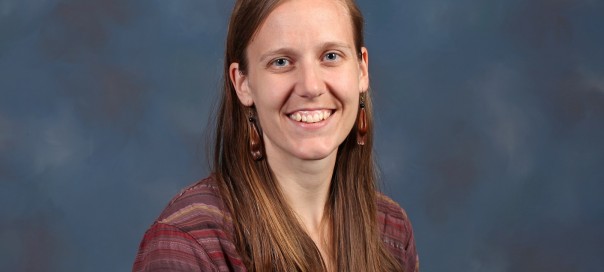
Name: Jessica Stoltzfus Buller
Home congregation: Walnut Hill Mennonite Church, Goshen, Indiana
Official title: Peace Education Coordinator for Mennonite Central Committee US
1. How did the church you grew up in talk about the concept of peace? What did you think it meant to be a pacifist Mennonite?
I think growing up at Walnut Hill, I learned that peace is central to the Gospel. You can’t read the Scripture and not understand that peace is the central message that Jesus speaks.
Peace means loving your enemy. It means taking those words from the Sermon on the Mount (Matthew 5) seriously; taking them to be a literal and true call to embody and not just a pretty word picture.
Growing up, it was a challenge to know how to live peace out. In a daily life it meant getting along with my friends, not being mean, being inclusive, etc., but I didn’t have a lot of interaction with people who were very different from me or in conflict scenarios. My understanding of peace started to feel a little bit conflicted with my lifestyle. It felt like, if we are actually called to be peacemakers and to be a voice of nonviolence and Shalom in the midst of a violent world, is Goshen where I need to be?
That’s the main reason why I went to serve in Colombia [with Mennonite Central Committee]. I wanted to live in a context of conflict and find out what my peace commitment meant to me in that place.

2. You’re a product of several years of Mennonite education. How have those programs equipped you for the work you’ve taken on since then?
I would say that I am a strong fan and proponent of Anabaptist education. I was raised in it. I do believe that young minds are very formidable. I think the influences that culture and the outside world have on us—culture and media—are really strong. As young people are more and more and more involved in sports and music and have ten thousand things to do, the church, unfortunately, is one of the things that seems to get cut out of schedules. That wasn’t my experience, but I see it happening a lot.
We need the constant influences of peace theology and a commitment to being Jesus followers that reach us more often than just on Sunday morning. I think also that Mennonite educational institutions teach church history in a way that churches don’t teach it. You learn a commitment to the theology and to the history and the roots of Anabaptism, or at least you’re exposed to that kind of history in a way that you’re not exposed to it in church. Where else would you get it? Mennonite education is a key place where that happens.
3. You spent several years living and working in Colombia. How did living in a conflict zone impact the ways you think about peacebuilding?
I learned that peace is very messy. I think we idealize a black and white theology of peace sometimes. In a world where we don’t experience a lot of conflict, it can sometimes feel difficult to know how peacemaking plays out. There’s a textbook version of what peace is and how it looks.
Living in Colombia, being part of the armed conflict and being part of conversations about negotiations to end that conflict, I reinforced what I knew from my Anabaptist theology: That dialogue is really, really important and having everyone—all key stakeholders—be part of a conversation is really, really important.
There’s a strong sentiment in Colombia about victims needing to be involved in decision-making on how negotiation and implementation happen. Negotiation has been formal dialogue between government and the FARC [Revolutionary Armed Forces of Colombia]. There’s a real sense from the victims that they are the ones that need to decide how this happens and where and why. The voice of the victims are very important and need to lead the discussion.
But I’ve also learned that if we want a lasting peace, the victims can’t be the only voice. In Colombia, we’re talking about paramilitaries and guerrillas and civil population and multinationals and national governments needing to be in conversation. Finding compromise is really, really painful when it feels like the victims are being almost re-victimized by having to agree on things that aren’t ideal for them. But I’ve also learned, from many Colombians, that for long-lasting peace to happen, it will require compromise from everyone, even the victims, and even though that shouldn’t have to happen.
The other thing I’d say I’ve learned is how much conflict and violence here actually does touch us no matter where we are. We shouldn’t think that we have to go abroad to work for peace and justice. That doesn’t make sense.
I think some of my leaving was a frustration or anger with not addressing that kind of low level local conflict. We glorify peacebuilders abroad, but I think we have to continue to work on addressing conflict here in the United States, too. Within our communities. Colombians have learned to take really good Anabaptist theology, use very biblically-based ideas and go into their communities and their homes and places outside the church and work at peacebuilding. Colombian Mennonites are some of the very well-respected voices in the national peace movement in Colombia, and that work comes straight out of their Anabaptist peace convictions.
We need to continue to push ourselves to do that more; to take our theology and use it beyond ourselves. In the US sometimes, we can get caught hiding behind our history. Peace work has to be current and constant all the time.
4. What did you learn from Colombian Mennonites?
I learned never to give up. Peace is really slow, and Colombian Mennonites are really patient. They’ve dealt with civil war for almost 60 years and they are fearless. Their candle is always burning. I’ve seen them down, but I’ve never seen them say, “We can’t accomplish that.”
My former boss really believed that our small Anabaptist organization can be a game-changer for Colombian peace at a National level. He has this big vision and sometimes I wanted to say, “That’s not possible.” But the strength of their belief and their hope is very strong.
I’ve also learned to believe that we have to work with the government. We can’t be our own little world that creates peace and a Shalom community apart from the broader world. It’s a fine line, because there is a part of who we are and who we need to be that is being a light to the world and a model and a witness. But I’ve also learned that we have to work with imperfect people and imperfect systems to create change. The government is a huge player in most countries and long term change will have to involve them at some level.
5. Given this commitment, what would you tell Americans right now in the midst of a presidential election year?
In general we are first and foremost members of the Christian body and members of the people of God. And God is the leader that has defined for us what is right to follow. But secondly, we are citizens of a country or of countries and we therefore participate in those systems of politics whether we like it or not. Recognizing that and learning to work within these systems in that order (God, then country) is important.
6. How would you describe what the MCC peace educator does?
I’m still learning. Ask Titus Peachey [the former MCC peace educator who recently retired]. This role is supposed to educate and resource MCC constituents on peace. MCC constituents include people from Mennonite Church USA, Mennonite Brethren Church, Brethren in Christ, Conservative Mennonite Conference, Amish and Beachy Amish.
Peace is a really big umbrella. Historically we have talked about peace as being opposition to war, but if we look at Shalom as peace, that includes poverty, development, racism, conflict resolution, etc. So I think one of the jobs of the peace education coordinator is to help the church connect those dots, understand what it means to be a peace church and to find ways to live out that call.
In Colombia we talk about integral peace. This role is helping the church think about how all of these different pieces fit into what we understand as our peace witness. This could be resourcing through learning tours or events or worship resources or Sunday school materials or youth events. In a lot of ways, it will mean partnering with and giving feedback to different programs or partner organizations.
7. What are some of the ongoing projects that you’d invite people to get involved with?
This is not an ongoing program, but what I am doing right now is visiting people. I would invite anyone to invite me to their church, because in this first year I’m doing a lot of listening to what churches think about peace education.
What do you think we should be focusing on in the church? MC USA just passed the Faithful Witness amid Endless War Resolution. What does that mean for us? What is the work of MC USA? Is it antiracism? Is it ending gun violence? Is it conscientious objection? What’s the center of our peace work or is it this myriad of things?
We have to recognize as a church that war is different now so peace is also different now. As the resolution has stated, we are in a state of constant war. Maybe not formal war, but we are in a state of constant war. So, what is our state of constant peace? We have to think about all of the ways that “war” is happening, especially if we consider that war is violence done against people and God’s creation.
There are also two things that are tentative that we’re dreaming up with Jason Boone from the Peace and Justice Support Network:
- There’s a movement among churches in MC USA who have been talking about the idea of a peace camp. Parker Palmer writes about how the military trains for war. There’s a long, hard and intentional process of training. Palmer says, why do we expect as a church that we can do nonviolent action and peacebuilding without that intensive training? We need to have peace boot camps all over. There seem to be a number of churches thinking about this idea and peace camps are springing up in MC USA churches around the country.
- We are planning on doing a two day peace gathering right before MC USA convention in Orlando to specifically dialogue around what our peace witness is during a state of endless war. This will be the first of many conversations. Historically there were summits like this that happened for decades, and we want to try it out again. Anyone is welcome to participate. It will be a space to share and listen to one another as we follow God’s call to peace together.
Read previous Seven Question interviews.


Have a comment on this story? Write to the editors. Include your full name, city and state. Selected comments will be edited for publication in print or online.