


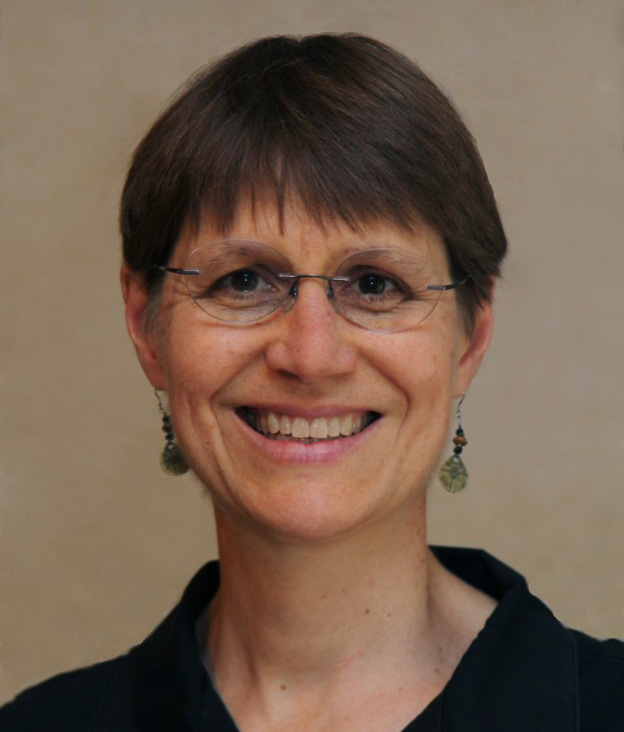
Name: Heidi Regier Kreider
Role: Conference Minister, Western District Conference
Home congregation: Attending Faith Mennonite Church, Newton, Kansas; Member (and former pastor) at Bethel College Mennonite Church, North Newton, Kansas
1. What is your earliest memory of church?
One of my earliest memories of church is in the Mennonite congregation at Nyanga, a village and mission station in the Democratic Republic of Congo.
I was living there as a child with my parents who were working with Africa Inter-Mennonite Mission (AIMM; formerly Congo Inland Mission). We lived on a farm 2 kilometers away and usually walked or rode a motorcycle up the sandy road to the church. On rainy days, we could stay home because in the rain we didn’t go that far on foot or motorcycle.
My memories from that church were singing songs in Gipende, including their translation of the hymn, “For God so loved us” or “Gott ist die liebe.” And I remember the multiple choirs in the church and the annual Christmas pageant which had much fanfare.
2. If someone asks you what it means to be a Mennonite, what would you tell them?
I have multiple ways to answer this question.
For me, one way of looking at it is belonging to a family of churches shaped by the Anabaptist movement which grew out of the Radical Reformation. I also appreciate Palmer Becker’s summary in his booklet What is an Anabaptist Christian?, which emphasizes the three tenets: Jesus, community and reconciliation.
For me this means working to pattern my daily life after Jesus’ teaching and example. It’s practicing active peacemaking, nonviolence and justice, and participating in a worshipping community that exercises mutual accountability and interprets Scripture through the lens of Jesus’ life and teaching.
I would also say that while I enjoy the culture and ethnic background that my particular Mennonite people come from, I would prefer to define “Mennonite” theologically and spiritually, not ethnically. We share this common spiritual tradition with people of many racial-ethnic and cultural backgrounds. I think of the Mennonite community in which I grew up in Congo and the ethnic diversity in Mennonite Church USA today. I feel an affinity with the wider global Mennonite community and have been shaped by a global sense of the church.
3. When did you first realize that you were called into pastoral ministry?
As a child growing up in the context of a missionary family, I always had a sense of the importance of the church as central to God’s purposes. That was the air I breathed. So I assumed I would do some sort of church-related work when I grew up because I observed that the church was an important instrument of God’s work. But it never occurred to me as a child that I would be a pastor because I didn’t have any female pastor role models.
In college, I pursued interests in Bible and religion and church music. It was really while playing the organ in church services that I felt most strongly drawn into ministry. But there was never just one point that I suddenly felt called. It was a gradual journey of using my gifts in the church and doing what I was interested in and enjoyed.
4. What has been one of the most surprising parts of the transition from pastoral ministry in a congregation and into conference ministry?
It is a different sphere of church membership that is both very public and somewhat lonely. On the one hand, I belong to the whole conference and feel at home visiting many different congregations. I love visiting congregations and feel a connection to them in all their variety.
But I sometimes feel adrift or even aloof because I’m not deeply involved in one particular congregation due to my travel and my role as a pastor to multiple pastors and a network of congregations. This reality wasn’t a total surprise—I anticipated it—but I continue to work at adjusting to it.
5. Tell me about Western District Conference (WDC). What are you learning about the gifts and particularities of this conference?
I have a long list here. WDC has a large geography. In my first one-and-a-half years as conference minister, I’ve visited congregations in locations all the way from Beatrice, Nebraska, to Houston, Texas, to Kansas City to Turpin, Oklahoma, and places in between.
WDC has experienced diversity in its DNA from its very beginning. Not surprisingly we’ve also experienced conflict and division. Yet we seek to work together across differences with the understanding that our differences do not prevent us from being part of the same church and sharing a common mission.
WDC values leadership and is fortunate to have very gifted and dedicated pastors serving in congregations. WDC has been a leader among Mennonite conferences in offering opportunities for women in ministry. The conference makes it a priority to provide strong support for pastoral leaders through resources like continuing education and scholarships, healthy boundaries training, IBA and SeBAH training [theological education for Hispanic Mennonites], and consulting and leadership development. Currently we have a grant from the Kansas Leadership Center in Wichita that has provided opportunities for congregational leaders and members to receive adaptive leadership training.
WDC has placed a high priority on education. We have had a strong relationship with Bethel College in North Newton, Kansas, throughout our history, and value our connection to Camp Mennoscah, our church camp, for over 60 years. Those institutions have been important in shaping who we are. WDC also has an excellent resource library that serves both our local patrons and also congregations at a distance, including congregations beyond WDC.
6. What are your hopes or dreams for the next year or two of ministry in this context?
A conference minster, I hope to continue to build relationships with pastors and congregations. I’ve only been in this role since August 2015.
I hope we as a conference can find ways to more effectively support congregations to grow in vitality and relevance. We see a lot of congregations seeking support for mission and outreach in their local communities.
Another dream is to increase intercultural competence and continue the work of anti-racism, as we nurture cross-cultural relationships within WDC.
7. If you could travel anywhere in the world, where you would you go and why?
Right now I would like to travel to Europe to visit friends and exchange students with whom we have connected over the years. And I’d like that trip to include biking in the Netherlands with plenty of stops for coffee and pastries!
Interview by Hannah Heinzekehr. You can also read past seven question interviews online.


Have a comment on this story? Write to the editors. Include your full name, city and state. Selected comments will be edited for publication in print or online.