


The long, innovative tradition of cross-cultural education continues at Mennonite colleges.
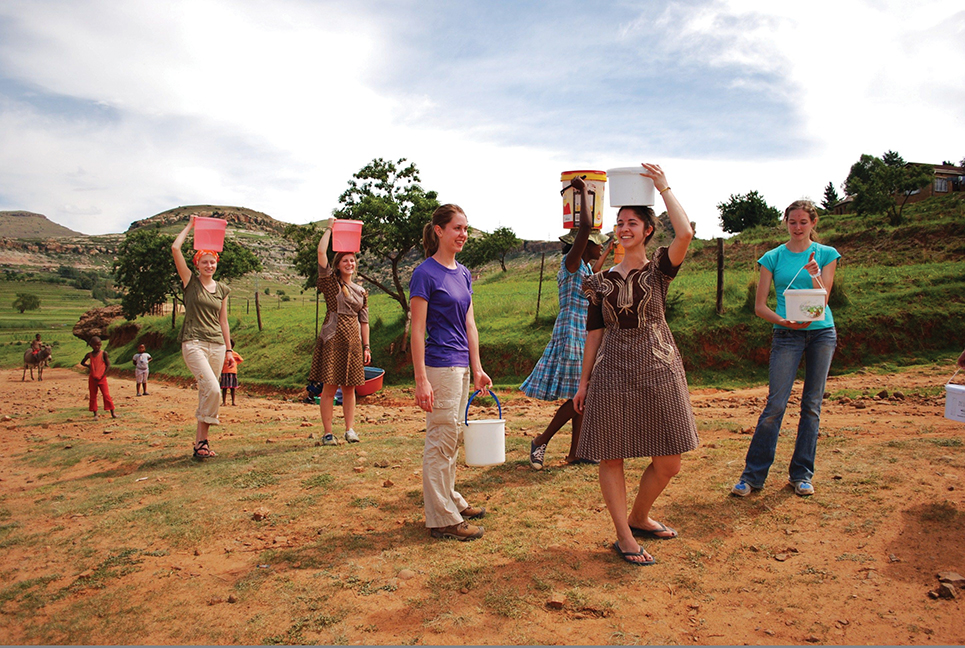
Within days of landing in Botswana, Kali Emans and her classmates from Bluffton (Ohio) University arrived in the small village of Pitseng, where they spent much of their three-week cross-cultural study program.
Their visit coincided with a teachers’ strike, which came at an inopportune moment for students of Pitseng, soon to face an important test to determine if and how their formal educations would continue.
Emans, an education major, and others decided to help by tutoring 15 or so students preparing for the test. One of the best things Emans found she had to offer was working with the students on their English, the test language.

In the evenings, Emans stayed with a host family; the near-total language barrier that existed between her and them made things difficult at first. Before long, though, these two things—tutoring English learners and the anxiety of not being able to communicate with people around her—coalesced into something bigger: Emans decided to become an ESL (English as a Second Language) teacher.
“It just opened my eyes … to see the struggles because of language barriers that children deal with on a day-to-day basis,” says Emans, who graduated in 2013 and now is a high school ESL instructor in Fuquay-Varina, N.C. “Me experiencing that [language barrier] in another country allows me to relate to students experiencing that in a classroom here.”
Hers is one of countless such stories of new clarity and life direction gained through cross-cultural study at a Mennonite college or university. And stories like these are a reason why, time and again, faculty and staff at these schools hear returning students describe these experiences as a, or the, highlight of college.

In decades past, the fact that Mennonite colleges allowed and encouraged students to study abroad (or in unfamiliar settings closer to home) was once distinctive in itself.
Today, as study-abroad programs have become the rule rather than the exception in American higher education, cross-cultural programs at the five Mennonite-affiliated colleges or universities in the United States—Bethel College in North Newton, Kan., Bluffton University, Eastern Mennonite University (EMU) in Harrisonburg, Va., Goshen (Ind.) College and Hesston (Kan.) College—remain at the leading edge of preparing students to live and work in an increasingly multicultural world.

“Our education is part of a belief and a faith tradition that all people in the world are really one people,” says Paul Neufeld Weaver, cross-cultural program director at Bluffton University. “We want students to catch that vision.”
While each Mennonite institution’s cross-cultural program has unique characteristics, the following themes are common to most or all of them and distinguish these schools, as a group, from the crowd:
1. Decades of tradition and experience
Bethel College’s Wuppertal exchange program may be one of the oldest exchange programs in the United States, according to Merle Schlabaugh, adjunct professor of German and Bethel’s study abroad adviser. Continuously running since 1951, the exchange program with Bergische Universität in Wuppertal, Germany, runs two ways: This past fall, two Bethel students studied in Wuppertal, while two students from Germany enrolled in classes at Bethel.
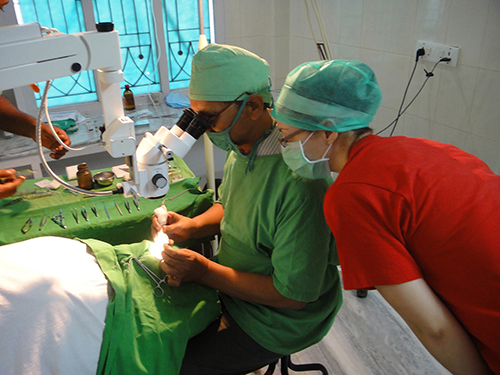
In the mid-to-late 1960s, the first foreign study programs began at Bluffton and Goshen. Bluffton’s earliest destination was Colombia, offered as either a 12-week or three-week program. Goshen launched its Study Service Term, or SST, in 1968, with programs in Costa Rica, Jamaica and Guadeloupe, while EMU’s earliest cross-cultural trip, to the Middle East, was in 1972.
Hesston, a two-year college, has offered a multiweek choir trip—including heavy doses of Anabaptist history and humanities—to Europe every other year since 1980.
2. Cross-cultural study as a requirement
While nearly every university now offers some sort of cross-cultural study, few require it. Of those few are all the four-year Mennonite colleges or universities in the United States, which were also among the first to do so in the country.
At Goshen and EMU, most undergraduate students participate in one of several semester-long programs. Bluffton and Bethel each offer one semester-long program per year plus an assortment of several-week programs during breaks (EMU also offers some May programs).
Each of these schools also offers alternative cross-cultural study opportunities (usually involving interaction with an unfamiliar culture close to home) for students who are unable to study off-campus or transfer credit from other off-campus experiences.
3. Faculty leadership
Cross-cultural study programs at Mennonite colleges and universities are overwhelmingly developed and led by faculty and staff rather than outside vendors. Linda Martin Burkholder, interim director of cross-cultural programs at EMU, says faculty-led, semester-long programs are particularly distinctive, as most other universities’ faculty-led trips occur during breaks.
Faculty leadership also gives individual programs their own academic flavor, depending on the leaders’ expertise and life experience. A semester program to Central America led by a biologist, for example, could differ significantly from another program to the same destination led by a sociology professor.
4. Institutional commitment to cross-cultural education
Requiring students to earn cross-cultural credit requires a supportive atmosphere on campus, where advisors and professors understand cross-cultural study as part of a broader educational goal rather than an inconvenience to smooth academic progress.
At Goshen, for example, the fact that the SST program has been going for 45 years makes cross-cultural study and the on-campus adjustments it requires “embedded in the culture of the college,” says Tom Meyers, associate academic dean and director of international education.
When so many students, faculty and staff go on an off-campus cross-cultural term, their experiences inevitably filter back to campus, where they can inspire, inform, influence and reinforce the underlying mission of cross-cultural education.
5. An immersion experience, far off the beaten path
According to recent estimates by the Institute of International Education, about half the American college students who study abroad go to Western Europe, mostly to just four countries: the United Kingdom, Italy, Spain and France.
The Mennonite college programs, though, have long sent students to destinations less closely related, culturally speaking, to our own. Collectively, they have sent students to dozens of countries all over the world.
“From the very beginning, we’ve tried to focus on countries that are significantly different from North American and European cultures,” says Meyers.
In this vein, EMU’s programs purposely minimize in traditional tourist areas, says Burkholder.
“We try very hard to create programs that are culturally immersive,” she says. “[Students] are interacting with real people around real issues, … and that results in a deeper level of learning that we want for our students.”
Home-stays with host families often play a significant part of achieving this and are among the most talked-about aspects of the cross-cultural trips after students return, says Burkholder.
While all five Mennonite colleges and universities offer some cross-cultural programs that include home-stays, these are particularly prominent in Goshen’s SST programs, most of which place students with host families for the entire semester.
6. Dramatic, long-lasting impacts on students’ lives
One of the most profound effects of studying in another culture, says Schlabaugh, is the ability it gives students to “look at their own culture through different cultural lenses.”
By the time they get back home, participants are changed in all sorts of ways—pragmatically, spiritually, politically—that persist for years.
Katie Miller, who toured Europe with the Hesston choir in 2012, gained new appreciation for “the rich history that our faith has” after visiting Anabaptist historical sites.
“I hadn’t really ever thought much about the fact that the Anabaptists were persecuted so much that they had to hide in caves in the mountains,” says Miller, now a senior music education major at EMU. “We had Communion [in one of those caves] … and took some time to reflect on what being Anabaptist means to us. … We have so much to be thankful for that we take for granted.”
Practically speaking, the culturally immersive focus of these cross-cultural programs can force students to new levels of independence and self-sufficiency.
“The whole study abroad experience was one of the most formative of my whole life,” says Lisa Thimm, an assistant professor of mathematics at Bethel who earned her undergraduate degree there in 2001.
Thimm spent the fall of 1999 in the Wuppertal exchange program before studying mathematics the following semester in Budapest, Hungary. Thimm lived alone in Budapest, where few people spoke English.
This meant that life minutiae, like rent negotiations, often became adventures. Surviving and thriving on her own for months there gave Thimm new confidence in knowing she had “the capacity to figure things out and get things done.”
Other alumni look back on careers directly shaped by their cross-cultural experiences. Rita Lopienski went with Goshen’s SST program in 1976 to Haiti, where she taught violin lessons at a summer camp in the town of Léogâne. She enjoyed it so much that she returned for several more summers.
After graduating in 1978, Lopienski earned a master’s degree in music education and became a music therapist based in Bartlett, Ill., where she works with hospital patients and residents of long-term health facilities.
Others experience a fundamental shift in the way they think and live. Philip Borkholder signed up for EMU’s Central America cross-cultural in 1985, largely because a few friends were going. But after learning about the region’s poverty and wars—and the American government’s role in perpetuating these—Borkholder found himself simultaneously “radicalized” and in love with a once-unfamiliar part of the world.
“It was like someone took a big fire hose and washed out all the dirt around the roots of my life, and made me start all over again,” he says.
He later spent five years in Central America with Mennonite Central Committee and, since returning to his home in Michigan, has maintained close ties to the communities he worked in.
In conscious emulation of the way immigrant workers send remittances from their American jobs back home, Borkholder has used his good-paying computer programming job to help finance college educations for seven Central American students and fund other projects in their communities.
“It was a life-changing experience,” he says. “There isn’t a week that goes by where I don’t remember something. It affected me forever.”
Andrew Jenner is a freelance writer in Harrisonburg, Va., and a 2004 graduate of Eastern Mennonite University in Harrisonburg.


Have a comment on this story? Write to the editors. Include your full name, city and state. Selected comments will be edited for publication in print or online.