


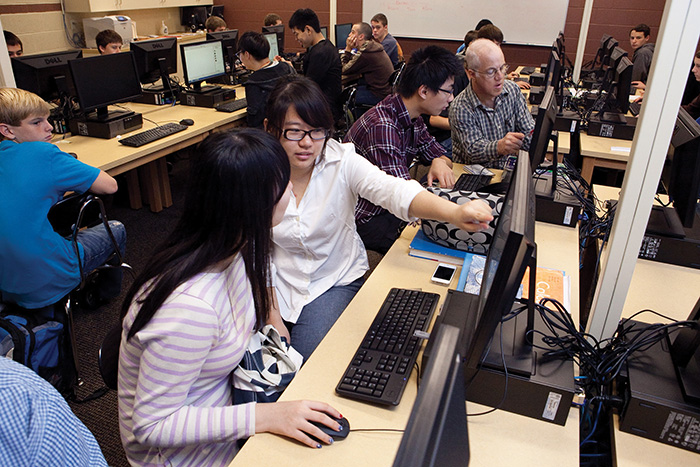
When the founders of Mennonite high schools in North America began to develop their campuses, they probably didn’t imagine the Chinese, Korean, Japanese, Ethiopian and Colombian students who would fly halfway around the world to attend. Neither could they have envisioned Chinese pop music floating from a dormitory, Korean drums in chapel or Colombian worship leaders.
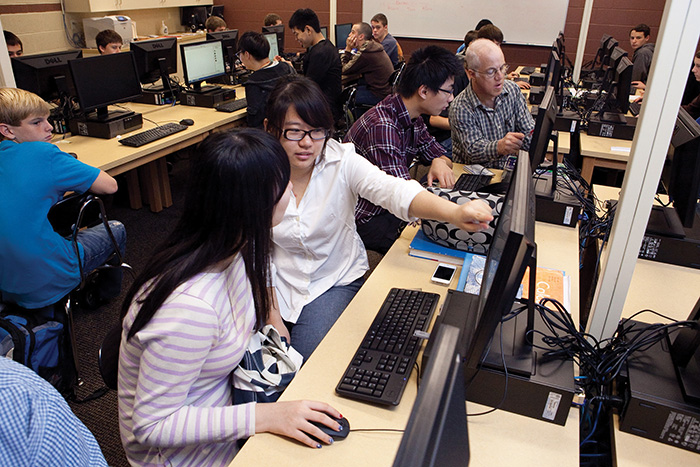
But in 2013-14, many Mennonite high schools have an international student presence. Bethany Christian Schools (Goshen, Ind.), Central Christian School (Kidron, Ohio), Christopher Dock Mennonite High School (Lansdale, Pa.), Eastern Mennonite School (Harrisonburg, Va.), Freeman (S.D.) Academy, Lancaster (Pa.) Mennonite School, Rockway Mennonite Collegiate (Kitchener, Ontario) and Western Mennonite School (Salem, Ore.) are a few of the schools that have opened their doors to students from around the world.
Introducing students of different cultures into a high school campus has its challenges. The natural tendency to clump together into groups of “people like me” can sometimes rear its head. But faculty, staff and U.S. students all say their campuses benefit from the presence and contributions of international students, and the U.S. students who seek out friendships with international students are rewarded with fresh perspectives and new ideas.
In the classroom
For teachers, having students from around the world in their classes is a real benefit.
“In one of my classes, I realized I had five different countries represented,” says Zach Bower, a history and social studies teacher at Christopher Dock. “That generates a lot of rich discussion.”
That discussion is important to guidance counselors like Cathi Hunsberger, who works on Christopher Dock’s curriculum committee. “We often talk about the global perspective,” she says, “but having students as a part of our community really brings that home. We’re one community, getting to know each other.
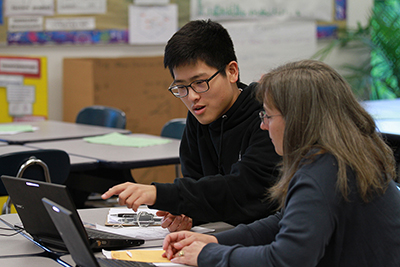
And Dorcas Lehman, campus pastor and counselor at Lancaster Mennonite School, says LMS probably wouldn’t have Chinese classes as part of its curriculum if it wasn’t for the Chinese international students on campus.
“It really is the global village,” she says. “Millennials are the first generation to experience the day-to-day global village, and in a way, that global village comes to us.”

Heather Rudy, a senior at LMS, has benefited from the global village on her campus. “When you talk with someone from another country, you understand world issues and social issues in a different way,” she says. “I viewed China as a country and a culture, and I didn’t look at the modern day social structure. Now I’ve learned how they view women and how they view men, how they view occupations, how they view Japan—I knew there was tension, but not the depth or the reasons. I learned not from a textbook but from the people themselves.”
As a Chinese student on an American campus, Catherine Huang, a student at Central Christian School, believes it’s important to have international students on campus to fight misperceptions about other cultures.
“Talking to people from different backgrounds gives you different perspectives,” she says. “The nice thing is you don’t have to agree with everything everyone says, but you learn from it. Many Americans have stereotypes of another culture; it’s good to let American students learn from real people.”
Kathy Moyer, who teaches English at Christopher Dock, says she has given up making assumptions.
“I used to make assumptions about international students, but our international students are like other students,” she says. “But because they’re away from home, they have needs that you just don’t think of right away. So I’m learning and growing, too.”
Faith formation
Having students from around the world come to campus can be an eye-opening faith experience, as well.
“Exposure to our international students has helped us to recognize God’s people on a global scale,” says Jim Buller, Bethany Christian School’s admissions counselor. “It helps us think about other ways to look at the world.”
Many of the international students on Mennonite school campuses are not Christians. They come for education at an American school, and while they are aware of the beliefs of their host school, they don’t necessarily share them.
Far from being a problem, however, numerous teachers and students say the outside perspective on their own beliefs was important.
Zach Bower, who is the liaison between Christopher Dock and Dock House, where international students can board, says working with international students has helped him develop a deeper sense of compassion.
“I see these students having to live in a culture [where] they’re the outsiders,” he says. “I experienced a deep sense of empathy and it’s changed me. I haven’t been forced to do that in my own life.”
Katherine McCoy, a sophomore at LMS, developed a close friendship with Chinese student Vivi Song, who wasn’t a Christian. Song’s perspective made McCoy take a look at her own faith.
“She had morals that were identical to Christian morals: be kind, treat someone else the way you’d want to be treated,” McCoy says. “She was attracted to Christianity because it had things in common with what she believed. She went to a conservative nondenominational church and got a Lutheran experience and a Mennonite experience. Her questions made me think about why I believe the things I believe.”
Lachelle Hackman, a dorm advisor at LMS, says she had an experience that forced her to think about the rituals and culture connected to North American Christianity when she offered to pray for a Chinese student who was sick.
“She said ‘yes’ but had never prayed before,” says Hackman, who prayed for the student in her dorm room. “When I was done praying, she asked, ‘Do you always have to face your door? Do you have to close your eyes?’ Thinking about that changed my perspective. I thought more about how I can pray anytime, and I wanted to put that into words that are easy to understand.”
One international student at LMS, a senior last year, said she’d never met a Christian before coming to LMS. “She knew about Christianity and wasn’t enthralled with what she had heard,” says Jon Heinly, Lancaster Mennonite Conference youth pastor. “She got to come here and experience living with Christians and seeing that it’s a way a life, not just a belief. Hearing her perspective forces us to reflect a little more on what we do and say and how we live.”
Outside the classroom
Rich Martin, admissions counselor at Western Mennonite School, says he enjoys seeing the ways international students and U.S. students come together, especially as the school year progresses. “It’s fun to watch,” Martin says. “As the year goes on, international students get integrated, and it’s fun to see friendships develop over the course of a basketball season or a soccer season.”

Martin says Western’s International Club gives international students a way to share their food and traditions with U.S. students, and international week includes meals from places like Ethiopia that allow many students to experience a different kind of cuisine.
At many of the Mennonite schools, international students are hosted with families. LMS has a dormitory as well as host families, and Christopher Dock recently opened Dock House as a home-away-from-home for international students.
Kayla Alderfer, a senior at Christopher Dock, says she has enjoyed building friendships outside school with international students.
“Language doesn’t have to be a barrier,” she says. “There’s a common perception that international students don’t want to talk. I think some might be anxious about their English, but if you give them an opportunity and are patient, many of them love having an opportunity to talk to someone.”
At LMS, international students have participated in the school’s Music Friday, playing songs or singing, sometimes with instruments unfamiliar to their U.S. audience. The spring drama at Christopher Dock featured a one-act play based on a Chinese proverb that was chosen specifically to involve international students.
“Seeing the students work together toward a common goal made me think, Wow, I don’t know where else I would’ve been able to experience something like that,” says Zach Bower.
The students who host international students learn about their international friends’music and food preferences, enjoy each other’s company and often get invited to visit China or Korea.
And students from the same country who may not know each other become friends, as do international students from diverse countries.
“We’re trying to demonstrate the value of inclusivity in the dorms,” says Hackman. “It’s hard whenever you have a group of people living together, but we’re learning about how we influence each other.”
“For me, it’s about hospitality,” says Dorcas Lehman. “What does it mean for a Christian school with Anabaptist values to also be a hospitable place to people of other faiths or no faith—whether international or not?”
Melanie Hess is a technical editor and freelance writer from Lancaster, Pa.


Have a comment on this story? Write to the editors. Include your full name, city and state. Selected comments will be edited for publication in print or online.