



Immigrants from Indonesia receive different treatment, depending on their circumstances.
Sunoko Lin, the bivocational pastor at Maranatha Christian Fellowship in Northridge, Calif., sees multiple sides of the immigration issue.
Lin came from Indonesia to the United States in 1985 to attend the University of Washington and study accounting.
 He says that being a Christian Chinese Indonesian means experiencing double discrimination, Chinese ethnicity and Christian faith. Normally, Christian Chinese Indonesians are given limited access to government employment positions or admittance into a public university.
“Many in my generation left Indonesia because we were mistreated because of our status,” he says. “If I had stayed, my only option would have been to attend the lesser quality, private colleges and pay a lot of money.” Going to the University of Washington was similar in price and a much better experience.
Currently, discrimination against Chinese Christians in Indonesia has decreased; however, people still want to emigrate to the United States for economic reasons and improved living conditions.
“For those who come here legally for school and get a job, the United States treats us very well,” he says. For Lin, his status as an international student and then finding a job as an accountant made the process relatively easy, and he became a U.S. citizen in only five years.

He became the pastor in 2004 and still works as an accountant.
However, as a pastor he sees the other side for those who lack resources—for example, affording higher education outside Indonesia.
It remains competitive to receive a visa, so many Indonesians apply for asylum—which offers no guarantees. Applying for asylum is costly, too. One case costs $1,500 for the documentation, with the added costs of court hearings and lawyer fees.
“If your petition for asylum is denied, you can request an appeal. However, the process may take years, with no guarantee of approval,” he says.
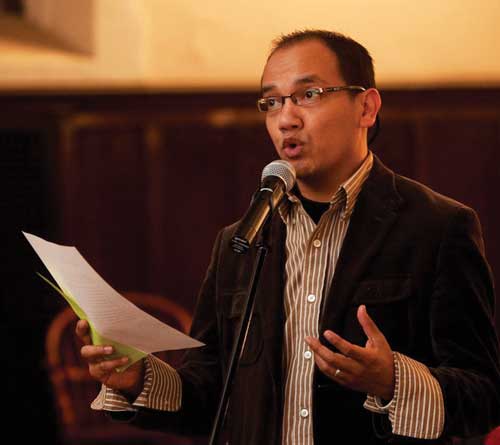 Aldo Siahaan (pictured, photo by Tim Moyer), pastor of Philadelphia Praise Center, says that finding a lawyer and in many cases a translation also costs a lot of money. Some of the immigrants at his church work in factories, and much of their income goes toward paying these fees.
These immigrants also need a lot of support from Siahaan and other church members in terms of translation and understanding when and where their immigration hearings are scheduled.
The undocumented individuals live in fear, and some disguise themselves when they are outside their home, Siahaan says.
At his multicultural congregation, 60 percent of the Indonesian immigrants are documented, and 40 percent are undocumented. Of the Hispanic immigrants at the church, about 80 percent are undocumented, he says.
“Most immigrants work hard and aren’t involved in crime,” Siahaan says. “They want to send money to their families back home.”
While Lin believes the issue’s costs and complexities is too much for one organization to take on, he suggests partnerships between Mennonite Central Committee, Mennonite Church USA, area conferences and others, especially in the areas of education about immigration issues and support for immigrants.
“Maybe together we can come with better strategies,” he says.
Lin is on the West Coast Mennonite Central Committee and Mennonite Mission Network boards. He received master’s degree in crosscultural studies from Fuller Theological Seminary in Pasadena, Calif.
Sunoko Lin told three stories of Indonesian immigrants of his acquaintance:
Removal withheld:
Six years ago, a member of our church found out his petition for asylum was denied. Five years ago, he had a surprise visit from Immigration and Customs Enforcement (ICE). He was sent to jail and faced deportation.
The church got in touch with an immigration lawyer to see whether or not a request for a “withholding of removal” could be granted. While there was no guarantee, after three months, an immigration judge who reviewed his case decided to grant him the removal. That means he can stay legally in the country without having to fear deportation.
However, this does not mean he has U.S. residency. If the United States finds another country suitable for him to live in, he has to comply and leave. Recently, he received a letter from a deportation officer that required him to report. He feared he would be asked to leave the country. However, it turned out that ICE has misplaced his “withholding of removal” paperwork and wants to receive updates from him.
The loss of a dream:
Two years ago, we lost an entire family due to deportation. This family had applied for asylum, but their application was denied. After the final appeal with the Ninth Circuit was denied, they decided to stay, hoping they would receive U.S. residency when their youngest U.S.-born son could sponsor them at age 21. However, that dream did not materialize.
One night in 2010, they had a visit from Immigration and Customs Enforcement (ICE) and were sent to jail for two months before they were deported to Indonesia. It was heartbreaking for the family. They had worked hard to achieve a better life in the United States. After many years of hard work since their arrival in this country, both husband and wife became area managers for a national-chain fast-food restaurant. Now their achievement and dream for a better life were lost.
Adding to their grief was that one of their three sons had to return to Indonesia only five months away from high school graduation. The church is still in contact with the family and learned that the family is still trying to cope with the loss of their dream of a better life in the United States.
A fortunate marriage:
One member of our church worked with a major cruise liner before he joined the church in 2005. His journey of living in the United States began that year, when he decided not to return to Indonesia after his contract as a seaman expired. For the renewal of his contract, he had to return to Indonesia. However, while the ship was docking in Fort Lauderdale, Fla., he decided to leave and come to southern California.
A few months after his arrival, he got married. His decision to abandon the ship and stay in the United States violates the international law that a seaman will not be accepted as a legal immigrant.
Several months ago, he received a letter from the deportation officer for an interview, and he was worried. About two weeks later, after arguing whether he should report to the officer, he decided to attend the interview. To his surprise, he was granted permanent residency because of his history of no criminal record and his marriage to a U.S. resident with two children born in the United States.
Anna Groff is associate editor of The Mennonite.


Have a comment on this story? Write to the editors. Include your full name, city and state. Selected comments will be edited for publication in print or online.