


When parents teach generosity to their children: a profile of four people
Among many generous people in the farming and business community of Archbold, Ohio, are Maynard and Myrl Sauder and their wives, Carolyn (Yoder) and Freida (Gingerich), respectively. These two couples’ largesse has benefited their local community and their congregations (Maynard and Carolyn are members of Zion Mennonite Church, Myrl and Freida are members of Tedrow Mennonite Church, Waueson, Ohio). They have contributed time, talents and treasure to Mennonite Church USA and the world beyond the church, particularly disadvantaged individuals, higher education and “people who need the gospel.”
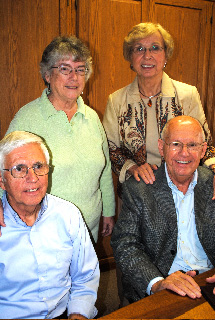
To what might one attribute the Sauders’ habit of giving?
The generosity of each of these four people—Maynard, Carolyn, Myrl and Freida—is likely explained in recent studies compiled by Mennonite Church USA. Eighteen individuals, known to be generous, were interviewed in a quest to learn why they were generous. The study led to one important finding: All 18 said they were taught to be generous at a young age by their parents.
You don’t chat long with the two Sauder couples before you hear them expressing gratitude for their parents’ gifts handed down: Erie and Leona Sauder of Archbold; John L. and Bertha Yoder of West Liberty, Ohio; and Eli and Abbie Gingerich of Kokomo, Ind.
Maynard and Myrl
Myrl, 72, sits across from his brother Maynard, who is 79, and says, “He is my model, my cheerleader, the optimist who balances out my pessimism.” Maynard responds, “Myrl is thoughtful, focused, inventive.”
In telling their story, they begin with their parents, Erie and Leona Sauder. Erie was an entrepreneur, beginning his own woodworking company in 1934. But more than that, Erie was a dedicated Christian and humane neighbor.

Leona was a homemaker, involved in the church and Erie’s partner in business. She took a correspondence course to learn bookkeeping. She became the business’ accountant and handled payroll. She wrote much of the company’s correspondence. She learned Spanish in order to relate to local residents from Latin America. And she raised three boys.
Erie, a member of the original Mennonite Economic Development Associates, made more than 20 trips to Paraguay to help establish a colony of Mennonites and neighboring indigenous people through his practical expertise in technology, agriculture and industry.
“My father was status blind,” says Myrl, citing an occasion of a phone call from his father in Florida in which Erie told of interacting with a plumber who had earlier installed a sprinkler system in the factory. But he declined to mention that on the same day he received a phone call from E. Gordon Gee, president of Ohio State University, who would later bestow on Erie an honorary doctorate.
Maynard tells of his father’s handing down responsibilities for the company. Maynard first worked as an accountant and office manager, later as general manager and by 1975 was named president. In 1965, Maynard asked Myrl, who finished an engineering degree from Ohio State University and was working in Indianapolis, to come back to Archbold and join the company.
“If you truly think you need an engineer, and if you promise not to put me in charge of a lot of people,” replied Myrl, surely in the quiet voice he uses to this day.
For more than 45 years the brothers have worked together “with never an argument between us.” Maynard loves management, marketing and sales. He’s a motivator and morale booster. Myrl has a technical mind. For example, he bought a microwave oven for Freida, but it didn’t fit properly into the kitchen so he made a cart for it. That product was perfected and given to the company, which eventually produced 1,200 of them per day.
Their parents modeled generosity with employees by establishing a Profit Sharing and Trust Plan in 1968 that gave 25 percent of the company’s before-tax profits to full-time employees. At that time, full-time employees numbered 96. Today there are nearly 2,000.
Erie handed down the business to his sons. In like manner, Maynard and Myrl have passed leadership responsibilities to their children. Len Geiser, formerly director of Goshen (Ind.) College’s Family Business Program, recalls “a favorite session,” when Maynard and Fred Meijer (of Meijer Stores) explained the process of moving their family business to the next generation.
Throughout their adult lives, the brothers have consulted each other in matters of financial stewardship. The brothers and their wives have often decided together where to make contributions.
The brothers have worked together in yet another way, giving care to an older brother who had limited abilities yet worked faithfully in the factory and at Sauder Village. Now retired, he lives in Fairlawn Haven Retirement Community. He, too, understands the value of being generous. The conversation with Myrl and Maynard invariably returns to their parents. “Dad planted trees and expected others to water them,” Maynard adds. “He was a wonderful, wonderful person.”
Carolyn Sauder
“My father, John L. Yoder, loved the Mennonite church,” says Carolyn Sauder. “He never spoke ill of it. So I, too, came to know and appreciate the church, its peace emphasis, its theology and doctrines.”
Similarly, Carolyn’s mother, Bertha (Krabill) Yoder was an ardent supporter of the local congregation. In fact, John and Bertha were instrumental in building the South Union Mennonite Church in West Liberty, Ohio. Her parents and grandparents helped establish a children’s orphanage (Adriel School) in West Liberty.
A dairy farmer, John L. Yoder, was a graduate of Ohio State University. He and Bertha valued education, so they supported their children’s formal schooling. Carolyn, along with her parents and six siblings, all studied at Goshen College.
As mother and active church and community participant, Carolyn developed a strong interest in people. She prays for friends in their trials. Carolyn is joyous and spontaneous, a happy traveler, an enthusiastic extrovert. She says she is happiest when with people.
Her interest in people, her heritage and the traditional arts led to a second vocation following her years of child rearing. Her father-in-law, Erie Sauder, was intent on recreating the history of the Great Black Swamp that once occupied much of northwest Ohio. He collected tools and artifacts and moved buildings in his efforts to construct a museum.
Carolyn was invited into what was becoming Erie’s energetic retirement to focus on the people aspects of this dream. She was there most every day, developing a management team, nurturing the many employees and volunteers and planning and implementing special events.
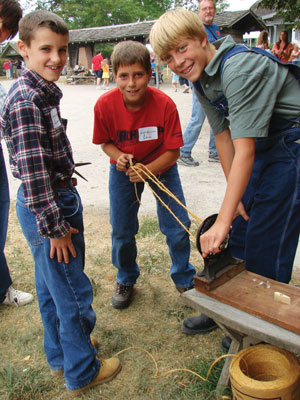
Today, Sauder Village, Ohio’s largest living-history destination, reveals many of Carolyn’s touches, particularly Founder’s Hall, which hosts cultural events such as the Toledo Symphony, of which Carolyn is a board member. Nearly 100,000 guests each season experience the daily lives of ancestors while visiting with costumed guides in historic homes, community shops, farms and gardens. An inn, campground, restaurant, bakery and retail shops add to the ambiance that Carolyn helped create. Currently the Village has 500 employees and 600 volunteers.
Carolyn’s dedication and generosity applied itself to the Zion congregation and Mennonite Church USA. Shirley Showalter, former president of Goshen College, tells of an occasion when Carolyn and Maynard joined her, some Goshen faculty and other alumni and friends in Colorado Springs. One Sunday morning in a hotel near the Rocky Mountains during the worship service the group sang favorite hymns. Later, as the group focused on the opportunities ahead for the college, Maynard made a speech that galvanized the group, highlighting the college’s tradition of music. From out of that meeting came not only the idea for a music center at Goshen but the conception of what it might be. Maynard and Carolyn served as co-chairs of the fund-raising campaign; Shirley credits Carolyn for many of the concepts that make the building an aesthetic marvel.
In much the same way that Myrl and Maynard speak with regard for their parents, so Carolyn happily credits John L. and Bertha Yoder in telling her story. She is, in many ways, an extension of their interests and values.
Freida Sauder
Daughter of Eli and Abbie Gingerich of Kokomo, Ind., Freida was the oldest of 13 children. They were a farm family, “ordinary country folk.” They did general farming—milk cows, corn, soy beans, wheat, hay, hogs, sheep—not the best atmosphere for Freida’s father, who suffered from asthma. Even Freida remembers the “chokey” chaff at harvest time.
Freida preferred outdoor work to cleaning, so she helped in the fields and garden. As more children were born, however, Freida was needed elsewhere as sister-nanny to younger siblings.
She also remembers her parents helping neighbors in their fields, sharing garden produce and giving meat to the needy at butchering time. She didn’t see much cash, except for the nickels or quarters given them for the church offering.
Later, as a teenager, Freida began to hear asides from teenagers about her family’s lesser resources. But these comments didn’t lower Freida’s self-esteem. “We were taught to be nice, no matter what.”
Freida completed only two years of high school, then went to work. Later she took the train to La Junta, Colo., and there obtained an LPN degree from the nursing school. She returned to work at the Howard Community Hospital in Kokomo. Then on a blind date she met Myrl Sauder. He, too, was a gentle, humble person, belying his recent degree from Ohio State in engineering. Several years later they married.
Upon arriving in Myrl’s community, she imagined that people expected her to conform to the perfect model of executive spouse—which she was not. It took her several years, through childbearing, involvements in church and volunteering, to return to being the person with her feet on the ground.
She and Myrl have three children, to whom she has passed down the wisdom of her parents. A favorite line of hers is, Remember who you are; you are a child of God. The children did not grow up with silver spoons in their mouths. “We tried hard not to flaunt privileges or resources.”
Even as Freida and Myrl were raising their family, they lived with the philosophy that God expected them to share talents and time. They served as MYF sponsors for nearly 30 years at Tedrow Mennonite Church.
A connection with youth has influenced Freida’s priorities in financial giving. Her own contributions, apart from those with her spouse, go usually to Mennonite organizations, especially those pertaining to children and education. For example, they have befriended a number of local teenagers whose family resources were minimal. They encouraged them, helping them attend Mennonite colleges. Today, one of them, Joanne Gallardo, is associate campus pastor at Eastern Mennonite University in Harrisonburg, Va.
Freida has given many days to the local Care and Share, a partner with Ten Thousand Villages. She served on the board of Fairlawn Haven, a continuing-care retirement community founded in 1961. She designs exquisite quilts that other women in the community then complete for the Fairlawn Benefit Auction. She is in charge of the Tatter Club, a gathering of women who do custom quilting. She has served on the board of Adriel School for many years.
Freida would be much the same Freida whether she was worth $100 or many millions. She is not much different now in attitude from when she lived at home with her parents and large family in Kokomo.
This article features four interesting people from Archbold, Ohio. But the dominant theme pertains to the role of parents in teaching generosity and responsibility. John and Bertha Yoder, Erie and Leona Sauder, and Eli and Abbie Gingerich are just three of the couples of the bygone generation who have endowed us today. We, in turn, have the opportunity to bless the generation to come.
There is a story to be told, one that follows this account, a story about the children of Freida and Myrl and Carolyn and Maynard. Each couple has established a public charitable foundation, with links to Everence, that their children will someday manage. Even now they are invited to help decide on donations.
The Sauder corporation is headed by Kevin, son of Maynard and Carolyn, with brother-in-law Garrett Tinsman and cousin Dan, son of Myrl and Freida, serving in leadership roles.
Kevin’s sister Debbie is executive director of Sauder Village. She reflects on her grandpa Erie Sauder’s words: “We are blessed to be a blessing.”
There is a story to be told, one that follows this account, a story about the children of Freida and Myrl and Carolyn and Maynard. Each couple has established a public charitable foundation, with links to Everence, that their children will someday manage. Even now they are invited to help decide on donations.
The Sauder corporation is headed by Kevin, son of Maynard and Carolyn, with brother-in-law Garrett Tinsman and cousin Dan, son of Myrl and Freida, serving in leadership roles.
Kevin’s sister Debbie is executive director of Sauder Village. She reflects on her grandpa Erie Sauder’s words: “We are blessed to be a blessing.”
“Generosity is important,” she adds, “not just with money but with our time and energy, our talents and ideas—empowering others and serving with a spirit of gratitude.”


Have a comment on this story? Write to the editors. Include your full name, city and state. Selected comments will be edited for publication in print or online.