



A meditation on Romans 12:14-13:10
Romans 13 starts with this phrase: “Everyone must submit himself to the governing authorities.” What does that mean? Are we always supposed to obey everything the government tells us to do?

Is Paul just exaggerating to make a point? Before we look at the text, let’s consider some examples of how Christians have chosen to obey or not to obey the government authorities.
I begin with a story from my family history. My mother was a teenager in eastern France when World War II began. She lived on a farm and attended the Diesen Mennonite congregation. When Germany occupied eastern France, members noticed a man they did not know in the back of the church building during worship services, observing what was being said and done. Congregation members assumed he was a plainclothes member of the Gestapo. Several years ago, I asked my mother what she remembered of what had been preached at Diesen during the war. “Submit yourselves to the governing authorities,” she said. What would you expect? What else could a preacher say when he preached under the eyes of the Gestapo?
A second example comes from Indiana history. Levi Coffin was a Quaker merchant who kept a general store near Richmond, Ind., in the 1830s and 1840s. Against the advice of some of his friends, he became involved in the Underground Railroad movement. He and his wife sheltered escaping slaves in their home and transported them to the next stop on their road to safety and freedom in Canada. His work was illegal. Neighbors boycotted his store, and some leaders in his church disapproved of his activities. He is credited with helping more than 3,000 slaves escape.
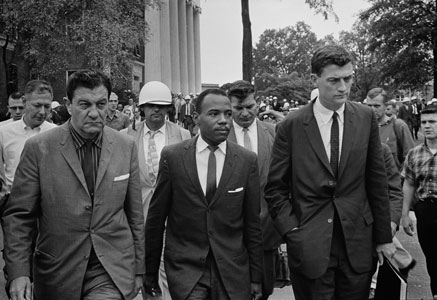
Another example comes from the southern United States. Twenty years after the Civil War, states in the south enacted laws mandating strict separation of black and white people. People with any degree of African ancestry could not use facilities reserved for whites. In the 1950s and 1960s, some courageous African-Americans challenged these laws. Accompanied by white friends, they sat together at lunch counters, rode buses together (see Mediaculture) and demonstrated together. Some were killed; many were jailed or beaten or both. The movement eventually led to the dismantling of the racist laws that had persisted for many decades.
Having considered those examples, let’s shift gears and move to the book of Romans, which began as a lengthy letter written to the house churches in Rome. The letter was probably read aloud and discussed in one congregation after another, as the listeners tried to understand what Paul was saying and how it applied to them. As in many large cities, there would have been people from many nations living in Rome, including Jews and Greeks. Some of the Christians may have been merchants, some owned property and some were poor. Maybe they were suffering persecution. They brought all these perspectives to their hearing of Paul’s letter.

Instead of starting at the beginning of Romans 13, let’s back up to the last few verses of chapter 12 so we can get a sense of the flow of Paul’s thought. Imagine yourself as a Roman Christian hearing these words read to you: “Bless those who persecute you; bless and do not curse.” (All quotations from Romans are from the New International Version.)
You might be thinking about a recent event of persecution that happened to you or to someone in your congregation.
“Rejoice with those who rejoice; mourn with those who mourn. Live in harmony with one another. Do not be proud, but be willing to associate with people of low position. Do not be conceited.”
If you are a well-to-do Roman, you might be wondering whether Paul realizes how hard it is to reach across class barriers or how hard it is for you to wash the feet of a poor brother or sister in imitation of Jesus. If you are a Jewish Christian, you might be thinking about how hard it is to share a meal with those who don’t observe the food laws that you have observed since childhood. No matter who you are, you know that living in harmony can be a lot of work.
“Do not repay anyone evil for evil. Be careful to do what is right in the eyes of everybody. If it is possible, so far as it depends on you, live at peace with everyone. … Do not be overcome by evil, but overcome evil with good.”
Now you might be thinking about the last time someone sinned against you and wishing Paul would be more understanding about how hard it is to get along with some folks, especially those in power. Perhaps you would find yourself thinking about rebellion. But the Roman Empire was ruthless with insurgents. Jesus was crucified under a banner calling him the King of the Jews, and many others who looked like rebels to Rome were also crucified. So Paul did not want his readers, wishing they could return evil for evil, to plot rebellion. Imagine yourself, again, as a Roman Christian hearing these words of Paul:
“Everyone must submit himself to the governing authorities, for there is no authority except that which God has established. The authorities that exist have been established by God. Consequently, he who rebels against the authority is rebelling against what God has instituted, and those who do so will bring judgment on themselves. For rulers hold no terror for those who do right, but for those who do wrong. … It is necessary to submit to the authorities, not only because of possible punishment but also because of conscience. That is also why you pay taxes, for the authorities are God’s servants, who give their full time to governing.”
That sort of takes the wind out of your rebellious sails. Jesus submitted to crucifixion, and you, too, are to submit when persecution and punishment come your way. And it does seem that God has allowed the Romans to be in charge of the known world, at least for now. Maybe Paul teaches against insurrection in order to avoid greater persecution and bloodshed.
But does Paul really mean it when he says that rulers hold no terror for those who do right? Certainly we who read this letter in 2010 know of cases where governments, from Nazi Germany to Central American dictatorships to the killing fields of Cambodia, have been sources of terror to those who did right. But Paul did not live in any of those times or places. Remember that Paul was a Roman citizen, with all the privileges of that position. In Acts 23, we read about how Paul was protected from a lynch mob by Roman soldiers. He appealed to the protection of Rome when it seemed that he could not get a fair trial in Caesarea. So it seems that, for him at least, the Roman government held no terror.
Let’s go back once more to imagining ourselves as Roman Christians hearing this letter:
“Give everyone what you owe him: If you owe taxes, pay taxes; if revenue, then revenue; if respect, then respect; if honor, then honor. Let no debt remain outstanding, except the continuing debt to love one another. For he who loves his fellow man has fulfilled the law. The commandments ‘Do not commit adultery,’ ‘Do not murder,’ ‘Do not steal,’ ‘Do not covet’ and whatever other commandment there may be are summed up in this one rule: ‘Love your neighbor as yourself.’ Love does no harm to its neighbor. Therefore love is the fulfillment of the law.”
Here is where it all comes together for the listener. We have to pay the taxes we owe to the government officials who come to collect them. We owe respect to those in authority. Above all, we owe honor to God, and we owe love to each other and to all of our fellow human beings. Submitting to the government authorities is not the greatest law. It’s one of those “other commandments” Paul mentions. Love of God and of neighbors is the greatest law, and submission to the government is only one thing that we are asked to do to avoid unnecessary bloodshed and harm to our neighbors.
If love of our neighbors is a greater commandment than submitting to the authorities, then maybe we can figure out when to obey and when not to obey the government by looking at the needs of our neighbors. Let’s go back to our examples and see how the greater law applies to the question of obedience to the authorities. When a plainclothes Gestapo man stood at the back of the Diesen congregation, love of neighbors led the preacher to preach about submission to the authorities, since he knew that preaching about rulers being toppled from their thrones would probably result in harm to his congregation.
Levi Coffin and other Christians broke the law when they sheltered people who were fleeing from slavery through the Underground Railroad. When asked to defend his actions in court, Levi said: “I had read in the Bible when I was a boy that it was right to feed the hungry and clothe the naked and to minister to those who had fallen among thieves and were wounded but that no distinction in regard to color was mentioned in the good Book, so in accordance with its teachings I had received these fugitives and cared for them” (Reminiscences of Levi Coffin, Ayer, 1992).
Coffin acted in love toward his neighbors, and this led him to disobey some of the laws that supported slavery.
During the Civil Rights movement of the 1950s and ’60s, some Christians—especially white Christians who already enjoyed their civil rights—disapproved of the demonstrations, saying that legal methods should be used instead. Other Christians argued that the greater law of love for the neighbor justified breaking the Jim Crow laws that denied basic civil rights to people of African descent.
We have looked at the text from Romans and at a few examples from more recent Christian experience. What does Paul’s teaching mean for us today? Sometimes we can call upon our government to right some wrongs, and the government can be a source of protection from angry mobs, as it was in the case of Paul. (Think of Ruby Bridges and the federal marshals who protected her as she walked to school every day.) Laws mandating free public education and providing health care for low-income pregnant women are good laws, and we support them. Most of us obey most of the laws of our land most of the time.
But there are times when we are called to obey the greater law of loving our neighbor and to disobey some of the lesser laws that keep us from doing that. Some of us have felt called to withhold a part of our taxes in order not to participate in killing those whom our government considers enemies. Some churches have provided sanctuary to people fleeing persecution in their own lands but unable to convince our government of their need for protection as refugees. Food and relief supplies have sometimes been provided to people our government did not consider worthy of our aid.

So let us read Paul’s writings and other Scripture texts together, and let us talk with each other about the greater laws and the lesser laws. Together let us seek to be faithful disciples of Jesus, loving God with all our heart, soul, mind and strength, and loving our neighbors as ourselves. When the law of our land conflicts with the greater laws, let us work together to discern the right path, and let us support each other if our attempts to be faithful lead to suffering. When in doubt about the right path, let’s reread these words from Paul: “Let no debt remain outstanding, except the continuing debt to love one another. For he who loves his fellow man has fulfilled the law.”


Have a comment on this story? Write to the editors. Include your full name, city and state. Selected comments will be edited for publication in print or online.