


Finding friendship in the faith community
They can attend school, hold down jobs and turn the key in the door of their own apartments. They have won the legal battle for inclusion, but by the time they land in the pew at church, they may be too exhausted to fight for something more precious than their rights. Friendship is a gift the law can never guarantee to people with
developmental disabilities. Churches across the United States, however, are reaping the rewards of building genuine relationships with those in their midst who are epitomized not by their disabilities but by their rare abilities to deepen the congregation’s spiritual life.

“They have their rights and laws and they can sue. They can fight all week, but they come to a service and don’t want to have to put themselves forward in the faith community,” says Joe Landis, executive director of Peaceful Living, a Mennonite Health Services Alliance member organization based in Harleysville, Pa. Peaceful Living provides community-based services to people with developmental disabilities.
Sharing their stories
Friendship is what makes people flourish, according to Landis, and Peaceful Living is helping local faith communities, including two synagogues and a Hindu temple, establish the mutual give-and-take of friendship with the special needs population. Sometimes the starting point is as simple as finding out where that population exists.
Peaceful Living staff discovered the magnitude of the church-going special needs population by conducting a survey in 2000 of approximately 100 local congregations and identifying 500 people with disabilities. At the end of its Honoring a Place conference in 2008, Peaceful Living staff asked 10 faith communities to commit to including people with disabilities over the next two years.
Peaceful Living encourages the faith communities it supports to identify members’ needs by completing their own congregational surveys. A congregational coach then interviews people with disabilities and their families, bringing before the church leadership the stories of those who may not be able to speak for themselves.
“Everybody has their own amounts of suffering,” Landis says. “Until it”s in your family, you don’t know, and until you hear somebody”s story, you don’t know.”

Revolutionizing Sunday school: Tyler’s story
Bob and Regina Rutt experienced the solace of having their family’s story heard by members of Blooming Glen Mennonite (Pa.) Church. When the Rutts began attending the church in 1991, they found that church members readily assisted them in practical ways, such as holding the door open when they arrived with their wheelchair-bound son.
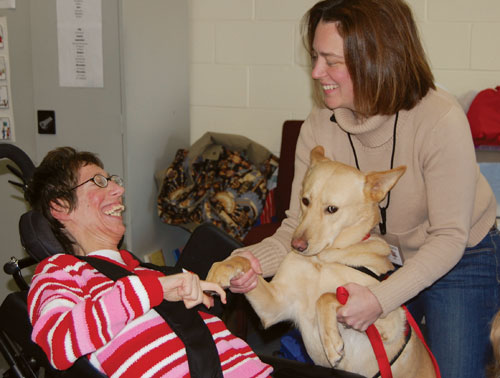
Tyler, who passed away seven years ago at the age of 20, sustained a brain injury from oxygen deprivation at birth. Progressing in development to that of a 6-month old, he required total physical care. Although he was legally blind, Tyler came to recognize church members by their voices, laughing and smiling when they greeted him.
“He developed a lot of friends in the congregation,” Bob Rutt says. One of the most profound ways the congregation reached out, according to Bob Rutt, was during the family’s first summer at the church. Members Ruth Yoder and Bronwyn Histand visited the Rutts home to discuss how Tyler could have a meaningful Sunday school experience that would still allow his parents to attend Sunday school with their own age group. “We came up with something unique and very much of a blessing for Tyler and other congregation members,” Bob Rutt says.
Eight women volunteered on a rotating schedule to spend the Sunday school period reading and singing with Tyler. Tyler loved music and the sound of the human voice and looked forward to these times, as did the volunteers, according to Bob Rutt. “I know it was a stretch for many of them,” Bob Rutt says. “They had never spent much time with a child that was developmentally and physically disabled … there was a bit of a learning curve but they were courageous. Tyler was blessed with all these new friends, and I think the ladies were blessed with a relationship with a special child.”
In for the long haul
After the Honoring a Place conference, church members formed a committee geared toward making the church an even more welcoming place for people with disabilities and their families. The church renewed its commitment at Peaceful Living’s 2010 Divine Power of Friendship conference, resolving to offer a four-week-long worship series and Sunday school elective on inclusion.
“We want to adopt this as part of our church philosophy rather than a project with an end date,” church member Robin Long said at the 2010 conference while reporting on the church’s progress over the last two years. Thirty church members attended the elective taught by Courtney Smith, Peaceful Living’s director of congregational and community education, according to Landis. A congregation’s willingness to explore options and accept people as they are is what the families of people with disabilities need most, according to Bob Rutt. The Rutts felt their presence at church was appreciated, even though Tyler made noises as his way of participating in the worship music.
“It almost has to be a customized kind of arrangement because every person with disabilities is unique,” Rutt says.
Getting out of the pew
Grace Mennonite Fellowship in Harrisonburg, Va. also finds ways for individuals to use their unique gifts to bless the congregation. The church collaborates with Pleasant View, Inc., another Mennonite Health Services Alliance member organization, which offers residential and community-based services in the Broadway, Va., area. Pleasant View staff believe the individuals they serve should have the opportunity to express their faith as they choose, according to executive director Nancy Hopkins-Garriss. While some have no interest in attending church, others attend various denominations, and one participates in mission work.
Staff used to take individuals to the same church, where they all sat in a pew together. They were going to church but were not truly part of the congregation, according to Hopkins-Garriss. Now a staff person initially accompanies the individual to a church of their choice, backing away over time as the congregation steps forward to get the person connected.
“We really want it to become their church and not part of their program,” Hopkins-Garriss says.
Powerful pray-ers: Joey and Junior’s stories
Joey Taylor and Junior Shifflett, two individuals served by Pleasant View, have made Grace Mennonite Fellowship their church home. “They’re just a part of the church like you and I would be,” says Tamra Wilson-Puffenbarger, Pleasant View human resources director and a member of Grace Mennonite Fellowship. Both men enjoy singing praise music and have become unofficial greeters, shaking hands as they welcome other members of the congregation, Wilson-Puffenbarger says.
At the fellowship meal held the first Sunday of the month, they contribute not only food but labor, volunteering to set up chairs and ensuring the room is ready by the time church members arrive.
The congregation has been especially touched by Joey and Junior’s participation in prayer, assistant pastor Mark Landis says. During sharing time, people may express particular needs so that others can gather around them and pray. Taylor and Shifflett take part by laying their hands on the person and joining in prayer for them.
“It doesn’t hinder anything,” Landis says. “When they want to be a part of something, we make room for them.”
Their faithful attendance spurs on other church members, since Taylor and Shifflett look forward to the Sunday worship service as a crucial part of their week. “I used to see Joey every day when I came into the office, and I’d better not have missed church,” Wilson-Puffenbarger says. “He would ask where I was and say he would see me at church. He was kind of my conscience.”
An attitude adjustment
Pleasant View pastor Dave Gullman says many churches will readily make physical adaptations to their buildings to accommodate people with disabilities, but adjusting attitudes can be a more difficult matter. A few people must be willing to see the person with disabilities as a person first and lead the way for others to draw them into fellowship. “It takes some energy, and that’s often another obstacle,” Gullman says.
“People feel they come to church to have their needs met, and now they have someone else to look after.” One way church members can look after the needs of others is by offering them a ride to church, since transportation tends to be a major obstacle preventing people with disabilities from attending, according to Gullman.
With fewer staff on hand at Pleasant View on Sundays, transportation was a problem for Taylor and Shifflett until Grace Mennonite Fellowship pastor Richard Early volunteered to drive them. Because they arrive early with the pastor, Taylor and Shifflett are able to spend additional time serving the church by assisting with tasks before the worship service begins.
“Thinking about some churches where people have been included well, they say they have learned about a different facet of who God is through that person,” Gullman says. “When a church is open to the abilities and gifts a person does have and doesn’t focus on the disabilities … the person with disabilities blossoms … and the church becomes more real and


Have a comment on this story? Write to the editors. Include your full name, city and state. Selected comments will be edited for publication in print or online.