


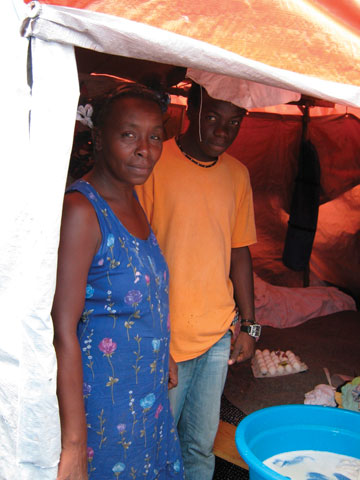
Haitian brothers and sisters have much to teach us about faith, generosity, gratefulness, grace and Easter.
Three months after the earthquake, Haitians were still sleeping in tents. The Haitian government hadn’t yet given permission for people to begin rebuilding, and even when it did, Haitians were afraid of another earthquake and too frightened to sleep indoors.
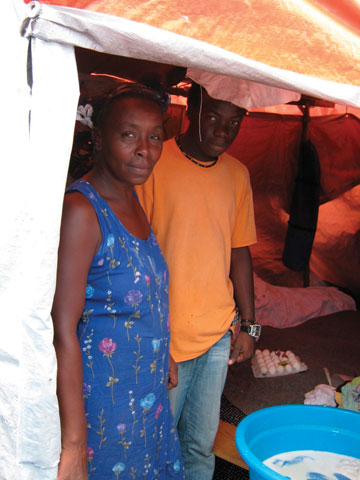
Part of my work with Mennonite Central Committee was as chauffeur and translator for American engineers that had come at MCC’s request to help assess the safety of buildings. We visited some homes that required major work to be inhabitable again, but we also saw homes where the engineers assured people that the damages were only cosmetic and told them it was fine to re-enter their homes and even sleep in them. Each time they gave this suggestion, people shook their heads, “I won’t ever sleep inside again.” Their fear is understandable.
I visited our friends Michelle and Pierre and their three children in the largest tent city in Port-au-Prince. The tent city is on the grounds of the only golf course in Haiti, one of the few green spaces in the city that before the earthquake was open to members only. The grass is gone, and in its place is hard-packed earth, which turns to mud in the rain. This particular tent city had around 50,000 people living in it.
Michelle and Pierre’s tent was a makeshift 10-by-10-foot shelter made of tarps. There was no space outside, so Michelle spent her days cooking for her family and washing their clothes by hand inside this small shelter. She said that during a recent thunderstorm Pierre had to hang from the makeshift rafter inside the tent and use his full body weight to keep their tent from blowing away. They slept on cement blocks so that the water ran under their bed instead of through it when it rained.
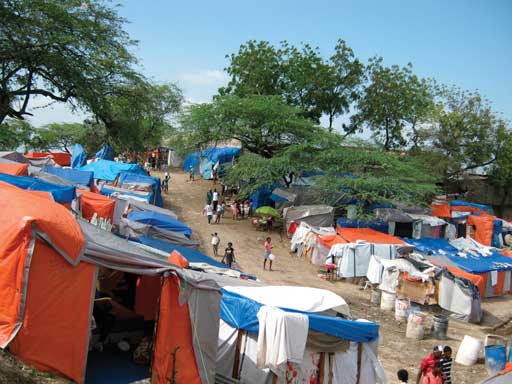
As we talked, I said, “Michelle I’m so sorry that you have to live here right now.” She said, “We have it good; we are being well taken care of; we have health care, water, food and security at night.” I was caught off guard by her appreciation for the little she had and was reminded of how hard daily life was for her even before the earthquake.
I visited our friend Guerline, and met for the first time her husband, Cesar, and their 3-year-old son David. She and her family sleep in a tent with 17 others. There isn’t enough space in the yard for more than one tent. She was honest with me during our afternoon together about her fears and all that has been lost in the earthquake. She mentioned a loss I hadn’t considered, even a space for a private moment between husband and wife has been lost.

Jimmy, a soft-spoken 26-year-old who was one of the teenage boys in our neighborhood when we lived in Haiti, pulled me to the side one day when I visited his family. “Could you help me get a job with your organization? It’s embarrassing to be 26 years old and not have a job. I feel like I have no future, and it’s next to impossible to get a job here unless you have connections.” He had work for a short time, but his only payment was one meal a day. He took the job in hopes that he could prove himself to his employers as a valuable employee. It didn’t lead anywhere, so he didn’t stay working there. Jobs are hard to find, but there’s no dignity or future in working for one meal a day.
Then there are the complicated concerns and questions about relief aid and development work. The rest of the world wants and needs to help, but in doing so Haiti’s fragile economy is at risk of being undermined. For years aid has been brought in from the outside, and the unintended consequence of this aid is that it hurts Haitian businesses. Food aid hurts Haitian farmers and the market women that sell food grown in Haiti. Bill Clinton publicly apologized this past March for his part in the free market policies that destroyed Haiti’s rice production. He said, “It may have been good for some of my farmers in Arkansas, but it has not worked. It was a mistake.” Free health care since the earthquake is a gift for so many Haitians but leaves Haitian medical personnel struggling to make ends meet. Free distribution of drinking water since the earthquake has affected available jobs in the country because the factory owner can’t afford to pay his employees. All aid comes with questions about the future.
Haitians have functioned without a security net for a long time. The earthquake has only added to the weight on their shoulders. Now even the ground beneath their feet feels unsure.
On the drive to the MCC guesthouse from the airport I saw my first glimpses of post-earthquake Port-au-Prince. The devastation is mind boggling, yet I experienced hope as I observed that life was continuing amid the rubble. Paths had been cleared, many by hand, through the debris so that vehicles could pass through. Street vendors and market women were selling along the street, people were out and about, children were playing, life continues. Seeing these familiar sights gave me hope. Haitian lives have been greatly disrupted, but they persevere just the same.
I felt hope when we learned that the Haitian government had begun an organized plan to have Haitian engineers assess buildings throughout the city. When MCC learned this, the decision was made to shift the focus of MCC engineers from assessing buildings to providing workshops for builders to encourage and teach safer building practices.
I went to Haiti to help, to walk in solidarity with our friends and to offer a listening ear to their heartache. I took gifts of tents, tarps and money that my congregation helped send, and those were gratefully received. But repeatedly I found myself on the receiving end of their generosity, hospitality and care.
Gabriel and Marie invited me to spend Sunday afternoon with them. When I arrived at their home, they told me they had prepared a bucket of water for me to use to bathe. When I said, “No thanks, I am fine,” they insisted. ‘It’s hot, Rhonda. You’ll feel refreshed, please bathe, we want you to be comfortable.” My cold bucket bath felt like a baptism of sorts—refreshing, life giving, full of love. Marie and Geralda prepared a wonderful Haitian meal of salad, rice, chicken, fried plantains, spicy coleslaw and cold lime juice. They made much more than I could possibly eat and chided me for not eating more. “We know you don’t get to eat Haitian food often. Eat more, Eat enough for your husband, too, since he’s not here to eat with us today.” I savored the tastes and the love that went into the meal. After eating, I noticed their son Jimmy was pulling bedding items out of their tent and taking them behind their house, but I didn’t know why. A short time later, Marie asked me to come with her to the back of the house. She led me to a bed they had made for me in the shade. “Now your stomach is full, you need to rest.” I protested, “I didn’t come to sleep, I came to visit with you and your family.” She said, “There will be time to visit after you rest. We know you’ve worked hard all week, and we want you to rest at our home.” At her insistence I took a short nap. I awoke refreshed and rejuvenated and enjoyed the rest of the afternoon visiting with the family. I came to offer them my love and concern, and here I was being cared for by my friends.
Before I left Haiti, friends came to the MCC guesthouse bringing gifts for me and my family. They remembered that when we lived in Haiti, Lance, my husband, had enjoyed flying kites with kids in our neighborhood, and so they brought Haitian kites for him and our children. There is a wonderful tradition in Haiti of flying kites around Easter.
The kites they gave as gifts have messages on them that read in Haitian Creole: “The earthquake throws you” but also, “Life is not over” and, “Haiti won’t perish.” Messages of hope on small fragile kites; the symbolism is powerful.
I had taken Gabriel a pair of work boots and was disappointed to realize that they were too small for him. When I apologized, he shrugged and said he would share them with someone else. Before I left, he traced my foot and returned the next day with a pair of Haitian sandals that fit me perfectly. Knowing my love of music, they brought Haitian CDs, and in thanks to our children for sharing me with them, they sent Haitian flags for our kids.
I ran into a few friends on my way to the market to purchase Haitian coffee to serve back home in Iowa at church. When they learned what I was doing, they insisted on going to the market for me and purchasing the coffee as a gift for my congregation. These friends, whose lives have been so hurt by poverty and devastating circumstances, have a wealth of deep-seated grace and generosity.
And I can’t forget to mention gratitude. I have thought of this often since my return home. They are so grateful for the generosity of the world in this moment of crisis. They are so thankful to be alive, because, as they told me, “Life is all that really matters.” MCC workers in country speak of hearing singing in the darkness in the nights that followed the earthquake, songs of praise to God for life. Haitians trust that God walks with them intimately as they move forward in uncertain times. While in the tent city and feeling overwhelmed by the immensity of need, I was taking a video at Gabriel’s insistence. A small, yellow butterfly flitted through my camera lens, surprising me with its presence. I experienced the gift of its appearance in my camera lens as a tangible reminder to me of Jesus’ Easter words: “And remember, I am with you always.”
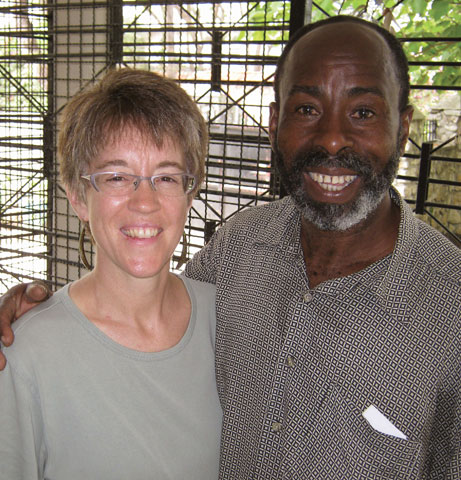
The first morning I was in Haiti, I heard singing. The words to the song were “Mesi Senye.” (Thank you, Lord.) These two simple words, sung over and over, were simple but powerful for their very simplicity. I shouldn’t have been surprised, but I was.
Haitians have lost family, friends, homes and the sense of solid ground beneath their feet, yet still they sing, “Thank you, Lord.” Their clarity of faith stuns and challenges me. I have much to learn from my Haitian brothers and sisters about faith, generosity, gratefulness, grace and Easter.


Have a comment on this story? Write to the editors. Include your full name, city and state. Selected comments will be edited for publication in print or online.