


The photos are precious and few, spread across the lap of an old quilt. Several stick with me, worn around the edges, more faded than all the rest. One I’ve folded and tucked deep inside my jacket pocket, a frozen moment warmed in the palm of my hand.
Pregnant in Ireland: There is my mother, standing gorgeously young in a way I’ll never know her. The hills of Ireland billow around her, not quite as bright as the smile sewn to her cheeks. She is resplendent, the picture of a young traveler with her hands resting on the great swell of her belly. My brother and I are there with her, carried close to her, though we can’t be seen. I look at that picture and can’t help thinking how happy my parents were—so vibrant and young, so untouched by life’s misery. The photo has preserved something time has undone.
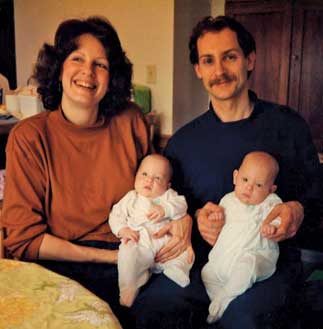 There on the quilt, amid all the framed images of baby smiles, lips laced with milk, and two yawning twins in that bulky double stroller, a picture catches the eye and says more than any sentence could.
At my brother’s grave: The photo shows the passing of time. I have been transported to the warmth of my mother’s lap, again pulled close and swallowed by rolling farmland. We both squint against an invisible wind, my face turned from the camera. It is hard to tell whether my mother squints from this wind or from something else unseen, but when you follow her glance, her expression becomes more traceable. We are a bundle of love beside a headstone unweathered by time; a baby lamb has been erected across the front. My brother is there with us, too, but this time he is the only one who cannot be seen. I am alive and well, a rambunctious 2-year-old, and he is there in the solid granite we lean against; in the trees, in the sky and in us, too.
 To learn the story of my brother, I had to retrace many steps. For me, it’s like the past was erased, a page torn from the book of my life before I got a chance to read it. I was a drooling 6-month-old when my twin brother Nicholas passed away from SIDS.
For the majority of my life I’ve felt far removed from the event. I have no memories of him, only the pictures in my head, which have been conjured from the words of others rather than real life. I wish I was able to remember so that I could feel something other than indifference. I’ve grown up without him, unable to miss him because his absence is the only thing I’ve ever known. But in some distant way I’ve felt a longing to know who he was.

As a tiny girl falling asleep under the sheets, I would make a tent with the moon coming in and think all sorts of things about my long-lost brother. Did he have a pillow underground? Did he eat? I couldn’t imagine it. I would whisper that I missed him and that if he were here, we could eat buckets of waffles and throw bread to the ducks. I’d even share my tire swing. I imagined a best friend. Though I have no memory today of those late-night thoughts, I must have felt on some unconscious level that part of me was missing. I had a brother who was gone and I wanted him back. I put his picture by my bed and wrote him letters in crayon.
Yet it seemed to be a phase I went through, this wanting Nicholas. He soon became just another wayward thought in my head, stored away and almost forgotten. After I was given a baby sister to play with, as I started school and slowly began to grow up, real life was better. Nicholas slid easily to the sidelines of my mind.
We were born as a pair, so it was only natural to have a fondness for things in twos. We were twins, born two months early, requiring a two-month stay in the ICU at St. Vincent’s Hospital. We were not yet ready for the world but came into it anyway, wrinkled and wizened with arms and legs as fragile as eggshells. We squinted in the lights of the incubator helping keep our tiny bodies warm. The nurses knew us by name and cheered each time we gained an ounce.
After we put on six pounds, our bodies finally slipping into healthy coats of skins, we were ready for the world. In our case, the planet expanded minimally; brought home to a closet-sized Brooklyn apartment, the space was cozy and crowded and did nothing to mask our cries. My parents took turns going out to the dim hallway to sleep, where the noise of screaming babies was at least somewhat muffled. The kitchen, visible from the bedroom, was crammed with an endless stream of relatives and friends who stopped by to help out. Mom got used to feeding a baby in each arm, cradling the phone against her shoulder as we squirmed.
As twins, Nicholas and I shared many things: a zoo’s worth of stuffed animals, a lacy bassinet, a double stroller that took weeks to find. We discovered each other one day, realizing our worlds overlapped, and spent hours with eyes locked. Tangling hands and feet, we were in amazement at the solidity of the presence of someone else. It was a wonder to have someone so close, to learn each other by sight and touch rather than with words. It was as if our happiness suddenly depended on the other one being there, too.
Although we were twins, Nicholas was a boy all his own. Whenever I ask now what he was like, people are always sure to mention his smile. He could light up a room with his grin. It was a smile that would come in handy one day, that kind you put on after stealing a cookie or pinching your sister. He had everyone in the palm of his baby hand. It is still a mystery why we had to do without this smile; why he had to go.
The morning of June 4 began like any other morning. The day was unashamedly hot, devoid of clouds, steam rising from the streets. Windows were open, dogs were walked and worn out, a paper slid under our door. It was an ordinary day, summer in the city with the buildings shimmering. My parents went to work—my mother’s reluctant fourth day back—and a babysitter stayed with us in their absence. I wonder if we were fussy that morning, if we were hot. We drank our bottles in the shade of a park, Nicholas and I sharing a swing with our backs against one another and overfed pigeons scuttling beneath us. We wore laceup shoes, and our hair came in waves now. We were getting big.
After the park was naptime, sleep a relief after chattering crowds. Maria put us down with our stuffed hippos, drawing the shades, following a familiar routine as we yawned milky yawns and closed our eyes.
When my mother came in the door, setting down her briefcase, I was crying. She brought me out to the kitchen so I wouldn’t wake Nicholas. He did not stir as she lifted me from my blankets. Babies cry all the time; I was probably just hungry, maybe needed a change. But I can’t help thinking I must have known something my parents did not.
This is where I switch to autopilot. I cannot identify or even try to picture the way my father, home for dinner, went to wake Nicholas, his work shoes scuffing the floor, printer ink still on his hands. If he had only known what was coming, he might have walked more slowly. Dad anticipated a hungry boy waiting for him in the bedroom, gumming a smile as he woke from his sheets.
Instead, the heat from my brother’s sleeping body slowly grew cold, and he did not wake.
I can’t imagine what my dad must have been thinking as he ran down the pavement with his little boy clutched in his arms. Deep down, he already knew the worst. Yet with each step came the reminder that the solidity of our life was still there and it must not be disturbed. He only had to reach the hospital and everything would be OK.
If only life were kinder. Instead, the lives of my parents and my life, too, were about to change. The hospital confirmed what my parents already knew: Nicholas would never wake up.
In the middle of our darkest time, when nothing seemed right or true or even real, my family was surrounded by the support of many people. I still cried and wanted food; my cloth diapers still had to be changed. My parents had to go on with normal as best they could, when everything was so far from it. When my brother’s body needed to be transported across state lines to the countryside, my great uncle was there to take him.
There were cards and calls and food from down the block, a circle of waiting arms where grief could begin and comfort taken. It was all there for us, a community of love in a time of need.
The funeral had white roses, lovely music, the smallest casket many had ever seen. A crowd of people showed up to mourn my brother, and I joined them, held by my mother and dressed in blue. I was quiet in her lap, sleeping while someone gave a testimony and others lit candles. It was only during the last song, “Children of the Heavenly Father,” that I cried. It wasn’t even a cry; I was wailing, mourning my brother, who should have been next to me, should have been cradled safely in what was now empty space on my mother’s lap. Two weeks later, at a cousin’s funeral, I cried during the same song. Some things cannot be explained. Was I sad? Did I realize? A baby’s grief is hard to understand.
My parents buried Nicholas while the sun was out. It felt too wrong with the light mingling in the dirt, a pretty day for something so bleak, but there they were. He was laid on a hilltop overlooking the swell of gorgeous fields. Cows walked leisurely along the fence, and wildflowers grew rampant. Since that day, a barn has been erected in the distance. Plows hum with the heat, corn grows fierce and tall; life moves on.

It has been a long time since Nicholas went away. Long enough for me to forget I was ever a twin, long enough for it to seem normal. The pictures hide in a box collecting dust. On the rare occasion I do look at them, I find it hard to believe that the gurgling baby with her hands curled into fists and staring intently at the brother beside her was me.
But Nicholas is aimed right at the camera in his wrinkled sailor suit, smiling one of those precious grins at the person behind the lens. This is how I choose to see him. I don’t dwell on why he died, why it was him instead of me. There are no answers to these questions.
I do not ask for sympathy. I am merely telling my brother’s story. I tell it for my parents. I tell it in the hope of figuring out some piece of myself.
Nicholas’ death has taught me, as clichéd as it is, not to take life for granted. He has missed out on all my favorite things in this world; he will never eat a chocolate chip cookie still gooey from the oven, never hear the climax of a symphony. He will never get to breathe in air so cold it stings or dive headfirst into a hot summer pool. For Nicholas, I enjoy everything twice as much. I try to smile the way I think he would have. I eat two cookies and hug my parents extra hard.
I look across the cafeteria at twins giggling over lunch, so close and so real with that visible bond, and I smile. We might have had that. I will never know, and that’s OK. I’m content to imagine we would and leave it at that.
I see us at a crossroads with the light coming down hard; I am on the brink of something new, a high school senior about to step out into a beckoning world. And I see Nicholas with that silly smile; he raises a hand to wave and it’s as if he’s saying, “See you later.” Until then, Nick, I love you, and I’m letting you go.
Kate Sherer Stoltzfus attends College Mennonite Church in Goshen, Ind., and is a senior at Goshen High School. She is the daughter of Duane and Karen Stoltzfus. Her grandparents are Dale and Doris Stoltzfus, Lancaster, Pa., and Lon and Kathryn Sherer, Goshen.


Have a comment on this story? Write to the editors. Include your full name, city and state. Selected comments will be edited for publication in print or online.