


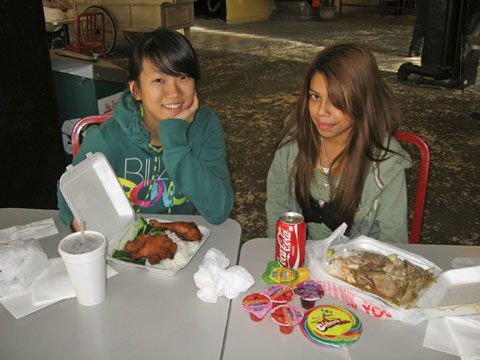
Students engage, learn from community involvement
Every other Friday the 10 students at the Peace & Justice Academy in Pasadena, Calif., step out of the classroom and into the community for Field Friday. When their destination is close, they travel on foot; when it’s farther away, they take public transportation in order to be engaged with the city rather than removed from it.
The Peace & Justice Academy, which opened its doors last fall, serves students in grades 6-9 (planning to grow into a grades 6-12 school). It is located in the Pasadena Church of the Brethren in a neighborhood that has a large Armenian population.
 Kimberly Williams, a student at Fuller Theological Seminary, Pasadena, often leads Field Friday activities, which tie closely into course curriculum. For example, in the classroom setting, students learn how to compare and contrast two experiences and write about them. Then they use this skill to write about their Field Friday experiences. This fall, teachers focused on comparing cultures and socioeconomic classes.
The Field Friday that explored culture began in the neighborhood, visiting an Armenian bakery. As the students sampled baked goods, they observed the similarities and differences between their own cultures and those new to them; one striking difference for everyone was an Arabic newspaper that opened “backward.”
Next on the agenda was a 30-minute drive to downtown Los Angeles for a scavenger hunt in Chinatown. Their to-do list included tasks like asking a person where they were from, finding unfamiliar items in a grocery store and locating a specific item in a bakery. The day ended with an Ethiopian meal at which students, following Ethiopian custom, ate with their hands.
Before the Field Friday that explored socio-economic classes, students prepared for the day by learning about the socioeconomic-ethnic composition of today’s world. To better convey the statistics in the world’s distribution of wealth, the group formed a microcosm—a theoretical village—in which each student represented 10 people. The students soon discovered the realities they each represented.
The Field Friday that explored socioeconomic class included a scavenger hunt as well. On Rodeo Drive in Beverly Hills, the kids were challenged to find the most expensive item they could. Their finds included a $179,000 ring and a $1.4 million art piece.

Leaving the opulence of Rodeo Drive, the group drove down Wilshire Boulevard for lunch in Grand Central Market downtown. Along the way the group observed the changes from one neighborhood to the next, noting socioeconomic indicators such as jobs and transportation.
When they arrived at the market, each student randomly received an envelope with lunch money, the amount corresponding to the wealth represented in their theoretical village. One student had $10 and another $5, but most received only $2. The staff challenged each student to purchase what they could afford and return to the group to eat. According to Kimberly Medendorp, co-director and teacher at the academy, the theoretical village provided a wonderful learning experience. Even though some students were initially upset that they received so little, they came to understand what the disparity indicated—a small percentage of the world’s population holds a significant percentage of its wealth.
Neither the day nor the lesson was over. Following lunch the group went to Skid Row, an area of Los Angeles that contains one of the largest populations of homeless people in the United States, to meet with an organization that runs after-school programs for homeless children.
“What struck the students most,” Medendorp says, “was that the people they saw coming in the doors were kids just like them. Instead of returning home after the program, though, these kids would return to a cramped motel room, a shelter or the street.”
How does a student respond to the fact that the average age of a homeless person in the United States is 9? Encountering such drastic disparities can weigh heavily on adults, let alone children, so the Peace & Justice Academy debriefs after each Field Friday and requires each student to keep a journal to reflect on thoughts and feelings. To encourage action on what they experience about class distinctions, students do a service project at a family shelter at Christmastime.
The value the school places on students interacting with their community influenced the development of family-friendly policies. The academy follows a late-start schedule; classes start at 9 a.m. and end at 5 p.m. to provide their adolescent students more sleep so that they are more ready to fully engage in their studies. A no-homework policy enables the students to spend more time with their families and plug into church and other activities away from school. Instead of homework, a block of time at the end of the day is designated for students to do their assignments with teachers present.
The Peace & Justice Academy is not alone in its commitment to integrate community involvement with learning. All the member schools of Mennonite Schools Council provide their students with opportunities to serve others in their community—either as schoolwide events or as part of the curriculum. The type of service opportunities are determined by whether their local community is urban, rural or suburban. No matter the form it takes, the emphasis is that service is part of following Christ.
Eastern Mennonite School (EMS), a kindergarten through grade 12 school in Harrisonburg, Va., offers students in all grades a variety of ways to engage their faith through community interaction. With more than 350 students at EMS, involvement takes many forms.
This year, students in the National Honor Society at Eastern Mennonite High School accepted the challenge to coordinate schoolwide community service projects. According to the school’s principal, Paul Leaman, the challenge has already spawned a variety of service projects for students this fall. Some have prepared relief kits for Mennonite Central Committee, worked at Patchwork Pantry, a food distribution center, helped children with art projects as part of an initiative at Barnes and Noble and assisted a local dance and acting club by transporting their Nutcracker set for Christmas performances. The aim of each project is to develop leadership skills in the National Honor Society students and service opportunities for the student body.
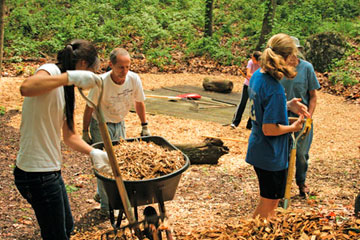
The high school curriculum includes formalized experiential learning in a one-week session called E-term. Participating students connect with the Harrisonburg community in activities such as spreading mulch and cleaning for those who need help. High school students also spend a Community Service Day each spring helping local community organizations prepare for summer camps, clean up trash and provide other much-needed help.
Middle school students at EMS are also involved. The sixth grade students worked with Tom Benevento and others at Our Community Place—a local nonprofit organization that promotes care for the planet, empowers marginalized and impoverished people, and builds a foundation for nonviolent response. One of the organization’s many projects is the Muddy Bike Urban Garden Project, which grows organic vegetables for local markets. The garden project uses no fossil fuels; all gardening is done with hand tools, and deliveries are made on bicycles.
While gardening, students learned about sustainable living practices such as solar power and water catchment. “The students have been so enthusiastic, and they’ve contributed greatly,” says Benevento. “They really engaged with the people they worked with.”
Patsy Seitz teaches English and Bible at the middle school and is in charge of activities for this school year. While there are formal service opportunities like the garden project, she says, there are also informal ways that service happens, such as reading to the elementary school’s students. In her classroom, Seitz encourages sensitivity to others, personal initiative and community involvement. “It’s important for the students to connect with community programs and go beyond themselves,” she says. “It taps into some important resources and gives them a vision for who and what they might become as they age.”
Maria Archer, the principal at Eastern Mennonite Elementary School, says every student has a role to play. “We are a part of this community,” she says, “and we want to give back as much as we can. Even at our students’ ages, we want to show them that they can be involved with the community.”
Elementary school students read to the 3- and 4-year-old children who attend Roberta Webb Child Care Center, a local preschool located at Immanuel Mennonite Church. Before traveling to the church this fall, the fourth and fifth graders baked cookies for the preschoolers. Preschool director Kathryn Morris says it was a positive interaction once the students read one-on-one. She was pleased to see that a few of the elementary school students had attended the preschool, making the connection between those who serve and those being served even more significant.
Community involvement is part of the Freeman (S.D.) Academy tradition, too. Each year the school earmarks two days for schoolwide service projects: one to rake leaves and another to can meat for Mennonite Central Committee.
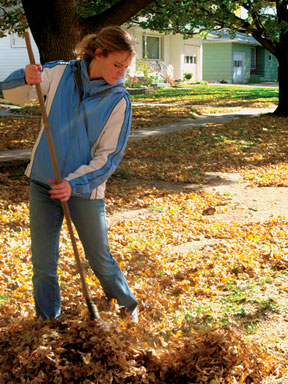
during a community service day
For the Freeman community, this kind of assistance is much appreciated. Ardella Gross, a resident of Freeman who is no longer able to rake her leaves, asks students to come during the fall service day. “It’s so good when the students come,” she says. “They have so much energy.” That energy is needed because they haul the leaves away, too, filling grain wagons and emptying them at the town’s compost facility. There have been some years, she says, when she has joined the group in a student-led devotion after they finished working.
A graduate of Freeman Academy herself, Gross recounts her time at the academy and its legacy of service. For a fund-raiser, she says, she and her classmates picked corn and sold it to the local grain elevator. Without today’s combines, the students had to work hard to shell the corn.
The annual canning event has been a Freeman tradition for at least 40 years. Volunteers can 16,000 pounds of turkey in two days. Classes from Freeman Academy come in shifts and work alongside community volunteers.
In addition to these annual opportunities to serve the community, many teachers at Freeman integrate the concept of service into their classroom teaching, from picking up trash to hosting guest speakers. Many Mennonite Schools Council teachers see the value of service as a way to help students socially, emotionally and spiritually.
Talk with any student, teacher or community member, and it will soon be apparent that a symbiotic relationship exists between schools and their communities. As often happens during shared projects, the connections between the school and the local community leave an impression on everyone involved and in many cases open doors for future opportunities.
The Peace & Justice Academy, EMS and Freeman Academy share a vision for education where God’s love is the most powerful force in the universe, and in response to God’s love we are called to live out the teachings of Jesus in daily life.
Renee Hochstetler is a member of Kern Road Mennonite Church in South Bend, Ind.


Have a comment on this story? Write to the editors. Include your full name, city and state. Selected comments will be edited for publication in print or online.