


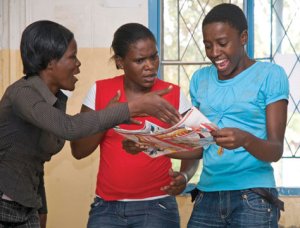
Young people in Botswana learn about faith and forgiveness.
Sitting on the veranda of Bopaganang Basha Ba Semoya youth center in Francistown, Botswana, on a July afternoon, we casually talked about the huge African sky. Observing the pearl gray and sepia clouds, I once again told the youth around me how much I love the vastness of space here.
We were waiting, as usual.
That day was different, though. While passersby may have thought we were idle, we were far from being still.
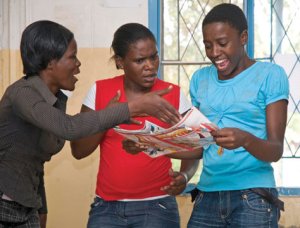
These young folks are heavily involved in peer counseling and education through community events and dramas they themselves organize, write and act out. They consider their messages and how their words and actions might influence others their age. Through drama and song, they tear away the shroud of silence that permits alcoholism, domestic violence and AIDS to ravage their society.
They teach others about how God wants people to respond to suffering, while they learn more about the role God plays in their own lives.
My job as a mission worker here in Francistown is to serve as a kind of mentor, looking over documents and helping with all activities, allowing these young adults to learn to lead. In practice, I have become a kind of mother, caring for them in times of trouble.

These past few months we had been embroiled in a traumatic scenario that, though not the fault of anyone at Bopaganang Basha, resulted in the suspension of our center’s funding for nearly nine months.
When this began, I had been in Botswana for a year. I had two choices: back out during this stormy period or dig in and help clean up the mess. I decided to dig in and help. Together with a makeshift team, we determined to go on with the peer education and counseling these youth were working so hard to provide.
This was a tough time for all. We needed to forgive the offenders in order to move forward.
I will confess to quite a bit of frustration and even anger at this situation. These kids had put a great deal of trust into people who let them down.
And, may I add, they are so talented.
I watch the dynamics of their theater group. These young adults strive to put on a cohesive, thought-provoking performance and they do it as a community. Because of the importance of these issues, egos have no real place in their rehearsals. Some sing, some dance, and some are writers. All are considered vital to the production.
They do have differences. But they will stop what they are doing, sit together and try to work on it. Their understanding is evident; they know their differences will be reflected to their audience, distracting from their teaching. We are still having Bible study at least three days a week, but they want it to be every day. They acknowledge nothing can be accomplished without God.
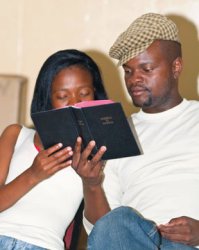
One young actor, Keneilwe Mokobe calls God by the Hebrew name, Jehovah Jirah, which means “The Lord, our provider.” Mokobe gives voice to many of her peers when she says, “We must trust in God every day and in every situation.”
But trust is difficult when there is no food.
The missing grant money provided the young adults with a small stipend for food and bus fare to the center for daily rehearsals and Bible studies.
Still, the youth continued with God’s work—even though some of them walk an hour to get to the center, even though they may have nothing to eat when they get home. Many of their neighbors support the Bopaganang ministry with the resources they have—an extra blanket against winter’s cold wind or a hot cup of tea.
The first Bible study after our funding dilemma came to light was hard—really hard. After all, how dare I suggest we all work on forgiveness? And was I ready to show the example?
Forgiveness is a powerful action; we must engage it often for it to be valid. I must change my action, my behavior. I cannot bring up the anger just to vent. Rather, I must forgive totally so we can gather ourselves and move on. I prayed for the strength to let go of my anger and frustration.
We brought in new administration to handle our office. We are committed to moving on and rebuilding. I ask my young brothers and sisters, Have you forgiven yet? Are you able to let go and give it to God?
With hard faces, many of them did not answer. The ones who did just told me, “Mommy*, you will know.”
In one Bible study, we read all of 1 Kings 17—the story of the widow of Zarephath feeding Elijah with the last of her flour and oil, before God provides unlimited sustenance, and the prophet then resurrects her son.
In Francistown, the idea of the boy’s resurrection from death is no more surprising than the miraculous feeding. The group seems to understand that God has no limits—all feats are equal to the one who provides for the world.
But how, the youths asked, could the poor widow disrespect Elijah when her son fell ill and was left without breath, after God had kept her and her son fed for such a long time? Peter Monyatsiwa said we must always praise God, no matter what, as God always is with us. God knows our needs, as God knew the widow’s needs, and all must know and respect the nature of God. When we do not question the purposes of the one who provides, God will continue to bless us. Mogomotsi Oarabile said we must pray to God with truth and faith, understanding that God knows our needs.
A visitor named Julia, took the story a step further. How many times, she asked, do we turn down giving because we fear poverty or we fear that we will be unable to do without whatever we might give? All of us, she noted, are guilty of this in some ways.
Our group never stopped giving. They determined to carry on with their ministry and their message, whether or not they received. Only in the last months were we able to get the funding returned and our equipment restored. But the restoration did not end with our equipment.
Sometimes after particularly hard days, the Bopaganang group gathered outside the center to pray, to pour out our anger to God.
Then, one day, comfort.
After loading the truck with our stage props, we gathered. We prayed for the day, for safety, for love, for friendship. As I looked around at their faces, I felt a great comfort. Suddenly the young women lifted their voices in song. I watched them open their eyes—their smiles were like the sun emerging from a cloud.
As they left, I got hugs. With laughter, one young man approached me, full of Christ’s forgiveness and ready to share that grace with others.
“We are not angry anymore,” he assured me. “We are free.”
*In southern Africa, “Mommy” is a title of intimate respect.
Melanie Quinn, is a worker with Mennonite Mission Network in Francistown, Botswana, supported by Atlantic Coast, Eastern District, Franconia, Illinois and Indiana-Michigan Mennonite Conference congregations. Bopaganang Basha Ba Semoya (Youth Center of the Holy Spirit) began in the mid-1980s with youth from African Initiated Churches in Francistown and Africa Inter-Mennonite Mission workers. Mission Network, AIMM and Mennonite Church Canada Witness collaborate with churches of Botswana in ministry.
Watch video and hear songs from Bopaganang Basha Ba Semoya in the Mission Sunday materials available online at www.MennoniteMission.net/Resources.


Have a comment on this story? Write to the editors. Include your full name, city and state. Selected comments will be edited for publication in print or online.