


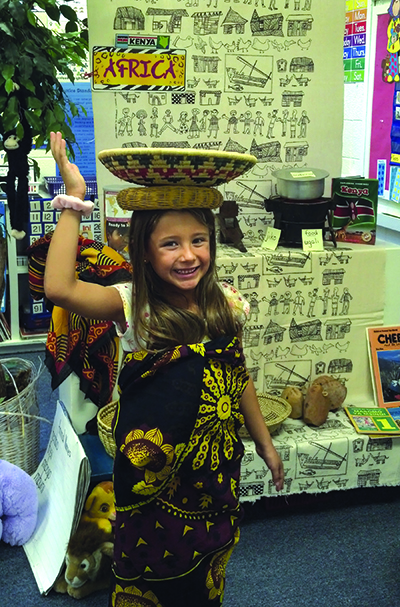
Photo: An elementary student in the Sarasota (Fla.) Christian School shares what she has learned about the culture of her class Global Family School. Photo provided.
As educators at Mennonite schools and members of Mennonite Church USA, Patricia Shelly and Elwood Yoder encourage their students to be steadfast in their faith.
But that doesn’t mean faith is static. As has happened for two millennia, Christian beliefs continue to be challenged and new understandings continue to develop.
Shelly and Yoder embrace that. She’s a Bible and religion professor at Bethel College, North Newton, Kan., and he is a history instructor at Eastern Mennonite School, Harrisonburg, Va.
While they teach different subjects to different age groups in different places, they each have vital roles in the faith formation of young people, the first distinctive of Mennonite education. They want them to engage different perspectives, even if they disagree with them. “I want to help students deal with the variety of beliefs,” Shelly says, “rather than just dismissing who we disagree with or ridiculing them.”

Among other Bethel classes, she helps teach Basic Issues of Faith and Life, or BIFL, an interdisciplinary course required of all Bethel seniors. Its purpose is not to indoctrinate students but is akin to a physical education class.

Shelly cites Jacob’s wrestling match in Genesis 32, which left him transformed. Students also need to be prepared to grapple with the possibilities of changes to their understandings of God and Jesus Christ.
“Faith isn’t something we receive and is settled,” Shelly says. “Faith is also a muscle that can atrophy. It needs to be exercised. The wrestling, the challenging, the learning is good for a living faith.”
Considering other perspectives is part of the scholastic enterprise, according to her, whether or not it changes a student’s beliefs. That’s an ability especially needed now as Mennonite Church USA struggles with issues of sexuality, notes Shelly, who is also the denomination’s moderator-elect.
After all the studying and discussing, BIFL concludes with each student presenting a credo paper. “You have to figure out what you claim as your own,” she says.
Exploring differing views and their implications is also part of Yoder’s high school-level Global Anabaptism class.
It covers Anabaptist-Mennonite history, then encourages students to apply their learnings to contemporary church life. Yoder regularly poses openended questions, ranging in topic from hymnody to sexuality, that the students are required to answer. “I want them to know the general story of Mennonites,” he says. “But the other piece is to talk about the issues.”
Part of the course is online, which Yoder says is a good environment for discussions because it enables his more introverted students to participate. Instead of struggling to speak in front of others, which can be intimidating, they type their comments in their computerized classroom.
Technology has other benefits as well. Last year for the first time, the Global Anabaptism class included students from beyond the Shenandoah Valley. Because it was online, two students from Southern California enrolled. They were students at the Peace and Justice Academy, a Mennonite Schools Council member junior and senior high school in Pasadena, Calif., a setting quite different from Harrisonburg.
Because of their “more cosmopolitan” context, Yoder says, the California students provided some differing perspectives, particularly to the discussions on sexuality, which pushed the others to “listen well.”
“And I applaud that,” says Yoder, who wants to expand the online course and include other schools and even homeschooled students across the country. “It was a fertile forum, and I view that as extremely positive in an educational setting.”
But the benefits were felt by more than just the students. Yoder says he was also challenged by the discussions with the California students. Bethel professors experience that as well. In BIFL, students spend the term studying a biblical text plus another book. In the past, that has included works on evangelicalism, novels and Yoder’s book The Politics of Jesus. The students are then given an oral exam on their readings by a panel of faculty members who go through a seven-hour workshop on the texts to prepare.
“In some ways, it’s a workshop for faith formation for faculty,” Shelly says.
Yoder’s class also emphasizes the international dimensions of the faith. Two of his current students are Hondurans who arrived several years ago with their parents, who are church planters in Harrisonburg. That approach to missions, of other countries sending workers to the United States instead of the other way around, changes the discernment process of faith formation, Yoder says.
It also changes the community where that happens. Growing community builders is the second characteristic Mennonite schools hold in common. For the second consecutive year, Sarasota (Fla.) Christian School is participating in a unique initiative with Mennonite Central Committee’s Global Family Program. Each grade, kindergarten through 12th, is connected with a different school around the world—from Serbia to Cambodia to Bolivia—which each class raises $300 a year to sponsor. But the project isn’t supposed to be a paternalistic case of wealthy Americans taking care of poor people in the developing world, says Sarasota superintendent Jeff Shank. “It’s really about relationships,” he says.
The students exchange letters and, thanks to technology, even videos when possible. “It’s a way for our students to learn about [the other students’] culture and valuing them as God’s creation,” Shank says.
That international angle is incorporated into each grade’s educational curriculum. Students may study literature or religious beliefs of the countries of their schools. The lower grades have done art projects based on their countries’ culture. High school science courses have focused on water management issues in those countries, with the students later making presentations at a sustainability conference at a local university.
Last September, a group of seniors went to Nicaragua to visit their Global Family school. It was the first time Sarasota students made such a personal connection, something Shank wants to make a regular occurrence.
“Part of our goal is really to work at this idea of thinking beyond ourselves, to help our students broaden their perspectives and their options,” Shank says.
Meanwhile, as Sarasota Christian School reaches out across the world, the world is coming to Lancaster (Pa.) Mennonite School, where 120 of its 600 students are from outside the United States.
“The Anabaptist church is clearly a global church,” says Dick Thomas, superintendent of Lancaster Mennonite School, which this year has students from 18 countries. “Our center is Jesus, but if we see life only through American eyes, we don’t see Christ fully.”
But the school is more than just internationally diverse. Two-thirds of its enrollment is not Mennonite and includes sizable numbers of Catholic and nondenominational students. To help build community out of this disparate body, Lancaster has organized “advisory groups” of 12-15 high school students each and led by a faculty member. The groups meet weekly to discuss issues, provide input to the school and study.
“To really build the type of community we want to build, we have to be intentional,” Thomas says. “We can’t assume it will just happen.”
Hesston (Kan.) College has a unique community-building responsibility because it’s the only two-year college in Mennonite Church USA. That means its student body is made up almost exclusively of 18- to- 20-year-olds. “A lot of firsts are happening,” says Joel Kauffman, interim vice president of student life. “Maybe the first time living away from home, first time with a roommate, first time managing their own schedule.”
Because of such a large group of people at the same stage of life, he says, “it really lends itself to developing strong relationships.”
But it’s a community that’s greater than just freshmen and sophomores. Kauffman says Hesston encourages and even expects students to forge relationships with adults on and off campus —people they can ask questions, test ideas and just socialize. It’s not uncommon for faculty and staff to invite students to their homes for supper.
Hesston residence halls utilize modular living: several bedrooms around a common lounge and bathroom, which fosters more direct interaction among students than might occur in more traditional dormitory halls. Furthermore, each mod is paired with a host family, some of whom have served for more than 20 years. “Mod parents” will have students over for meals and other social functions, celebrate their birthdays and attend their ballgames and musical performances.
Hesston’s strategy, according to Kauffman, is for students to have at least two “points of connection” with adults who can help provide support. “First and foremost, [Hesston] needs to be a place where young people can feel safe and can experience growth,” he says.
That’s a goal all MEA schools can embrace.

Rich Preheim is a member of Hively Avenue Mennonite Church in Elkhart, Ind.
What is a Mennonite education? Mennonite Education Agency, the education agency of Mennonite Church USA, has responded to this question by identifying six distinctives of an Anabaptist Mennonite education. These distinctives reflect the values MEA member schools—early childhood through continuing education—have articulated. Mennonite education is working to grow students to become Christ-followers, community builders, rigorous learners, peace seekers, difference embracers and service givers. These distinctives are guiding the way MEA talks about Mennonite education. This article shows a glimpse into the ways Mennonite schools at all levels are growing Christ-followers and community builders.


Have a comment on this story? Write to the editors. Include your full name, city and state. Selected comments will be edited for publication in print or online.