


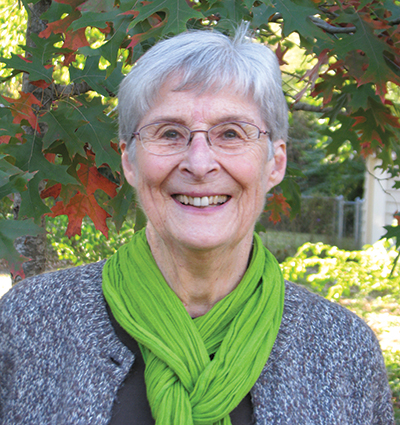
Sara Regier has served in Africa, Mexico and North America and learned to be friends with God and with people.
Sara Regier remembers starry evenings when she danced with Congolese women around campfires. The women teased each other about their different dance moves, and laughter transformed long-standing differences into new friendships.
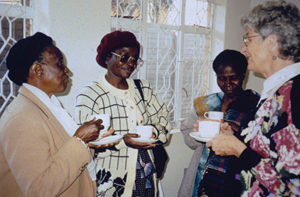
Photo provided.
In the 1970s, Sara drew together women from various regions of the Mennonite church in what is now the Democratic Republic of Congo, she said during an interview late last year at her home in North Newton, Kan. She coordinated two-week leadership seminars to help women learn to know each other in postcolonial Congo and explore ways to use their leadership and spiritual gifts in a male-dominated culture.
Sara wasn’t questioning local customs but inviting women to learn new skills, spiritual growth and solidarity, she said. Yes, she stood out as a tall white woman swaying her hips out of sync. But their teacher had become their student, happy to learn, happy to be part of a gathering that brought unity and joy.
Until then, “only the men went to church conferences, and I saw this seminar as a way to energize and empower the women,” she said. “I wasn’t there to teach. I saw myself as a facilitator who invited women to talk with each other, to worship together, to claim their gifts.”
It was this sharing of gifts in mutual friendship that excited Sara. Once a maternity-ward nurse, she now was a “midwife” of friendship amid differences, taking the role of a servant. From within these circles of women, far from her rural Kansas roots came some of the cross-cultural relationships she forged while joining her late husband, Fremont Regier, in a lifetime of global mission.
These seminars occurred in their second mission assignment, from 1965-1976. That’s when the Regiers served with what is now African Inter-Mennonite Missions (AIMM) in Nyanga, in southern Congo. She taught maternal and child health classes for women and children, directed an adult learning center for women, led leadership training and homeschooled her children—Chuck, Heidi [Regier Kreider] and Nathan. Fremont led an agricultural extension and demonstration program.
Global perspectives first sown in prairie seeds
The free-spirited Congolese gatherings were far removed from Sara’s younger life, including graduation with the Class of 1957 at the former Bethel Deaconess Hospital (BDH) in Newton, Kan. She stood prim and proper in her starched nurse’s uniform. That day launched her into her vocation, which would change and expand during the next five decades.

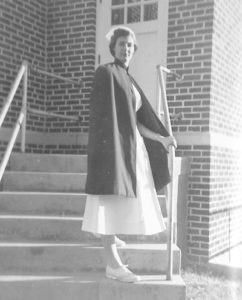
She and Fremont Regier, whom she married two days after graduation, later served in missions in Mexico and Africa and engaged with North American church leadership and education.
Sara said her training days were “like being in a convent,” with daily chapels, strict rules and classes taught by deaconesses who took vows and wore habits. This well-ordered, disciplined setting was an extension of her childhood and teenaged years growing up on a farm on the outskirts of Elbing, Kan. She was baptized at Zion Mennonite Church in Elbing.
“I had a very strong spiritual formation, and the best way I can explain it was that it was somewhat like a monastic community,” Sara said.
“Everyone was part of the same group and went to the same church, and our family had daily devotions and prayer.”
She and her siblings were expected to read the Bible and memorize Scripture. They were shaped by a strong emphasis on mission and service. During wartime, young men found alternatives to the military in Civilian Public Service (CPS) camps and 1-W programs.
Sara was born to the late Hilda and Louis Janzen on Nov. 6, 1935, the only daughter of four children. They were offspring of Prussian and Russian ancestors who immigrated to Kansas in the 1870s and helped found Zion Mennonite. She went to a one-room school through eighth grade and to high school at Berean Academy in Elbing. That’s where she first dated Fremont in her senior year. She attended Bethel College in North Newton for prenursing studies prior to BDH and her marriage.
The newlyweds moved to Manhattan, Kan., where Fremont completed undergraduate and graduate studies in animal nutrition at Kansas State University to prepare for agricultural mission. Sara gave birth to Chuck in 1959, worked at Riley County Hospital and earned a bachelor’s degree at K-State in family and child development.
Old Colony becomes new neighborhood
In 1961, the former Commission on Home Ministries, part of the former General Conference Mennonite Church (GCMC), called the couple to serve two years with Old Colony Mennonites in Cuauhtémoc, Mexico. Fremont worked in an agricultural extension program for the government. Sara shared about maternal and child health among her neighbors and gave birth to Heidi in 1961.
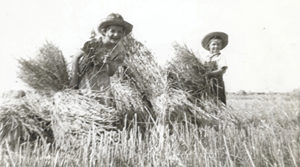
Photo provided.
“I could teach maternal and child health in natural, easy ways because of our new baby and the hospitality in our home,” she said. “As we sat and visited, Heidi gave me opportunity to model good health and feeding techniques.”
Sara said rural life in the Old Colony setting was similar to her upbringing. The Regiers lived in town, and so when Old Colony folks came there to shop, they often visited the family. Serving a light supper was common. Breads, soups, meats and potatoes were abundant, and skilled cooks taught her how to make noodles.
In this setting, she had opportunities for adapting and modeling, she said. “I never thought of wearing anything but a dress—and always a headscarf to church” she said. “And when we were out in public, I always deferred to Fremont. … On the other hand, we were able to model some healthy ways of living as a family.”
Part of that modeling involved helping her children adapt to different cultures. In Congo, the children were homeschooled and at fourth grade went to a boarding home in Kinshasa to attend school. Nathan was born in 1967. In 1977, the family moved to North Newton so Fremont could teach at Bethel College, where Chuck and Heidi attended. Nathan attended middle school in Newton, then went to public high school in Botswana, where his parents co-directed Mennonite Ministries, a new program of Mennonite Central Committee (MCC) and AIMM, from 1981 through 1985.
“My biggest challenge was raising children from a very affluent society—with all its privileges of education and health care—to be compassionate and open to the cultures where this wasn’t the case,” Sara said. In a recent telephone interview, Nathan, 47, said his parents’ modeling shaped him and his siblings into adaptive, resourceful and open people.
“We were taught that if we broke it, we fixed it,” he said. “If we couldn’t fix it, we built a new one. We had no option to buy a new one. My mom never seemed to be flustered, and she was unconditionally present and unconditionally accepting of everyone around us, including our gardeners and housekeepers.”
He spoke about when he was a fourth- or fifth-grader, experiencing a U.S. school for the first time. “Because I was a minority in Zaire, I didn’t see color as a thing that distinguished people from each other,” he said. “So back in the States, when I was telling someone about a friend of mine and was asked what color he was, I couldn’t answer because I didn’t know.”
Caring for self, making a home in transitions
Sara suffered an identity crisis when they moved back to the States in 1976. After two decades of caring for family and befriending families from other cultures, she now needed to care for herself. After Fremont earned his doctorate in adult education at the University of Wisconsin, they moved to North Newton. “We bought our first and only home, and there I found myself depressed and crying,” she said. “I had spent a lifetime learning languages and doing education with nonliterate women, and none of that was any good here. People at church would say, ‘Isn’t it wonderful to be home?’ But this wasn’t home.”
Kansas became home again as she found new places to share her gifts in the North American context. She joined a growth group for women in transition, and later led a similar group at the County extension office and at Prairie View Mental Health Center. Sara also became a part-time youth pastor at Faith Mennonite Church in Newton, the family’s church home.
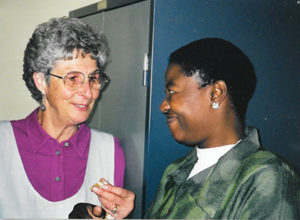
In 1981, they returned to Africa to serve with Mennonite Ministries in Botswana, the joint program of AIMM and MCC, where they gave leadership to 40 workers. These were good years but also exhausting, Sara said. “It was the anti-apartheid era, and we lived right on the border of South Africa. We lived next door to refugees and political activists. We faced the horror of across-the-border raids and the tragedy of friends dying from bombings.
The couple came back to the United States in 1985 so Nathan could attend college. Fremont did consulting and short-term assignments in international development. Sara coordinated the former Mennonite Women in Mission organization. In 1990, the couple moved to Elkhart, Ind. At what is now Anabaptist Mennonite Biblical Seminary (AMBS), Sara earned a master’s degree focused on spiritual formation and mission in cross-cultural settings.
In 1993, Fremont and Sara conducted a research project for PEW Charitable Trust on nonformal theological education in sub-Sahara Africa. One of the programs they surveyed was with the former Mennonite Board of Missions in Benin, where Rod Hollinger-Janzen and Lynda, his wife, both in their 30s, were working.
In a recent telephone interview, Rod, who now serves as AIMM’s executive coordinator, shared fond memories of the kind, older couple.
“I was intimidated at the thought of being visited by this very experienced Africa couple,” he said. “But they were so gracious and so gentle that my anxieties melted away. I feared they were coming to find things to criticize. Instead they were coming to look for things to affirm.”
Two last whirls around the world
In their later 50s, the couple still found energy for two more assignments. From 1993 to 1996, they became MCC co-directors in Mozambique after its civil war. From 1996 through 2000, they served as half-time MCC program directors in Zimbabwe and half-time regional coordinators for MCC in southern Africa.
Mozambique was their most difficult assignment, she said. “Our bodies were physically able, but we needed emotional and mental stamina,” Sara said. “We placed young couples in communities where people were coming back from refugee camps to find homes destroyed and looted.”
The Regiers were robbed, feared bodily harm and witnessed the effects on society of a generation of boy soldiers. “But Mozambiquan church leaders had an amazing love for Christ, a desire for peace and a strong sense of call,” she said, “so we hung in there.”
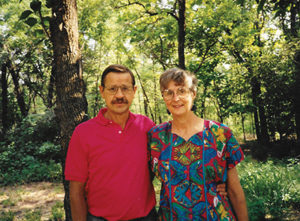
In 1996, they left Mozambique for Zimbabwe, where they served until they came back to North Newton in 2000. That’s where they deepened relationships with their extended family, which now included eight grandchildren. In 2010, after 53 years of marriage, Fremont died from prostate cancer.
Today, Sara still lives in the home they bought in the late 1970s to become a base for their college-age children, who eventually married and raised families. It is here where Sara still dances, in a different, quieter way, to the beat of loving relationships with God and others. Her passion for friendship with the divine and the human is still central to her core.
A women’s group meets biweekly in her home to share breakfast, practice silence, and listen and respond to Scripture. Sara also shares spiritual friendships, listens to others and prays with them to help guide their journey with God.
She credits a spiritual director, a Catholic priest in war-torn Mozambique, for introducing her to practices that continue to deepen her spirituality, she said. “He had lived the horrors of war and was a good guide for becoming more peaceful and centered in the midst of evil and life’s big questions,” she said.
In a recent telephone interview, Ann Dunn, one of Sara’s longtime friends, said, “Sara has an incredibly loving heart for people. Her insights make a person feel loved not only by her but also by God. She has taught me the importance of friendship—Jesus with skin on.”
Sara said some of her most important teachers about being “Jesus with skin on” came from her Congolese friends, who knew the joy of dancing and the tears of death. For example, a dying Congolese baby was laid naked on a blanket on a porch. “Everyone sat and watched as the baby’s breathing thinned and finally quit,” she said. “You could say that was barbaric, but I think it reflected a culture that knew its limits with medicine and still wanted to give this child an honorable death.”
Sara said she misses the “over the top” expressions of worship, anguished expressions of grief and injustice and deep longing for God to “save us.” She found these around the world in places where friendship with God and others was the glue of the community, not material wealth or “right” behaviors.
“I long for us to learn anew the meaning of receiving a call to follow Jesus as part of an ethnically diverse, global Anabaptist church,” she said. “I long for us to learn to trust and rely on God’s generous love and care for us. I long for us to open ourselves to the risk of compassionate listening to our neighbor, whether in the pew, next door or far away. I long for us to build inclusive community rather than define boundaries.”
 Laurie Oswald Robinson is a free-lance writer in Newton, Kan., and the author of Forever Family.


Have a comment on this story? Write to the editors. Include your full name, city and state. Selected comments will be edited for publication in print or online.