


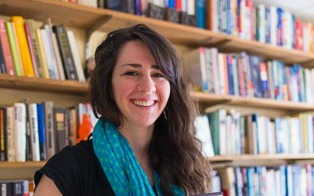
Elisabeth Wilder will be a senior at Eastern Mennonite University in Harrisonburg, Va.
What could I say to people that I had helped displace, starve, and traumatize?
Over May 20-23 I had the good fortune of participating in the 11th celebration of Days of Prayer and Action for Colombia (DOPA)–an annual event that works towards peace in a country that has suffered great internal violence for decades. Created in response to Plan Colombia, DOPA puts faith into acts with religious services, advocacy, celebration, and of course, lots of prayer.
This year is a special year. With the current peace accords in Havana between the Colombian government and the oldest guerrilla group, the FARC (Revolutionary Armed Forces of Colombia, Fuerzas Armadas Revolucionarias de Colombia), there is great hope for demobilization of not only the FARC, but also the ELN (National Liberation Army, Ejército de Liberación Nacional).
As part of the celebration, a group of delegates from the United States met with several communities in Colombia to hear their stories. We listened as people from Soacha—the slum outside of Bogota—told our group about guerillas trying to recruit their children and paramilitary groups forcing people from their homes. Our small crew heard tales from Guayabo, a small, rural community outside of Barrancabermeja, of how outside money and government support may displace 60 families if the police don’t capture and run them out of town in the meantime. There were stories from families within Bogota, too, of trial, suffering and pain.
The weary eyes that met mine during these gatherings were discouraged, but not without hope. Almost every story—no matter how horrifying—had the same ending: God has delivered us and is with us in the midst of this difficult journey home.
God?
Confused was an understatement. Plenty of Sunday school lessons had taught me that God never leaves us and shares in our joys and sufferings, but as people following the same God, why do I get to call somewhere home while the people who were in front of me don’t? It didn’t seem possible that as a United States citizen I had any place to tell people about God, justice, or peace.
How do people from the United States talk about God without acknowledging that the United States is responsible for much of the suffering in Colombia? What do I say about God to people that, because of my citizenship, I have helped displace, starve, and traumatize?
As the number one consumer of illegal drugs, it’s the United States’ consumption that fuels guerilla and paramilitary groups. Our obsession with snack foods such as Oreos, Skittles, and crackers contributes to the displacement of Afro-Colombian and indigenous people due to the harvesting of palm oil, which is used in a variety of treats. More than any other school, graduates of the School of the Americas in Fort Benning, Georgia, have been implicated in human rights abuses in Colombia. Of course, there have also been billions of US dollars spent to militarize Colombia, too.
My hand didn’t pull the trigger, sign the order, or light the match, but it’s my tax dollars, representatives, and country that helped create the problem. What I buy, consume, and endorse contributes to the agony of many in Colombia. And it’s my privilege that allows me to tell this story instead of living it.
But it’s a familiar tale, right?
Boo-hoo, there are repercussions to what I consume. What a surprise, the government is doing something that I don’t like with my tax dollars. So what? Everything comes with a price, no one gets everything they want, and there isn’t an easy answer to conflict. We pray, educate, write letters, and hope for the best. Done.
With only an associate’s degree to my name, I’m not the expert on ending conflict, poverty, and violence, but I do know that systems only change when people truly want them to change. If we really want peace and justice in Colombia, it’s going to take more than promising to give up cookies and cream ice cream, or writing a letter to a representative about indigenous people being sprayed with pesticide. Real change happens when we acknowledge that as long as the system continues to benefit us, it’s not going to work for someone else.
As long as we continue to live in a system where the United States and other wealthy countries benefit from the exploitation of people, injustice will keep reoccurring. The system has to change if we have any hope for justice.
A good place to start is with the United States’s War on Drugs. It’s a system in which wealthy white people can consume illegal drugs with little consequence, while people of color are incarcerated at drastically higher rates, cultivating and selling drugs to be sold thousands of miles away, and profiting only as a means of survival. In fact, by legalizing marijuana the United States, the United States can help stop narco-trafficking and thus limit income for armed groups in Colombia.
So as I sit here on my expensive laptop in a comfortable chair, sipping coffee and enjoying all the pleasures of being white and middle class, the words of one of my Colombian brothers haunt me, “Those who take up arms are not the only ones responsible.”
We have to want to give up more than Skittles, but rather, an entire system. It’s not enough for the guilt of privilege to make us more conscious consumers, though it is a modest start; we need to be actively working and seeking an end to powers that marginalize and ostracize.
What do I say to those who I helped displace, starve, and traumatize? For those in Soacha, Guayabo, Bogota, and for all those suffering in Colombia, you know more about what it means to walk the path of Jesus than I ever will. Your courage, grace, and wisdom in the midst of dire circumstance are why you are the experts of peacebuilding and we who had the honor to hear your stories are but your novice students. God is aching with you, and rejoicing in your deep faith.
Your voices are great, but your love is stronger.
I’m sorry we live in a system where few win and many lose—a system people like me helped create. This system of oppression that has caused displacement, starvation, and trauma does not come from God, but with those who have hearts for God—those who seek (restorative) justice, love mercy, and walk humbly—maybe we can end it.
The views expressed in this opinion post do not necessarily represent the official positions of The Mennonite, the board for The Mennonite, Inc., or Mennonite Church USA.


Have a comment on this story? Write to the editors. Include your full name, city and state. Selected comments will be edited for publication in print or online.