


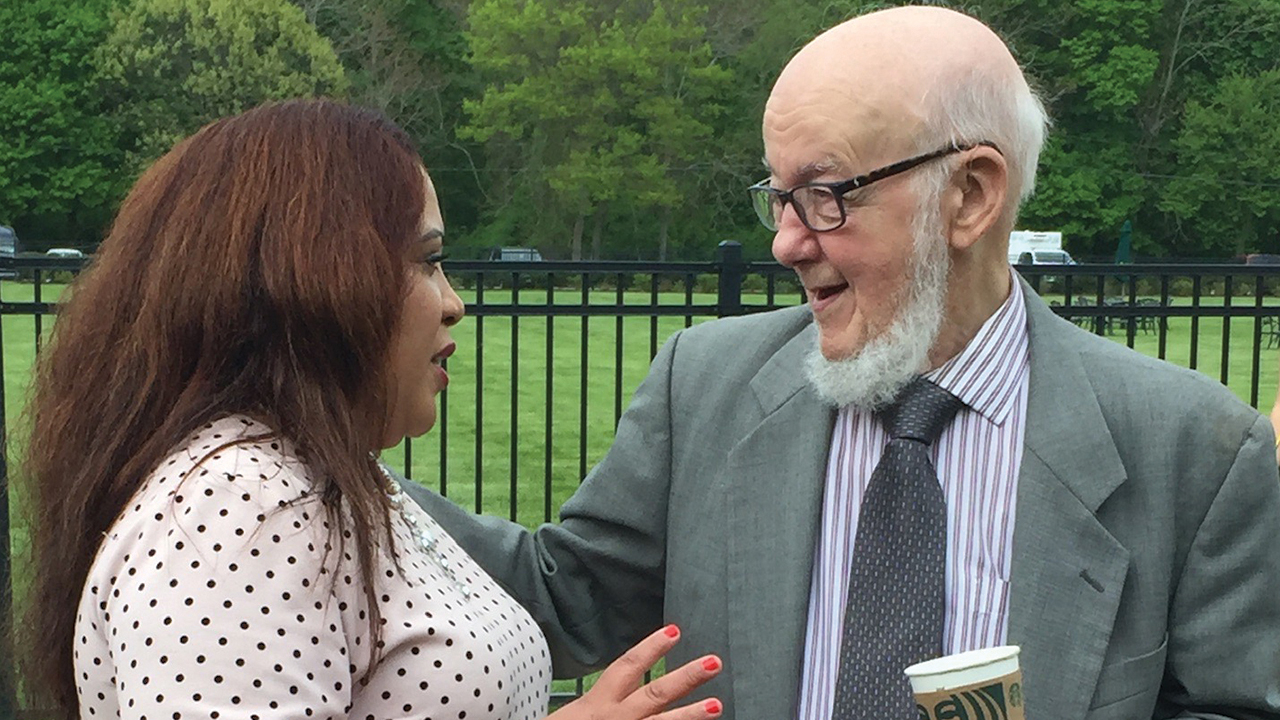
Monroe J. Yoder, 85, of Grantsville, Md., the first resident bishop of Lancaster Mennonite Conference’s New York City District, died Jan. 13 at Garrett Regional Medical Center in Oakland, Md.
Born in Boynton, Pa., and raised in an Amish-Mennonite farming community, he spoke only Pennsylvania Dutch until first grade. He hoped to become the first in his family to graduate from high school but had to leave school to work on the family farm after his father was incapacitated by a stroke.
Eventually he earned his GED, graduated from Eastern Mennonite University and earned a doctorate in biology from New York University.
Drafted during the Korean War, he opted for alternative service as a conscientious objector through Mennonite Central Committee. The three places he worked during his two years of service had a profound impact on his life.
At the National Institutes of Health in Bethesda, Md., he got a glimpse of the world of science. At Wiltwyck School for Boys in Esopus, N.Y., he connected with New York City youngsters court-appointed to live there — and was convinced that if he and his brothers had not been farm boys, they might have been sent to such a facility. At Prairie View hospital in Newton, Kan., he learned to appreciate the intricacy of the human psyche.
He married Rachel Miller in 1961. Four years later, they moved to Brooklyn for a two-year graduate program in biology at Long Island University. They began attending Seventh Avenue Mennonite Church in Harlem, where he was ordained to pastoral ministry in 1974. Later he was ordained as the first resident bishop of LMC’s New York City District.
He combined church commitments with full-time work at New York University as director of electron microscopy services.
Yoder’s ministry at Seventh Avenue made a strong impression on Melody Pannell, now of Harrisonburg, Va., who grew up in the congregation. She remembers his integrity and dedication to the gospel of Jesus Christ.
“Bishop Monroe crossed cultural boundaries throughout all of the five boroughs of New York and strove to create a beloved community in unconventional ways,” Pannell said.
“You could find him praying with men’s groups on the streets, advancing the vision of our children’s Head Start program in the boardroom or driving young adults to college.”
She considered Yoder a role model for people of all ages and backgrounds.
“His mission was to build the church, nurture the people and teach the Word of God in a way that everyone could receive it,” she said. “His nonjudgmental disposition and warm, invitational manner won over even the most skeptical personality. He embodied cultural humility and compassionate listening.”
Richard W. Pannell — Melody Pannell’s father, who served with Yoder as pastor at Seventh Avenue and was the first Black man licensed for ministry in LMC, in 1967 — described Yoder as “a giant of a man, slaying dragons of race discrimination, poverty, class distinctions, homelessness, crime, violence and sin in all its forms with the preaching and teaching of the gospel of Jesus Christ.”
Yoder was involved in founding Camp Deerpark at Westbrookville, N.Y., owned by the New York City Mennonite churches. He played a key role in the establishment of Seventh Avenue’s Head Start program in 1969. He helped bring to fruition a Harlem building project, initiated by Seventh Avenue Mennonite Church, that includes affordable rental housing.
In 2019 he joined several other New York City Mennonites to form Grace and Peace Mennonite Church, a primarily virtual congregation, where he became a founding member.
Survivors include a daughter, Naomi Yoder of Grantsville; a son, Keith (Lisa) Yoder of Morgantown, W.Va.; a brother, Marvin of Springs, Pa.; a granddaughter and a great-granddaughter. He was preceded in death by his wife, six brothers and four sisters.


Have a comment on this story? Write to the editors. Include your full name, city and state. Selected comments will be edited for publication in print or online.