


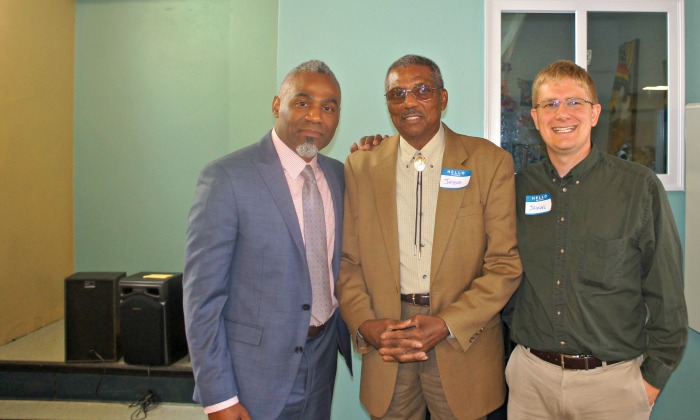
Photo: Speaker Ewuare Osayande, Pastor Jesse Dunigas and Pastor Samuel Voth Schrag at St. Louis Mennonite Fellowship. Photo by Mark Smith.
Two Mennonite churches, located five miles apart in St. Louis, Mo., have been working together to be a light in their community for racial justice.
Bethesda Mennonite Church started as a house church within the Pruitt-Igoe housing complex in 1957.
On the south side of the city is St. Louis Mennonite Fellowship—founded in 1975 by families and individuals who had moved to St. Louis from more traditional, mostly rural, Mennonite communities around the country.
Bethesda Mennonite Church’s attendees remain almost entirely black, and the people of St. Louis Mennonite Fellowship are nearly all white.
“We’re two different churches: racially, theologically, culturally, but we’ve been committed to find out what it means to be brothers and sisters together,” said Samuel Voth Schrag, St. Louis Mennonite pastor, in an interview on May 4.
A partnership between the two churches called City on a Hill was formed about 15 years ago, and they have been getting to know each other and worshipping together in various ways ever since.
Since the shooting of Michael Brown on Aug. 9, 2014, in Ferguson, Mo., the churches have increased their work together—especially in the area of racial reconciliation.
“We felt that someone had to make a move in the right direction—not just talking about [racism] but doing something about it. It’s not getting any better,” said Jesse Dunigans, pastor of Bethesda.
So, on May 2, the two churches hosted a workshop on racism, “Following Jesus to Ferguson.”
About 30 people attended the workshop, held at St. Louis Mennonite Fellowship, from a variety of backgrounds: Catholic, Mennonite, Lutheran and more.
The workshop presenter was Ewuare Osayande, a social justice activist, author and educator. He serves as the anti-oppression coordinator with Mennonite Central Committee U.S.
“Ewuare brought us an overview of the history of racism in this country. It was received well,” said Pastor Dunigans.
One of the things Osayande highlighted is that the whole church has an image of Jesus that is white, said Voth Schrag.
“That image of Jesus as white is a result of white supremacy, and it supports white supremacy. If we looked as Jesus as a dark person, as he most certainly looked, we would think different about black and white in our country,” Voth Schrag said.
In 2013, City on a Hill invited Mennonite Mission Network’s choir, Work in Progress, and John Powell of Indiana-Michigan Mennonite Conference for a weekend revival.
Earlier this year, they invited Cyneatha Millsaps, a Mennonite pastor in Markham, Ill., and columnist for The Mennonite, to speak at an event.
She suggested a “Guess who’s coming to dinner” activity in which families from one church invite families from the other church over for a meal. Both pastors said they hope to get something like this started in the summer.
The two churches participated in a MLK Day service project this year.
Together church members picked up trash on Martin Luther King Jr. Boulevard and passed out bags for homeless people with the names of both churches.
The high school students from both congregations are making plans to attend the Mennonite Church USA convention in Kansas City, Mo., in late June and July, traveling and participating as one united youth group.
Dunigans also said they hope to plan a joint picnic together this summer, instead of simply inviting one another to their own picnics.
The pastors both said they hope their churches can be a witness locally and around the world and within Mennonite Church USA.


Have a comment on this story? Write to the editors. Include your full name, city and state. Selected comments will be edited for publication in print or online.