


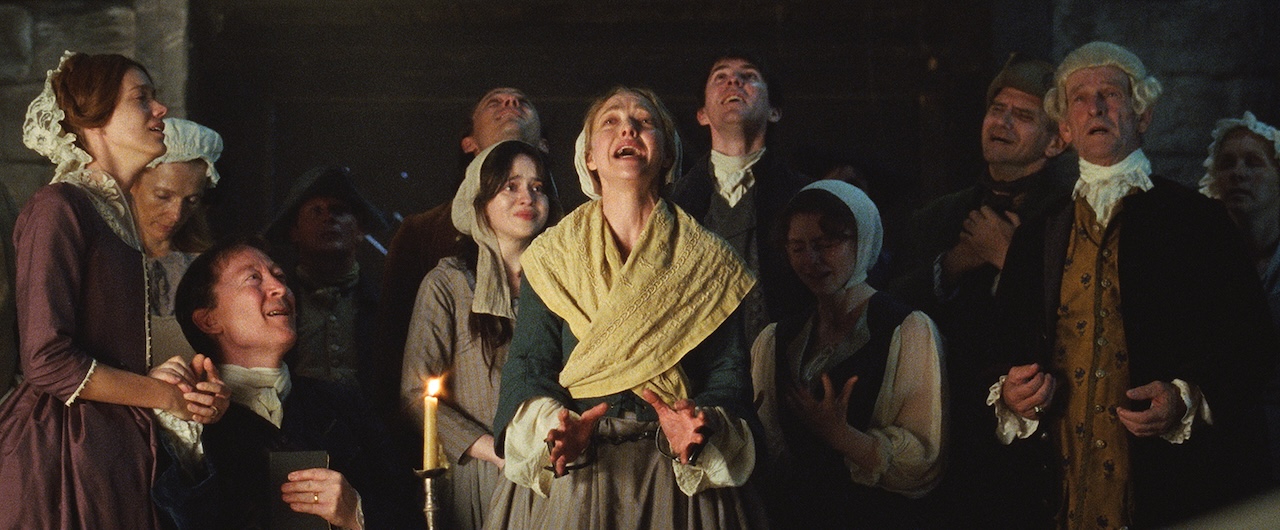
At first glance, the story of 18th-century Shaker founder Ann Lee may not seem like an intuitive choice for a movie musical.
The religious movement leader’s life was punctuated by harrowing moments, from enduring the death of her four infant children to facing violent mobs who condemned her as a heretic. And while plenty of musicals dabble in religion, the genre isn’t known for taking religious subject matter seriously.
But the new film The Testament of Ann Lee manages to depict sincere religious fervor without mocking it and to embrace music and dance without appearing contrived. After all, ecstatic worship was part of what earned the Shakers — known in the movement’s early days for “shaking off” their sin through ecstatic dance — their name.
In many ways, it’s the apparent contradictions that make the movie memorable. It’s a musical, but it’s also a historical drama. It depicts a woman who fiercely spearheaded a religious movement, but whose understanding of liberation is at odds with many modern definitions; Lee was consumed by the idea of sin and sexual purity.
Those tensions are deftly depicted by Amanda Seyfried. The actress has taken on film musicals before, but Ann Lee is an entirely different project than Mamma Mia or Les Misérables.
For Seyfried, who has said she is not religious, Lee’s story isn’t about the existence of God or about religious visions and miracles. Instead, it’s about the human urge to cling to something greater than yourself to cultivate a sense of protection, and the importance of community.
“We get so lost in the fear of daily life and the complication of daily life,” Seyfried told RNS. “Life is hard, which is why we search for a higher power, whether it be God or Mother Nature, Jesus, it doesn’t really matter who your higher power is . . . . It’s that these entities make you feel safe.”
Seyfried’s gritty, visceral performance has earned her a Golden Globe nomination. The film was also nominated for the Golden Lion award at the Venice Film Festival and was featured in The New York Times’ list of movies to see this winter.
Mona Fastvold co-wrote the film with her partner, Brady Corbet, and she developed the idea and directed the film. The pair also co-wrote the 2024 Oscar Award-winning film The Brutalist. She told RNS she was gripped by the story of Lee, whom she described as “one of America’s first feminists, really fighting for equality and acceptance.”
Born into poverty in Manchester, England, Lee grew up illiterate. She eventually joined an English religious sect that preached sin could be expelled from the body through dancing and chanting. Following the deaths of her four children, each in infancy, Lee became convinced that sex is what separated humanity from God.
Eventually, Lee founded her own religious group and moved to America, where she established a utopian community. Her followers, who called her “Mother,” came to see Lee as the female reincarnation of Christ. She taught that celibacy, even in marriage, and confession of sin were both key to achieving salvation. The Shakers claimed 6,000 members at their height around 1840; today, three Shakers are believed to remain.
The film’s telling of Lee’s life is more fable than strict biopic. Fastvold said the screenplay was based on in-depth research but also relied on intuition to fill in the blanks of Lee’s story. From Fastvold’s perspective, the religious movement was largely fueled by Lee’s grief and trauma. The film depicts the loss of Lee’s children in painful detail and links that grief to the release Lee discovered in religious ecstasy.
“For her, the immense trauma that she suffers, unspeakable trauma, her only way out of it is through faith,” Fastvold said. “I cannot mother my children. So I’m going to mother the entire world.”
While Fastvold said the movie isn’t a “traditional musical,” she described the musical elements as “integral” to the film. “All of my cast members just had to work together as a community, as a group, in order to achieve that,” she said.
Seyfried added that she hadn’t known about Lee prior to making the film but now sees how her story demonstrates the same physical and emotional needs people seek to fulfill today.
“Most of us want to find purpose in our short lives,” she said. “And that should be uniting us — that we need to constantly be reminded that humanity hasn’t changed that much over the centuries.”
Seyfried said Lee’s story is also timely in that it’s about an illiterate, poor immigrant woman who “did the impossible” by creating a society where people of all races and genders were equal.
“We need to look to leaders who lead with compassion and nurturing, and (create) space to thrive for the greater good of the community,” said Seyfried. “We’re all in it together.”
Editor’s note: This film is available in select theaters and is rated R.



Have a comment on this story? Write to the editors. Include your full name, city and state. Selected comments will be edited for publication in print or online.