


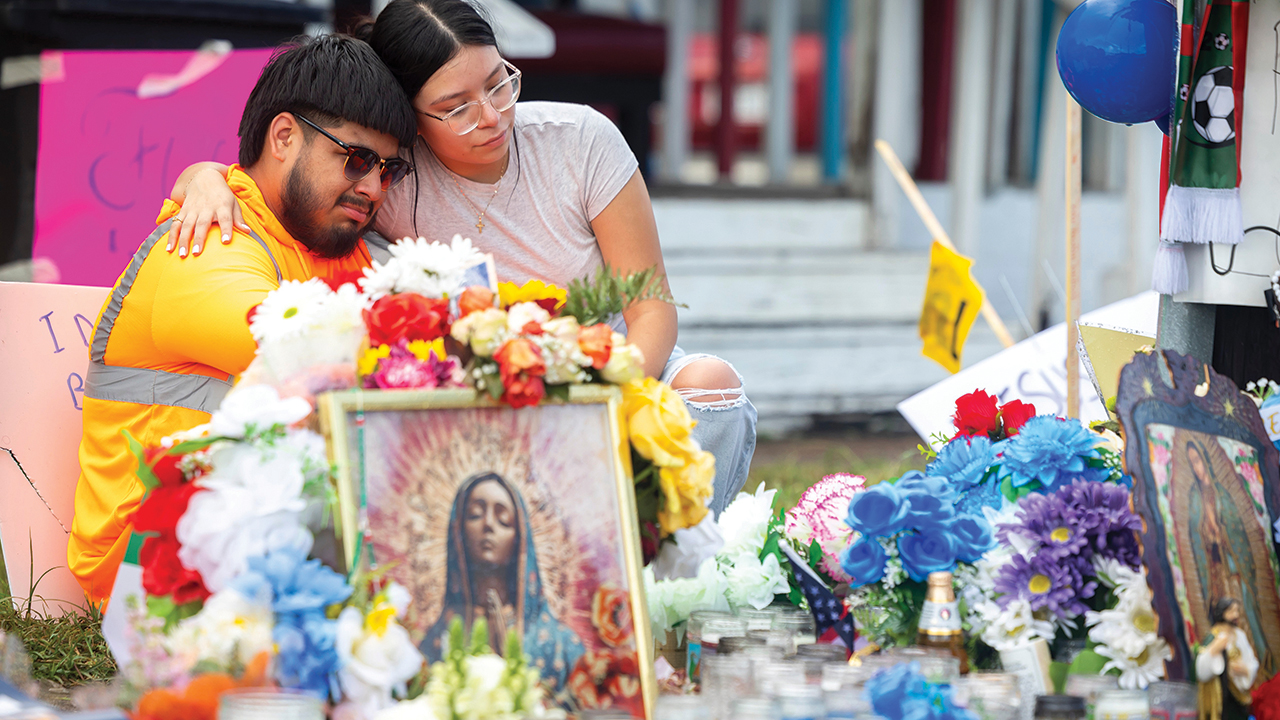
In my last report for Anabaptist World, “Four Days in Minneapolis” (March), I concluded that the story of violence against immigrants was not over. Tragically, this was true.
Six months after federal agents killed two U.S. citizens in Minneapolis, two more fatal shootings sparked outrage across the nation. In July, Lorenzo Salgado Araujo, 52, of Houston, and Johan Sebastián Durán Guerrero, 25, of Biddeford, Maine, were shot and killed by Immigration and Customs Enforcement agents, adding to the death toll of state violence against people caught in immigration limbo.
Theirs were not the only lives lost within the immigrant struggle. By August, advocacy organizations documented at least 23 deaths inside ICE detention facilities this year. Of some people held in detention, we know almost nothing. Information about them remains buried within the system.
Saulo Padilla, who worked for Mennonite Central Committee for 18 years and now facilitates seminars on migration and trauma, compares ICE shootings to a biblical image: public executions that spread fear in ancient Rome.
“In the time of Jesus, people would be crucified and left publicly for others to see so they would fear going against the empire,” Padilla said. “This is what we are witnessing now at the borders and in the nation.
“Trauma has different forms. When you watch people being caught by immigration officers anywhere, even at church, your body and brain think, ‘This could happen to me or someone I know.’ These campaigns are based on fear and force people to be quiet.”

Looking for a closer connection to Salgado Araujo’s family, I reached out to Cesar Espinoza of FIEL, an immigrant-led civil-rights organization in Houston. Espinoza has supported Salgado Araujo’s family.
“The family wants people to remember their father as a hard-working man, not a criminal,” he said. As he spoke, my memory flashed back to those who were killed in Minnesota, bringing tears to my eyes.
In a national media report, Ronaldo Salgado, one of Salgado Araujo’s sons, said, “Our father left for work at 5 a.m., waking up earlier than the rest of the world, and at 6 a.m. he had been killed going to work. We demand a full independent and transparent investigation, justice for our father, and that this never happens again.”
To counter the violence, just like in Minnesota, communities of all backgrounds are coming together, protecting themselves from the state — creatively and peacefully — while demanding justice.
At Houston Mennonite Church, members are involved in the ICE Watch community. “There is a lot of camaraderie with broader Houston community movements, and our church serves as a space for events and organizing,” Pastor Chris Becker said.
Leaders from faith communities across Texas came together to send a unified anti-ICE message to Gov. Greg Abbott and state lawmakers, saying ICE operations go against their values.
“This is not of God, this is a terror campaign with the mission of traumatizing our neighbors until they self-deport,” Dan De Leon, pastor of Friends Congregational Church in College Station, said in the faith leaders’ statement.
James Harrington, a priest at St. James Episcopal Church in Austin, added: “They use children as bait to deport their parents. This is haunting and is against our religious beliefs.”
I spoke with Isaac Rodriguez, co- founder of Chicano Boulevard, a historic gathering space two blocks from where Araujo was killed. For many Mexican- Americans, Chicano is a chosen identity rooted in cultural pride, political awareness and resistance to discrimination. Chicano Boulevard helped organize protests after Araujo’s death.
“There are a lot of community organizations here in Houston that join together as one community in the marches demanding for change,” Rodriguez said. “Our communities are under attack and being racially profiled whether or not we have a legal status. . . . We are not going to allow ICE to roam freely in Houston.”
Over the following weeks, the protests became both a cultural expression and a demand for justice. Hundreds gathered, including members of Danza Azteca, a traditional dance and art movement with colorful attire that showcases the Aztec ancestral roots and pays homage through dance and sound to the immigrant struggle.
Maribel García, one of the Danza Azteca leaders, said: “We got a call from our community to participate in the protests and memorial. It’s bittersweet because we celebrate our lives and cultural backgrounds but also remember those, like Lorenzo, who have tragically died. . . . Our dance represents a prayer in movement.”
Tony Díaz, a writer and Chicano community organizer, said artists, students, civil-rights groups and neighborhood leaders were coming together to keep Lorenzo’s memory alive and demand justice.
“The struggle for immigrants is not just about immigrants,” he said. “It’s about citizens. It’s about all of us.”
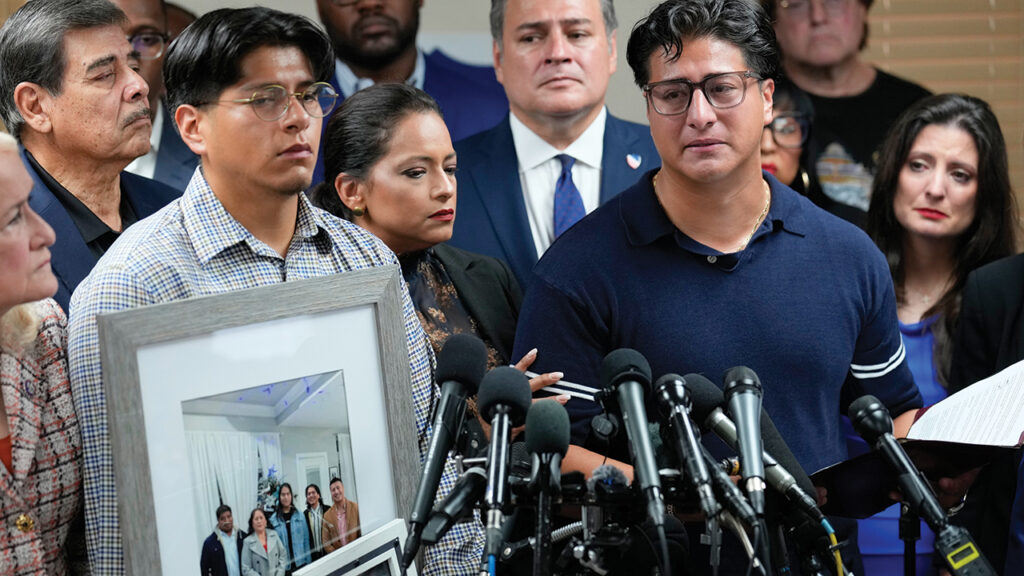
To explain the context of Latino immigration, Jesse Esparza, a history professor at Texas Southern University in Houston, emphasizes Chicano history in the 1960s, 1970s and 1980s.
“This reminds me of the long history of state-sanctioned violence against Latinos and ethnic Mexicans and persons of Hispanic extraction,” he told me. “Brutality by law enforcement has long been used to protect the economic interests of city and state elites and remind Latinos and others of their inferior status. . . . Communities have responded and resisted for many years, through protests, boycotts, forming multiracial coalitions working together across class, religious and color lines. You can see that happening today.”
Esparza sees the killings in Minnesota, Houston and Maine as linked: “For me, they are not different incidents. It is one incident. People from different communities are now connected forever through a larger state campaign to censor and silence.”
Felipe Hinojosa, a historian specializing in Latino and Chicano history who wrote Latino Mennonites: Civil Rights, Faith and Evangelical Culture, provided a historical perspective.
“There is a long history of immigration and discrimination in the United States,” he said. “Ideas of whiteness have changed over time, and immigration laws have changed with them, often trying to keep the country as Western European as possible while excluding Eastern Europeans, Asians and others. This is not new.”
Hinojosa traced Latino Mennonite history to the 1930s, when small numbers of Latinos began joining congregations connected to mission projects in Chicago and South Texas. By the 1940s, Chicano and Puerto Rican families were arriving in cities such as Chicago and New York to work in steel mills, while others labored in the agricultural fields of Texas. Their children later rose into Mennonite leadership during the 1960s.
“Most people see Latinos as recent arrivals, but they have been here for generations,” he said. “Anabaptist theology also connects to the histories of oppressed people, including Latinos in this country.”
The fear unfolding in Houston is not confined to Texas. In Atlanta, members of a Garifuna Mennonite community — part of an Afro-Indigenous people with roots in Central America and the Caribbean — describe living under similar pressure from immigration enforcement, racial profiling and the threat of detention.
“We held our Garifuna church service in the shared building of a Mennonite church, but many people of our community are undocumented and afraid to come due to the ICE raids,” said Dio Arauz, pastor of the Garifuna church. “We are now meeting secretly in houses rather than in church. We need more support from our broader Mennonite community, so we don’t walk alone.”
The stories unfolding across the nation are connected by the same structure of violent immigration enforcement — and a growing movement that refuses to remain silent. This is another tragic chapter but also one rooted in love of neighbor, community and action.
Resilience is visible among Latino students in Indiana. Gilberto Pérez, a Latino Mennonite leader at Goshen College, said students have created safe spaces and organized for immigrant justice even as fear has changed how many people move through their communities. Students formed Voces Fuertes, an organization dedicated to amplifying immigrant voices.
“We may be persecuted, followed or targeted, but we will still share our voices, tell our stories, advocate and stay educated,” Pérez said. “We must navigate this future together.”



Have a comment on this story? Write to the editors. Include your full name, city and state. Selected comments will be edited for publication in print or online.