


Three entities merge to form Living Branches, which serves residents and lets them serve in a variety of ways.
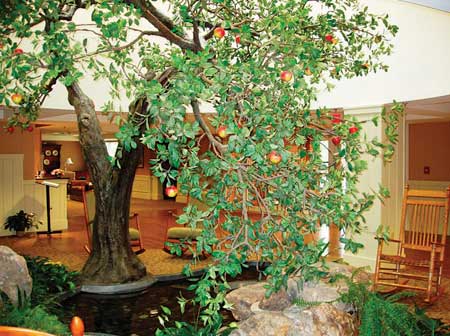
The lifesize apple tree in the lobby of Souderton (Pa.) Mennonite Homes (SMH) offers more than breathtaking décor or a place to sit and converse with friends. The tree is a reminder of the past and a symbol of growth.
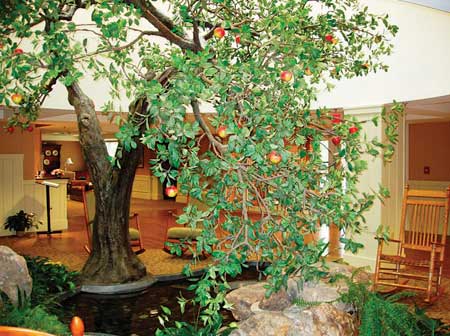 Built in 1917, SMH was surrounded by an apple orchard. Even then, the retirement community focused on service to others as the orchard provided food to the community, specifically during the Great Depression. SMH was not simply a retirement community but a place for canning, freezing and even butchering. It was as foundational to the town as the post office and bank.
The apple orchard no longer exists, but SMH is still a respectable monument. Combined with Dock Woods in nearby Lansdale and Dock Meadows in Hatfield, the homes are known as Living Branches. Today, Living Branches is recognized for strong roots, a solid trunk and blossoming branches of service within the retirement community and beyond.
Establishing roots: SMH, Dock Woods and Dock Meadows began as three separate retirement communities. With common Anabaptist affiliations and such close proximity, the three boards wondered if they might offer more to residents and employees if they joined together.
“We began asking, ‘Are there ways we can do what we do better together rather than separate?'” says Ed Brubaker, President and CEO of Living Branches.
One of the key benefits focused on employees. The discussion centered on how Living Branches planned to hire employees and develop them into capable leaders.
“This was an opportunity to grow better together through effective training programs, leadership development and more expertise across the organization,” Brubaker says.
A piece of employee development includes increasing training and development for members of the board. With a merge, one 15-member board could serve all three entities.
“This would free people to do other work in the conference,” Brubaker says. “Franconia Conference is not a huge conference, but it has a lot of Conference Related Ministries.”
Coupled with this discussion was one focused on using business consultants and other outside resources to increase the value of the organization. An internal focus combined with the use of outside resources would optimize the organizations’ financial resources.
The third, and greatest, key benefit involved the residents. “Affiliations or mergers focus on financial resources most of the time,” Brubaker says. “We don’t want to minimize that, but the bigger benefit was for our residents.”
Not only would residents benefit from a highly trained staff but from a wider selection of services and programs. The Life-Long Learning Program is one example. Because of the nearness to Christopher Dock Mennonite High School, residents from Dock Woods participated in academic classes to continue learning. Classes ran for a six-week period and were taught by Christopher Dock’s faculty. This is a difficult program to maintain for a single-site campus. However, with a larger population from multiple sites, the program is easier to maintain in the long run.
These conversations of key benefits continued to lead toward positive outcomes. “The conclusion was, Yes, we feel there is an opportunity here,” Brubaker says. “There seemed to be enough synergies between the organizations that we thought we could improve services to our residents, employees and the greater community by coming together.”
SMH, Dock Woods and Dock Meadows combined under the name of Living Branches on Nov. 24, 2008.
A solid trunk: The three campuses have much to offer residents and families.
Both SMH and Dock Woods are Continuing Care Retirement Communities. CCRCs consider all aspects of a resident’s life: physical, mental, emotional, spiritual and social. This approach provides satisfaction and fulfillment to residents.
As part of a CCRC facility, SMH and Dock Woods offer three main levels of care. Cottages, villas and apartments provide independent residential living. Personal care provides meals and some assistance with daily living activities. As part of personal care, both facilities offer memory support units. The third level of care is nursing care, offered to patients who need continual medical attention.
“The nursing unit has received a five-star rating at the federal level and is known for its high level of care in the community,” Brubaker says. “In this unit, there are strong, personal connections between staff and residents. They are like family.”
Dock Meadows, the smallest of the three campuses, offers personal-care services. These residents also have access to nursing care as needed.
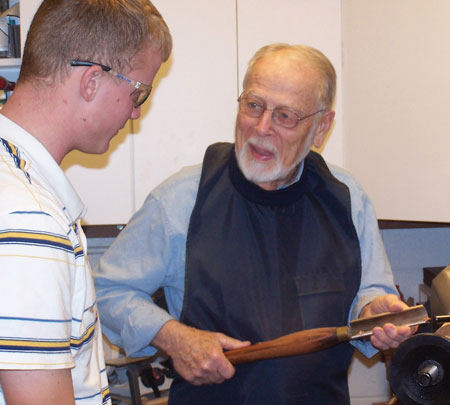
Living proof: Harry Moore moved with his wife to Dock Woods on Sept. 15, 2004. Harry received a doctorate, served in children’s ministry, taught, pastored, lived in Austria and Switzerland and has a keen interest in ballroom dancing, music and woodworking.
Even with this colorful background, Harry was happy to move to Dock Woods six years ago.
“I value the mission statement,” Harry says. “I affirm the solid administration, the secure financial base and the compassion of staff up and down the line. The residents themselves are great and have become family.”
Harry especially enjoys the fitness center and creating stunning pieces at the woodworking center. Still, he is careful not to overcommit himself.
“If I were to be included in everything, it would be like living on a cruise ship,” he says. “I choose my activities. I spend a lot of time in skilled nursing units holding hands with people and praying for them.”
Branches of service: The abundance of programs and activities Harry mentions is part of what makes Living Branches unique. Another unique aspect is that residents at Living Branches use these opportunities to reach upward and outward and nourish the greater community.
“While we want to focus on excellent care and food and all that is important to retirement communities, we don’t want to become exclusive—we are not a gated community,” Brubaker says. “We are part of a wider community and wider world and want to find ways to have residents and staff see themselves as part of that.”
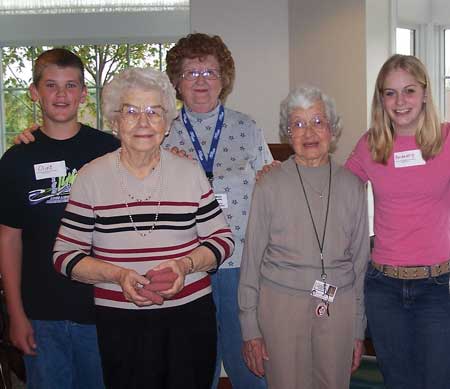
It is not uncommon to see residents rocking babies at the children’s center or students from Penn View Christian School volunteering with the residents.
Dock Village offers housing for families in need of rental assistance. The 100 rental facilities are not age restricted; many young people take advantage of the opportunity.
Residents of Living Branches get involved in the food pantry, and students from Christopher Dock volunteer as tutors. For students with high academic achievement, Living Branches offers a Dock Village Youth Fund, which rewards students and offers scholarships to attend private schools.
Staff and residents also serve on an international level. Each year, Living Branches sponsors a volunteer from Mennonite Central Committee (MCC) to become part of the family. This person spends one year working with residents and developing friendships—often staying in touch with residents upon return to their home country.
But MCC volunteers not only come to Living Branches, staff and residents go as volunteers also. A fund within the foundation sponsors staff and residents to serve with MCC in the United States and overseas.
Living proof: As residents volunteer, a strong sense of community develops. This bond draws others, including staff. Alta Yoder, director of volunteers and auxiliary president, and Mark Derstine, director of pastoral services at SMH, joined Living Branches after feeling burned out from previous jobs. Yoder began as a volunteer and has worked at Living Branches for 22 years. Derstine wanted to return to pastoring and found his dream job at Living Branches nearly five years ago.
“We are blessed with a number of faith-based retirement communities in the area, and I have visited all of them,” Derstine says. “There is a different level of value and of caring that the staff brings to Living Branches and that the community of residents carry for each other.”
“Family members tell us the staff and residents are so committed that they act as extended family,” says Cheryl Loftus, director of personal care at Dock Meadows. “This is so fulfilling to hear.”
Living Branches: Sometimes families must engage in difficult conversations, specifically about death and end-of-life decisions. Living Branches is committed to talking and walking with residents as decisions are considered and finalized.
“I am often asked, Don’t you get depressed?” Derstine says. “I don’t. This is a sacred journey we are asked to be on with the residents. The last stages of life are meaningful, and we want residents to be cared for, respected as children of God and always treated with dignity and love.”
Though death is a familiar and healthy conversation, Living Branches does not focus on the end of life. “Residents like the idea of living and growth at Living Branches,” Brubaker says. “This is another stage in life, and we want to be a place where living takes place.”
And so it does.
Living proof: Rachel Myers moved to SMH on her 70th birthday in 1988. The move was not easy, especially for her husband, Jesse, who enjoyed working on their small farm and restoring antique cars.
Rachel refers to the first five years as “the time of putting roots down.” Through activities such as shuffleboard, bowling and the annual chicken bar-beque, the Myers made friends and felt part of the community. When Jesse passed away in 1993, the community offered comfort and encouragement.
Rachel is thankful she and Jesse moved to SMH together. She is also thankful to be close to the bank, doctor, church and bowling alley, which she still frequents.
“I appreciate all of them,” Myers says, referring to staff and residents at Living Branches. “I especially appreciate the mission statement, which says we do all for the glory of God, whom we love and serve.”
“It’s the place to be,” Moore adds. “And I’m not just saying that because Ed [Brubaker] is sitting here beside me.”
Moore’s words are an invitation to join the community—perhaps to live, volunteer or simply visit beneath the shade of the vibrant apple tree.


Have a comment on this story? Write to the editors. Include your full name, city and state. Selected comments will be edited for publication in print or online.