


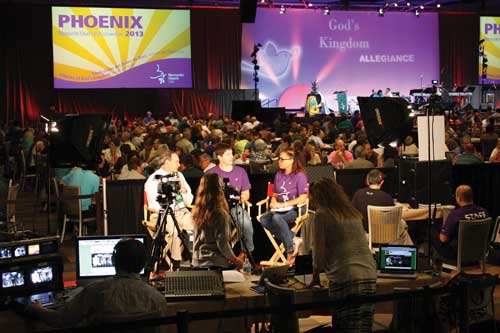
Assembly passes resolutions on immigration, child protection and creation care.
Delegates seldom give a speaker a standing ovation during Mennonite Church USA conventions. But Denver Seminary professor of Old Testament Danny Carroll was so eloquent, inspiring and entertaining, the Phoenix 2013 delegates did just that at the end of his 90-minute presentation and question-and-answer period on July 2.
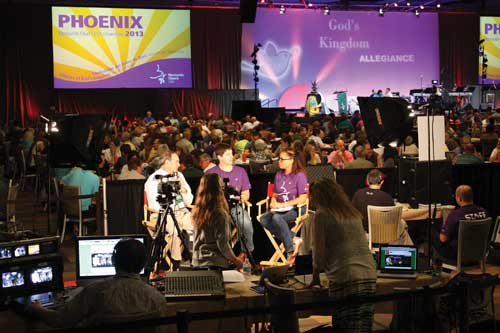
Framing the Old Testament accounts of Abram, Joseph and Ruth as immigration stories, Carroll challenged Mennonite Church USA to think about U.S. immigration issues as Christians rather than as U.S. citizens.
“The challenge for you,” Carroll said, “is, How do Mennonites think of immigration? Begin with Romans 12—don’t be conformed to the world, don’t be conformed to political ideologies. Romans 13 is the government. The Christians are Romans 12. The Christian position is the Word of God and Jesus on the cross.”
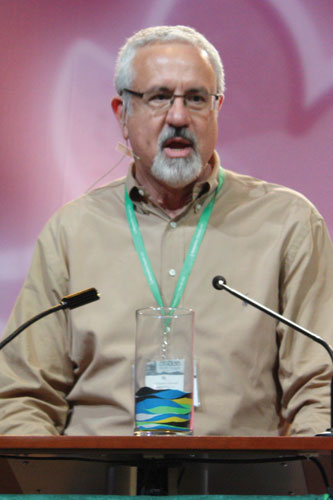
The primary focus of the 2013 delegate sessions was current U.S. immigration dynamics and whether to revise the statement on immigration adopted by the delegates in 2003. However, it became clear during the July 5 discussion on the immigration resolution, that more conversation will be needed before settling on new language.
Randall Justice, a delegate from the Akron (Pa.) Mennonite Church, said that the 2003 statement had “a lot of implicit political language” representing the politics of a decade ago.
Roberta Cabezas, a delegate from James Street Mennonite Church in Lancaster, Pa., asked that the word “undocumentable” be included in the resolution.

“People don’t know how hard it is to get documents,” Cabezas said.
Ron Copeland, delegate from Early Church in Harrisonburg, Va., asked that the new resolution use language consistently.
“A word of caution about demonizing the [U.S. immigration] system,” Copeland said. “It’s not one big, monolithic system out to hurt people.”
Margie Caraballo, a delegate from Templo Alabanza Menonita in Moline, Ill., said that the 2003 statement had “us versus them language” and had “no responsibility placed on current immigrants or Hispanic congregations.”
In the end, the resolutions committee adopted a statement that affirmed the 2003 resolution while calling for more refinement of the 10-year-old resolution, using feedback from the table groups, additional Constituency Leaders Council processing in the future and a final proposal from the Executive Board.
“We recognize that our witness to God’s embrace of the stranger in our midst is not complete,” said the statement. “Therefore, we reaffirm and resolve to update our churchwide commitments in light of delegate feedback in order to embody a fuller expression of God’s love, justice and grace to undocumented and undocumentable immigrants.”
The 2013 delegate assembly began with several housekeeping actions on July 2, and Mennonite Church USA’s Leadership Discernment Committee presented its ballot of new members to be elected to various Mennonite Church USA boards by affirmation.
Those ballots were collected in the first afternoon session, with the results announced in the second session. Ninety-four percent checked the “select all” box.
In the second session on July 2, Mennonite Church USA moderator Dick Thomas announced that the first of two offerings to be taken during the week totaled nearly $25,000, with the adults giving $13,851 and the youth giving $11,028. (The total eventually came to $25,047.28.)
The funds will be used to help the DREAMERs fund, which provides financial assistance for undocumented youth and young adults who want to initiate the process of becoming citizens.
This session focused on the churchwide goal of Christian formation. Getting special focus was the Shine Sunday school curriculum being created by MennoMedia and Western District Conference’s leadership in the Year of the Bible initiative.
Other sessions during the week focused on additional churchwide priorities, including Christian community, holistic Christian witness, stewardship, leadership development and undoing racism and advancing intercultural transformation.
The 627 delegates also quietly adopted several resolutions that mark major changes in the church. The most significant: embracing Mennonite Health Services Alliance as the fifth agency of Mennonite Church USA. Rick Stiffney, MHS Alliance’s CEO, had been shepherding the process along for nearly a decade.
By becoming an agency, the 74 MHS Alliance member organizations—including retirement communities, hospitals and mental health centers—are now formally connected to Mennonite Church USA.
“This action may take only 10 minutes,” Stiffney said on July 5, “but it is not inconsequential. We’re shaping a trajectory [that will bring the institutions closer to the church]. Studies show that if we don’t give constant attention to how institutions relate to their church, the institutions will drift away from the church.”
The delegate assembly vote was unanimous.
Two other resolutions, “Protecting Our Children and Youth” and “Creation Care,” also passed overwhelmingly after minimal discussion. The limited discussion was intentional.
With only 11.5 hours of delegate time instead of the usual 18 hours, Mennonite Church USA leaders had delegates adopt rules that meant most of the remaining discussion time was given to updating the 2003 resolution on immigration.
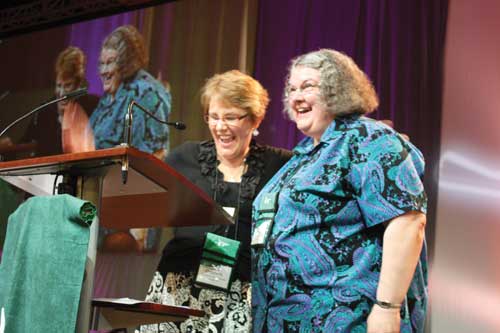
The delegate session ended on July 5 with the installation of Elizabeth Soto Albrecht, Lancaster, Pa., as the new moderator and Patricia Shelly, Newton, Kan., as the new moderator-elect.
Pink Mennos: Over a period of about 30 minutes on July 5, some 60 Pink Menno activists and their allies walked silently into the midst of the delegate assembly and stood waiting.
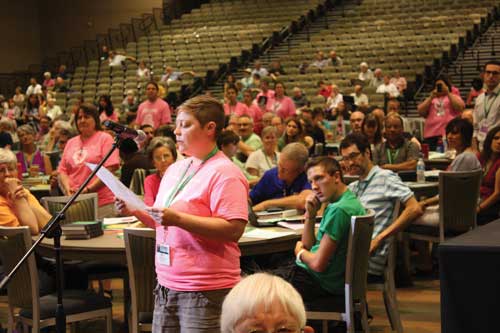
Some displayed photos of LGBTQ friends or family members they supported. Others carried signs. One young man carried an empty chair to replicate the empty chair on stage for Hispanic Mennonites and their supporters who elected to skip the Phoenix convention because of Arizona’s immigration laws and the risk of deportation.
When all the Pink Mennos were in place, moderator Dick Thomas suspended the discussion of resolutions addressing creation care and protections for children and youth. He then invited Pink Menno leader Katie Hochstedler to read a statement from Pink Menno. Hochstedler is a delegate from Faith Mennonite Church in Minneapolis.
“Today we bring before you our faces, our yearnings, our bodies, our dreams, our faith and declare that we refuse to be strangers to one another,” the statement said. “As followers of Jesus, we cannot and will not rest until the Mennonite church abandons its exclusionary impulses and embraces the width and breadth of God’s welcome, so that all may participate fully and God’s kindom (sic) is made whole.”
Thomas asked the assembly to pause in silence and then offered a prayer. The delegate assembly then resumed discussion of the resolutions on creation care and protecting children.


Have a comment on this story? Write to the editors. Include your full name, city and state. Selected comments will be edited for publication in print or online.